
“Bolar! Bolar!! Bolar!!!”
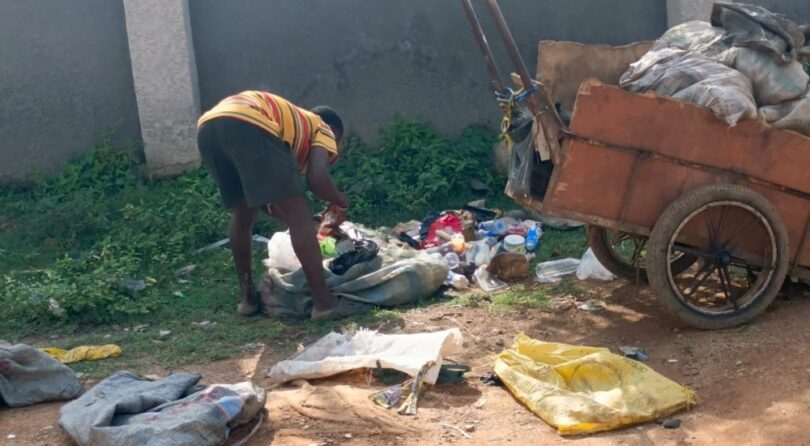
The familiar morning cry echoes across many communities in Nigeria’s Federal Capital Territory (FCT) before sunrise. Accompanied by the rattling of wooden carts, it signals the arrival of informal waste collectors popularly known as ‘Baban Bola’ or ‘Mai Bola’.
For thousands of Abuja residents, they provide an essential service abandoned by government. For security agencies, however, they have become a growing security concern. Increasingly, residents accuse some of them of using waste collection as a cover for theft, violent attacks, surveillance for criminal gangs and the vandalism of public infrastructure.
An investigation by THE WHISTLER found that while many waste pickers are genuine recyclers struggling to survive, weak regulation has enabled criminal elements to infiltrate the sector, creating an expanding network of insecurity across parts of Abuja.
The Abuja Environmental Protection Board (AEPB) is responsible for waste management across the FCT. But in many satellite communities, residents say the agency rarely provides regular refuse collection.
Unable to wait for government services, households increasingly depend on informal collectors who move from street to street collecting waste for a small fee. The arrangement appears convenient but has created an unintended security risk.
Residents told THE WHISTLER that the same individuals who enter compounds to evacuate refuse often gain intimate knowledge of homes, businesses, movement patterns and valuable property. Security officials believe some criminal groups now exploit this unrestricted access.
Authorities have repeatedly attempted to restrict the activities of scavengers.
In 2022, the FCT Police Command ordered divisional police officers to arrest scavengers following intelligence reports linking some operators to stealing, housebreaking, carjacking, arms smuggling and drug trafficking.
Police spokesperson Josephine Adeh said then Commissioner of Police Sunday Babaji directed officers to dismantle criminal networks operating under the guise of scavenging while warning residents against jungle justice.
The Federal Capital Territory Administration (FCTA) followed with another restriction in January 2025, banning scavengers from operating within the Abuja city centre and limiting their activities to designated dumpsites in Gosa, Karshi, Bwari, Gwagwalada, Kwali, Abaji and Kuje.
The administration cited repeated complaints of theft, vandalism of public infrastructure and robbery allegedly linked to some waste collectors.
Officials warned that anyone operating outside approved locations would be arrested and prosecuted. Despite these measures, residents across Kubwa, Byazhin, Iddo Sabon and neighbouring communities say the activities continue largely unchecked.
Security agencies insist their concerns are based on investigations rather than assumptions.
In 2024, the FCT Police Command paraded about 150 suspected scavengers arrested during operations across Abuja.
Police Commissioner Benneth Igweh said officers recovered generators, machetes, locally made weapons and other suspected stolen property from the suspects.
He disclosed that hundreds of additional suspects had already been remanded by courts, promising sustained operations against criminal elements hiding under waste collection activities.
Similarly, the Nigeria Security and Civil Defence Corps (NSCDC) announced the arrest of 36 suspected scavengers in 2025.
The agency recovered daggers, knives, narcotic drugs, codeine syrup, Indian hemp and tools allegedly used to remove public infrastructure including manhole covers, electrical cables and streetlight components.
According to the NSCDC, investigations suggested that some suspects also acted as informants for armed robbers, kidnappers and other organised criminal groups by gathering intelligence on residents during waste collection.
For Mr. Obiora Chinwuko, owner of Cost-Cutter Supermarket in Kubwa, the official warnings reflect his personal experience.
Around 6 a.m. one morning, while opening his shop, three men arrived with a waste collection truck. Initially believing they wanted refuse, he continued arranging his store.
Instead, they demanded money. When he refused, they forced him into the shop and began loading goods onto their vehicle. As he shouted for help, one attacker slashed at his neck with a long knife.
He instinctively raised his hand, suffering deep cuts before another blow struck his forehead. Bleeding heavily, Chinwuko watched the attackers cart away large quantities of goods.
“It was the third time they attacked me,” he recalled.
According to him, many business owners around the area now sleep inside their shops because of repeated attacks.
Ayomide Ayo still bears permanent scars from an encounter that turned violent in May 2024. She operated a small herbal and drinks shop behind Central Primary School in Byazhin when three suspected Baban Bola operators appeared near her business.
Feeling uneasy, she questioned why they were loitering around. Moments later, one allegedly attacked her. When another resident intervened, the suspect reportedly pulled out a knife before fleeing.
The violence escalated when the attackers later returned with reinforcements. Ayomide sustained serious injuries to her hand while shops in the area were looted.
The confrontation later degenerated into wider clashes that claimed three lives and forced schools and businesses to close temporarily.
Nearly two years later, she says her injured hand has never fully recovered.
“I still cannot use it properly,” she said. “Even bathing has become difficult because I need my children to help me.”
Her experience reflects the lasting physical and emotional impact many victims continue to live with long after police operations end.
For a resident identified simply as Handart, what began as a normal workday ended with the loss of almost everything valuable in his room.
Before leaving home in Iddo Sabon, he locked his apartment and left his HP laptop charging. His Samsung laptop remained on a table, while other personal belongings were secured inside.