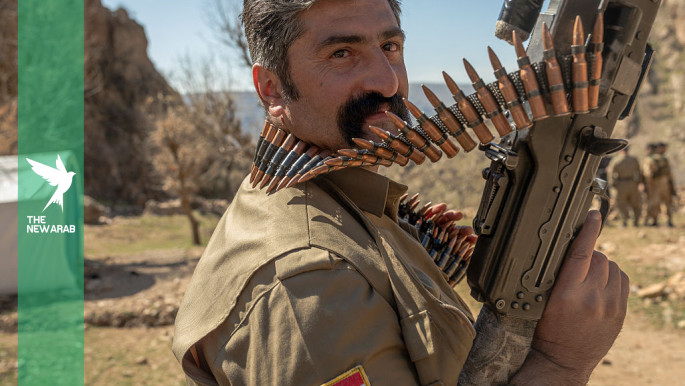
A member of Iranian Kurdish opposition group Komala near Erbil, Iraq, on 12 March 2026. [Getty]
In recent days, a new crisis has been escalating in the cities of Erbil and Sulaymaniyah in Iraq’s Kurdistan region, concerning the disappearance of a shipment of US weapons that President Donald Trump said had been sent to Kurdish groups opposed to the Iranian government.
Kurdish media outlets and political parties have been trading accusations over the arrival and alleged theft of the weapons. The controversy has in recent days expanded to involve Kurdish groups in Iraq, Syria, and Turkey, even as evidence for the arms shipments remains scant.
Soon after the US and Israel launched their war on Iran, US officials began briefing news outlets about a possible role for Iranian Kurdish opposition groups in the destabilisation of Iran and the toppling of the Iranian government.
There were reports of phone calls between Trump and Iran’s most wanted Kurdish opposition figure Mustafa Hijri, and Iraqi Kurdistan’s two most powerful leaders, Kurdistan Democratic Party chief Masoud Barzani and leader of the Patriotic Union of Kurdistan (PUK) Bafel Talabani.
One month later, the US president told Fox News that the US had sent “a lot of rifles” to Iranian Kurdish opposition groups, claiming that the Kurds kept them without offering further details. In the following days, Trump repeated the claim more explicitly, using the word “theft”.
The Daily Beast quoted him on 1 May saying he was “not happy” with the way the weapons had been delivered and that a “small quantity” of weapons had been sent to the Kurds. “We’ll see who has those weapons. I’m not happy with what happened with the Kurds. The Kurds did not deliver the weapons,” he said.
The wording suggested the existence of an intermediary that was supposed to pass the weapons on to Iranian Kurds, with suspicion naturally falling on the Iraqi Kurdistan Regional Government (KRG), which maintains close security and political ties with Washington. The Daily Beast had reported that the weapons were sent to “a Kurdish group based in northern Iraq” and were supposed to be delivered to Iranian Kurds, which allegedly never happened.
Iranian Kurdish groups deny receiving American weapons
Iranian Kurdish opposition groups quickly denied receiving weapons and argued that Trump’s remarks provided Iran with a pretext for further attacks against them. These included the Democratic Party of Iranian Kurdistan (KDPI), the Communist Komala Party of Iranian Kurdistan, the nationalist Kurdish Khabat Organization, and the Kurdistan Free Life Party (PJAK), which is close to the Kurdistan Workers’ Party (PKK). The Kurdistan Regional Government also described the claims as “completely false” and denied any involvement in the alleged plans to destabilise Iran.
Meanwhile, Iran’s Revolutionary Guard have repeatedly accused the Iranian Kurdish groups of receiving American support and has continued launching artillery and drone attacks against them in Iraq. Kurdish Iraqi officials interviewed by Al-Araby Al-Jadeed suggested that pro-Iranian Iraqi militias may also have carried out drone attacks on the groups.
The controversy intensified after Bafel Talabani, the head of the Iraqi Patriotic Union of Kurdistan (PUK) did not deny receiving arms from the US in an interview with British journalist Piers Morgan. “I can confirm that the weapons President Trump said the Kurds seized were not stolen in Sulaymaniyah, and I cannot speak on behalf of the other side because there are two different administrations,” he said, referring to the KDP administration in Erbil.
Talabani added in the interview, which circulated widely inside the Kurdistan Region last week: “Trump’s remarks did not come out of nowhere. What happened is very shameful. Using the Kurds as shields in war is a bad idea, but that does not mean you steal from your allies. We do not want to steal from President Trump, and this will have very bad consequences.”
Over the past five days, The New Arab contacted Kurdish officials and politicians in Erbil and Sulaymaniyah, as well as a senior member of an Iranian Kurdish party living in Sweden. All stated that there was no evidence confirming that any weapons shipment reached Iranian Kurds through Iraq. One official pointed to how quickly information and photos of US weapons shipments to the Kurdish-led Syrian Democratic Forces (SDF) through Harir base had leaked between 2018 and 2022.
“Washington cancelled the idea of arming Iranian Kurds because Iranian Kurdish groups did not engage with the plan, and no weapons or support were ever sent to them, as we understood before and shortly after the attack on Iran began,” a senior Kurdish official in Erbil, speaking anonymously, told The New Arab.
He added: “Iraqi Kurds believed that becoming intermediaries in transferring weapons would not only make them a party in the war against Iran but would also create consequences with Turkey and Baghdad.”
The official stressed that no US weapons had arrived in the first place. “What Trump said is inaccurate, and we asked White House officials to clarify it, but it seems difficult for officials in his administration to publicly deny or call his statements inaccurate,” they said.
Another official commented briefly by phone: “If even a single bullet had arrived, the world would know about it. What Trump said is incorrect. He does not understand the difference between the Kurds of Iran, Iraq, Syria, and Turkey and thinks they are all one group. We asked a US State Department official for clarification, but nothing has happened so far.”
KDP leader Majid Shingali said that “the American president said the Kurds in Iraq support Iranian protesters and spoke about stolen weapons intended for them, but Kurdish party leaders in the region reject being part of any external conflict.” He added that the Kurdistan Regional Government had worked to prevent Iranian opposition groups from participating in the recent war against Iran.
He told The New Arab that “some information on the matter remains unclear, and the KDP has distanced itself from the issue of these American weapons,” warning that “continued internal exchanges of accusations do not serve Kurdish interests.”
In PUK-controlled Sulaymaniyah, officials pointed fingers at the KDP. “Anyone following the situation in Kurdistan knows very well that Erbil controls the issue of military aid and weapons deliveries, and agreements with Washington are usually handled by one Kurdish side – Erbil,” senior party member Ghiyath Surji told The New Arab.
American planes land in Erbil
A member of the PUK political bureau in Sulaymaniyah responded to questions about evidence of the alleged weapons shipment by saying: “American planes land and take off from Erbil airport and Harir base; this certainly does not happen at Sulaymaniyah airport. Therefore, the Erbil government should be questioned, and Trump’s words must have some basis for him to say them.”
He added: “The only confirmed fact we have is that the Iranian Kurdish parties based in the region did not receive anything. So either the shipment really arrived, as Trump said, and was seized, or it never arrived at all. We are not accused, but others need to deny and clarify.”
Soran Berfan, a member of the PUK in Sulaymaniyah, said: “We are searching for evidence that weapons actually arrived, but so far we have found nothing confirming the shipment Trump spoke about.” He asked: “Why is the KDP upset by our statements about the issue while not denying Trump’s claims directly?”
Meanwhile, Milan Saeed, a researcher specialising in Kurdish political affairs, said the claims of stolen weapons are false. “No Kurdish party could realistically play such a role,” he said, noting that Trump’s statements are often inaccurate.
He added that the Kurdistan Regional Government should have addressed Trump directly to ask what evidence he had instead of allowing the matter to become an internal crisis between the region’s two ruling parties.
This view was echoed by Aram Behzad, a member of an Iranian Kurdish opposition organisation living in Sweden. “The story about an American weapons shipment to Iranian Kurds may have been part of the information chaos during the war, intended to confuse Iranians internally,” he told Al-Araby Al-Jadeed.
“Trump may have exaggerated or confused discussions about support with an actual delivery operation, something he does often even in domestic US issues,” he added.
“The arrival of new weapons in a region so heavily exposed to security and intelligence monitoring, and with highly competitive media activity driven by conflicting political agendas, without any details leaking out, would be extremely difficult.”
(Othman al-Mukhtar and The New Arab)