
This investigation reveals a widening gap between climate risk warnings, government response, and the lived reality of vulnerable rural communities.
In Mesar Tudu, a rural farming community in Gezawa Local Government Area of Kano State, every rainfall is a warning.
When the clouds gather, residents do not think of harvests or relief from the heat. They think of collapsing homes, disappearing farmlands, and whether the next downpour will finally take what is left of their community.
For Yusuf Abdulwahab, a 72-year-old resident with two wives and 15 children who has lived all his life in Mesar Tudu, erosion has already taken almost everything he depended on. A farm he had cultivated since he was 18 years old disappeared after years of relentless flooding and erosion.
Mesar Tudu, located about 40 kilometres from Kano metropolis, sits on low-lying terrain that receives runoff from upstream villages, including Bujawa and Kaurawa Yan’Hudu. When rain falls, water gathers, stagnates, and surges through the community’s sandy soil with increasing force.
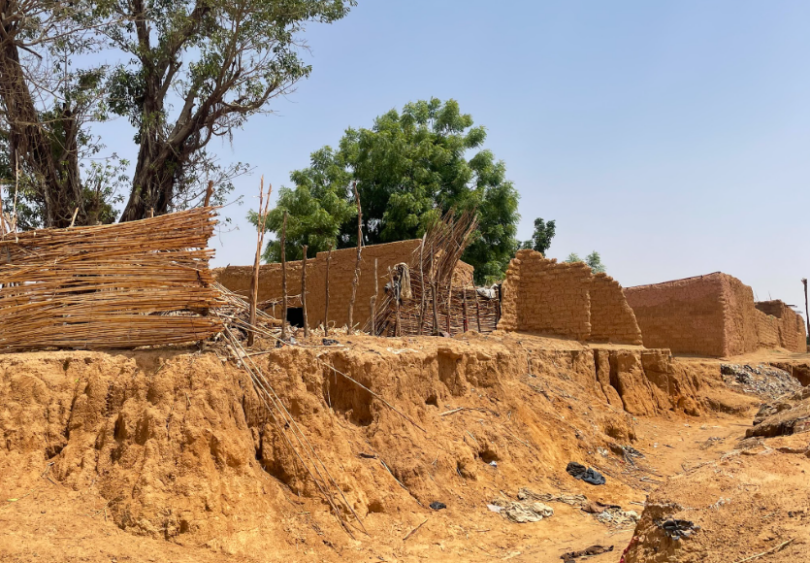
What appears today as a quiet rural settlement is a landscape under slow collapse.
When it rains, residents say the community becomes nearly inaccessible. During a visit on 7 June, this reporter navigated dried flood channels and deeply eroded pathways that residents say become impassable during heavy rainfall.
The farms are gone, replaced by flattened erosion channels filled with sand carried by floodwater.
“I lost my farm completely,” Mr Abdulwahab said quietly, sitting in front of a house that erosion is now threatening.
“It started like a normal heavy rain. I used to do both rainy-season and dry-season farming because my farm was large, about four acres. I planted maize, millet, guinea corn and groundnuts.
“First, it swallowed half of the farm. I managed the remaining portion for more than 10 years, producing only enough food for my family. But the annual flooding continued until erosion eventually consumed the rest, five years ago. This happened to many other people in the community, too.”
He paused and looked toward the broken edges of his home.
“Now it is eating at my house. I am old and have no means to relocate. I have a large family to care for.”
He said he once filled sacks with sand and placed them around his house to slow the advancing erosion.
“The rain washed everything away,” he said.
Now, he rents farmland in a neighbouring community to survive.
“I am old now. I do not know what will happen to my family after I die.”
Across the community, similar stories repeat.
Mansir Bello, a 35-year-old farmer, said his family lost a two-hectare farm.
“We contributed money to build embankments with blocks and cement, but it did not stop the water,” he said.
Others have been forced to leave entirely.
“My house had four rooms. The erosion took them one after the other until everything collapsed,” said Yahaya Sa’adu, a 70-year-old father of nine.
“I had to move with my family to a single rented room in another community.”
Hassan Ahmed, a teacher, said he relocated from the community after his house collapsed.
“It was only three months after my wedding that my house collapsed,” he said.
“I had to move to Gezawa town and rent an apartment. It was a very painful experience for me and my wife. I have not recovered from it.”
Also, Ramatu Muhammad, a 25-year-old mother of two, said she lost both her house and farmland five years ago.
“My husband also lost his farm. We now live in a relative’s house and struggle to feed our children,” she said.
“During every rainy season, we live in fear because the destruction keeps getting worse.”
She recalled how floodwater uprooted a giant tree near the community last year.