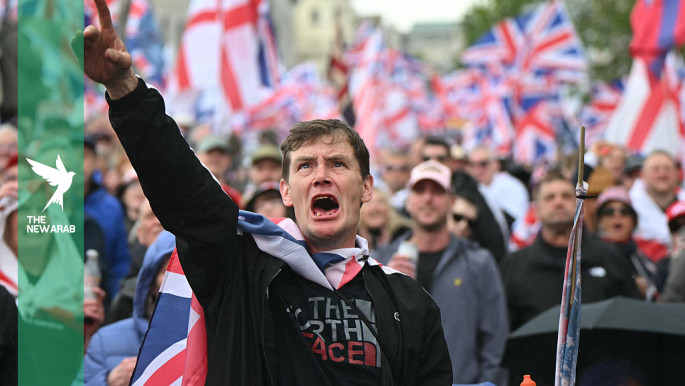
Robinson’s unironically entitled ‘Unite the Kingdom’ march ultimately becomes a pantomime with this contradiction at its heart – a proud display of Britishness constructed entirely on the idea of a vilified Muslim, writes Mariya bint Rehan. [GETTY]
British nationalism has now become so synonymous with Anti-Muslim sentiment that it’s almost impossible to disentangle national pride from Islamophobia. The “Unite the Kingdom” march that was organised by Tommy Robinson this past weekend exemplifies this shift towards a total eclipsing of patriotism with Islamophobic hate.
As mainstream media’s silence appears to signal these are acceptable scenes of public display and use of national symbols, it has left many of us wondering why certain forms of racism are deemed proper and what it means that a political system is happy to sacrifice its entire self-image at the altar of xenophobia and fear.
Anti-Muslim marches have reached such extremes and are so alarmingly common that we now have a definitive blueprint – the Union Jack-plastered crowds, the slurred expletive-filled Islamophobic chants, the incoherent ‘shariah law’-filled ramblings, all a charade of Islamophobic hate. Red, white and blue washed under the guise of patriotism.
It has left many of us wondering why a supposedly pro-British rally ostensibly designed to foment national pride and belonging, centred so definitively on Muslims.
Demonising Muslims to justify policy
The Muslim has, for much of modern history, been assigned the stock figure of ‘other’ in British and American politics and media – a role designated most saliently during the supposedly golden age of Bush and Blair, when foreign policy necessitated a nebulous and flexible enough threat to justify military action.
Over the following decades, Muslims have continued to be labelled a danger, with policymakers often using the fruits of such military action as justification.
With an infrastructure designed to surveil Muslims in almost all facets of public life – bringing the public into an active witch-hunt, this vilification has traditionally been couched in anti-terror sentiment and has depended upon an unconscious bias engineered by this frenzy.
In more recent years, with economic and global uncertainty reaching fever pitch, anti-Muslim hatred has taken on a more overtly articulated, publicly green-lighted shape.
In either case, the threat of the Muslim is considered existential – an assault on the very being and defining values of the “Judeo-Christian” West. The very notion of national unity, safety and identity – weaponised to manufacture consent – has been based on this illicit identity of the Muslim.
A long history of othering
Of course, this is not a new feature of Western society – many philosophers argue that some of the earliest concepts of Western selfhood were crafted from the shock of the European discovery of ‘other’ in the age of exploration, beginning in the sixteenth century. The prototypical concept of self in Western culture has, at its very roots, this tension between the affirmation of self and the negation of the other’s identity.
Certainly, when we look at democratic concepts of citizenship and its underpinning humanitarian framework of human rights, these are equally dependent upon the negative identity of the Muslim.
With the advent of the nation state itself, an imperial project designed to subdue the colonies, and “democracy promotion” again engineered to validate military intervention in Muslim lands, the final elusive thread in the emperor’s clothes unravelled with the revealed impotence of international law against the genocide in Gaza.
The Muslim is framed as the anti-citizen abroad and at home, and Islam as the antithesis of the amorphously defined ‘British values.’
At the crux of the anti-immigrant movement is the idea that Muslims are not qualified British citizens because their existence is at odds with the very soil of the British Isles – this is why there is widespread conflation between ‘immigrant’ and ‘Muslim’. The zero-sum logic behind contemporary British Islamophobia suggests that Britain cannot be Britain with Muslim people living within its borders, and so the very idea of Britain in populist thought is defined against the Muslim.
This is why Robinson’s stage included a surreal warm-up act consisting of a bacon shouldered cello player, and a main stage de-Burkaing fiasco. Given the opportunity to celebrate Britishness, those who appoint themselves as defining figures of the nationalist movement borrowed their sense of pride from symbols they use to define Muslims – their display of jingoism depended entirely on seemingly anti-British insignia.
Failing to see the irony
Robinson’s unironically entitled ‘Unite the Kingdom’ march ultimately becomes a pantomime with this contradiction at its heart – a proud display of Britishness constructed entirely on the idea of a vilified Muslim.
This express hatred against Muslims is itself an interesting phenomenon; when one group becomes totemic of all that society is allowed to articulate it reviles, it begs the question of how we got to this fevered and irrational point, and what this kind of illogical hate masks.
Anti-Muslim feelings are fuelled by political discourse which normalises, and often rewards bigotry against Muslims. As well as Robinson, anti-Muslim media and political figures are afforded credibility that expresses itself in mainstream airtime, book deals, and politically condoned public marches and events. Political and media establishment appear to carefully stalk the parameters of what is acceptable to say or what may even be inferred against some minority groups, while conveniently turning the other way from all perjuring and denigration of Muslims.
In sanctioning this hate at the very top – in allowing Islam to absorb all the political frustrations of our time – it creates a trickle-down effect that shapes the Muslim into the only acceptable totem of hate for public conversation.
In shaping acceptable speech in this manner – by making other forms of racism unutterable, and Islamophobic diatribes entirely acceptable – the establishment have heralded in a populism which proudly asserts itself against Muslims and effectively calls for Islam’s extermination.
When one form of racism successfully climbs from a tacit instinct shaped by policy making and institutions, into the oxygen of public approval, then it adopts the hues of all kinds of repressed prejudice that aren’t allowed to surface. In racist speech, the signifier of ‘Muslim’ can refer to any undesirable individual or group, and what is deemed an affront from other minorities is projected onto the conceptual figure of the Muslim.
Islamophobia becomes a swollen and inflated prejudice that is exemplary of British xenophobia and is at risk of swallowing Britain whole. Anti-Muslim sentiment itself becomes a kind of catharsis for racists – an opportunity to express all that they deem inexpressible, and a canvas on which to paint all the national fictions to validate a hate that consumes them.
Fables of Muslim men crossing the borders to exploit white girls are threatening to be as much part of modern British lore as complaining about the weather or queueing. The political classes appear to be succeeding in usurping national identity with bigotry and hate.
As we all know, these kinds of movement begin, but do not end, with just words – emboldening the language of hate also means emboldening violence. Hate crimes against Muslim communities in Britain and America are reaching an alarming frequency, often entirely overlooked by mainstream media.
The San Diego Mosque shooting is only the most recent in a line of increasingly violent attacks. Until the political and media classes are able to confront the hypocrisy, self-interest and convenience that fuels their condoning of anti-Muslim hate, they will be continuing to fuel a fire whose flames are already threatening to consume the entire kingdom.
Mariya bint Rehan is a writer and illustrator from London, with a background in Policy and Research and Development in the voluntary sector. Her collection of essays, ‘The Muslim (M)Other: Social and political commentary on contemporary Muslim Motherhood’, is out in Spring 2025.
Follow her on Twitter: @ummkhadijah13
Have questions or comments? Email us at: editorial-english@newarab.com
Opinions expressed here are the author’s own, and do not necessarily reflect those of their employer, or of The New Arab and its editorial board or staff.