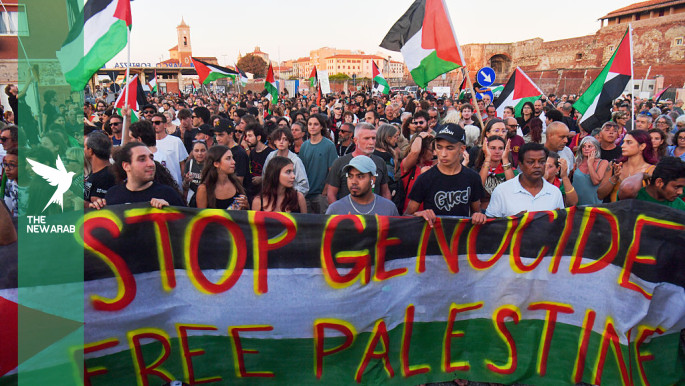
Pro-Palestinian protesters head towards the port on September 5, 2025 in Livorno, Italy. [GETTY]
The Ad Hoc Liaison Committee, co-sponsored by the United States and tasked with coordinating aid to Palestinians, met last week with representatives of the Palestinian Authority and the so-called Board of Peace. Yet behind this carefully staged humanitarian façade lies a deeper political reality, the European Commission would rather obscure ahead of the Foreign Affairs Council: the EU’s own responsibility.
One day later, in Luxembourg, EU foreign ministers returned to a familiar agenda item: the Middle East. This time, however, the discussion carried unusual weight. Across Europe, public attention has sharpened on a question long avoided by much of the political elite: whether the EU–Israel Association Agreement should be suspended.
For decades, that agreement has been treated as untouchable. But calls to suspend it are not new. They go back 24 years.
In April 2022, in response to large-scale Israeli military operations in the West Bank, the European Parliament adopted a resolution urging precisely that. The European Commission, then as now, chose not to act.
Around the same time, the UN Commission on Human Rights also passed a resolution condemning Israel for the mass killing of Palestinians. The main opponents included the United States, Germany, the United Kingdom, and the Czech Republic, countries that remain among Israel’s key military and political supporters.
Avoidance
Today, the EU’s inaction is no longer defensible. As Israel expands its assault across Gaza and the wider region, and advances draconian measures such as the recently approved death penalty law, the EU’s selective application of human rights and international law has become impossible to ignore.
In less than three months, more than 1.1 million Europeans signed the European Citizens’ Initiative “Justice for Palestine”, making it the fastest-growing program of its kind. More than 350 former diplomats and over 60 human rights organisations have echoed the call for suspension. United Nations experts have made clear that such a step is “the bare minimum”.
Within the Council, divisions are increasingly visible, and Palestine is increasingly a central issue. Spain, Ireland, and Slovenia have pushed to place suspension on the agenda. In a joint letter sent last week to EU foreign policy chief Kaja Kallas, the ministers of these countries said that Israel is in breach of the human rights clause, Article 2 of the EU–Israel Association Agreement, stating that “the European Union can no longer remain on the sidelines”.
Belgium and Sweden joined the push. Others, like Luxembourg, remain ambiguous. Meanwhile, Germany and Italy have once again blocked the process. Germany’s Foreign Affairs Minister Johann Wadephul dismissed the proposal as “inappropriate,” while Italy’s Foreign Minister Antonio Tajani claimed it had been “definitively shelved,” arguing that suspension would harm Israeli civilians.
Complicity
The subsequent press conference by Kaja Kallas, Vice-President of the Commission, was revealing. By emphasising the lack of majority support among member states, Kallas exposed deepening divisions – not only between governments, but also between institutions and the public as well.
However, Kallas’ failure to acknowledge the growing political, institutional, and popular calls for suspension sidestepped the growing weight of Palestine in EU politics and its broader implications for the Union’s democratic credibility.
This reluctance to act reflects a deeper fragility within EU leadership, namely an unwillingness to align its external policy with its stated commitments to international law and human rights, even as pressure mounts from within its own ranks.
The shift in language is equally telling. “Illegal settlements”, long recognised by the EU as a war crime under international law, have been softened into the milder term “land grab”. Meanwhile, systematic violence and political repression across Palestine and the wider region are reduced to a vague “humanitarian situation.”
These are not neutral linguistic choices. They are deliberate acts of political framing designed to depoliticise the situation and dilute accountability.
What Europe’s political leadership continues to underestimate, however, is that the public is no longer willing to look away. The evidence of human rights violations and breaches of international law, enabled, justified, and sustained by decades of EU policy, cannot be ignored. Nor can the selective application of international law, dictated by political convenience, remain unquestioned.
Across Europe, this moment is taking shape. Civil society, grassroots movements, and an increasing number of political actors are coalescing around a clear demand: consistency, accountability, and the enforcement of international law without exception.
The EU now faces a choice it can no longer postpone. It can continue to hide its inaction behind procedural divisions and diluted language, or it can act in line with the principles it claims to uphold. What it cannot do is both.
Tamam Abusalama is a Palestinian-Belgian communications professional, born and raised in the Jabalia Refugee Camp. She is currently leading the strategy for the European Citizens’ Initiative Justice for Palestine, which calls for the full suspension of the EU-Israel Association Agreement.
Follow her on Twitter/X: @TamamBeitJirja
Have questions or comments? Email us at: editorial-english@newarab.com
Opinions expressed in this article remain those of the author and do not necessarily represent those of The New Arab, its editorial board or staff.