

BELLO AKINKUNMI YAKUB
Nigeria’s journey towards becoming a one-trillion-dollar economy is not being driven solely by fiscal reforms, infrastructure investments, or industrial policies. Quietly but strategically, the administration of President Bola Ahmed Tinubu through its Renewed Hope Agenda is laying one of the most critical foundations for national transformation, which is a modern, secure and integrated digital identity management system.
To many observers, the direction became evident when government transferred the National Identity Management Commission (NIMC) from the Ministry of Communications and Digital Economy to the Ministry of Interior and when President Bola Tinubu appointed Engr. (Dr.) Abisoye Coker-Odusote as Director-General of NIMC. Having previously delivered remarkable success in identity management initiatives in Lagos State, Coker-Odusote’s appointment signaled that identity management would become a strategic instrument for governance, security, economic planning and digital transformation.
That vision has now taken a historic leap with President Tinubu’s signing of the National Identity Management Commission (NIMC) Act 2026 into law. The legislation replaces the outdated 2007 Act with a comprehensive legal framework designed for a digital economy, positioning identity management as one of the pillars of the Renewed Hope Agenda.
For nearly two decades, Nigeria’s identity management system operated under legislation enacted long before mobile banking, digital commerce, artificial intelligence, electronic signatures and today’s interconnected digital economy became realities. The NIMC Act 2026 transforms the Commission from an agency primarily known for issuing National Identification Numbers (NIN) into the country’s trusted digital identity authority. One of the Act’s most significant innovations is the designation of NIMC as Nigeria’s Root Certification Authority for the National Public Key Infrastructure (PKI) and Digital Public Infrastructure (DPI).
This means that NIMC now serves as the highest level of trust for authenticating digital identities, electronic signatures, government transactions and secure online communications. In practical terms, government agencies, financial institutions, healthcare providers, educational institutions, telecommunications companies and businesses can now verify identities securely through one trusted national platform.This marks Nigeria’s transition from traditional identity cards to a sophisticated digital identity ecosystem.
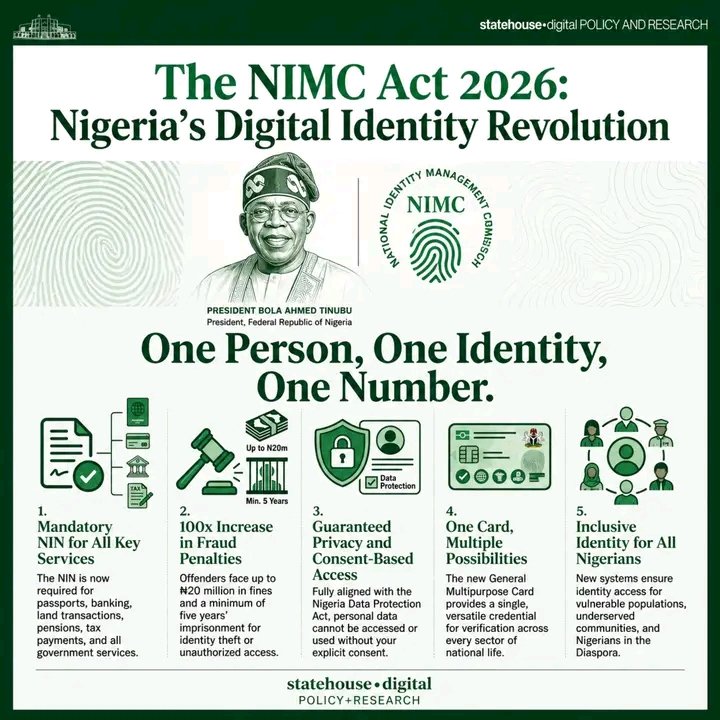
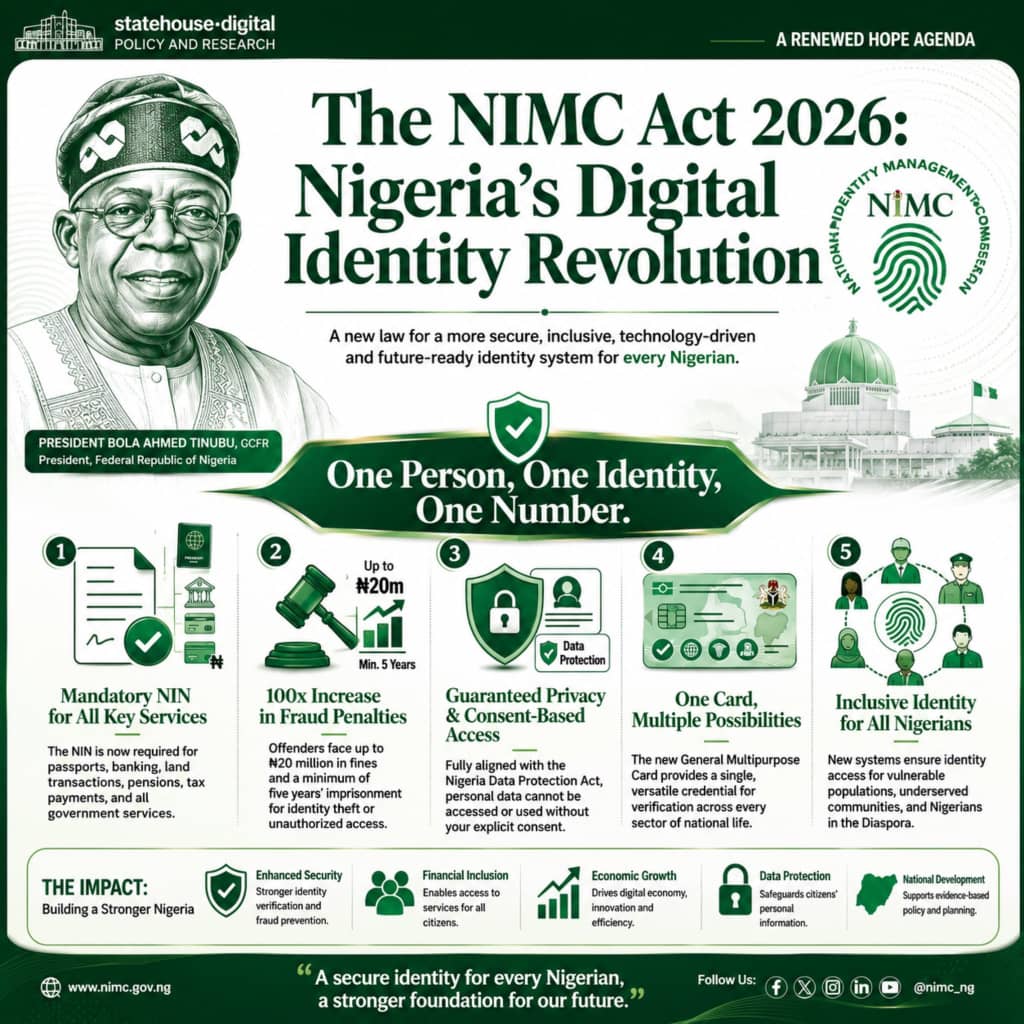
At the heart of the reform lies the principle of “One Person, One Identity, One Number.” The National Identification Number (NIN) is now established as Nigeria’s foundational identity credential, serving as the single trusted identity across government and private sector services. Rather than maintaining multiple identification systems for banking, telecommunications, pensions, passports, taxation, insurance, land administration, social intervention programmes and credit facilitation through the government’s CreditCorp created by the Bola Tinubu administration. The NIN becomes the unified gateway. For ordinary Nigerians, this means fewer documents, faster verification, easier access to services and significantly reduced bureaucracy. For government, it means accurate records, improved planning and more efficient public service delivery.
Perhaps the greatest impact of the reforms lies in national security. Modern security challenges including terrorism, banditry, kidnapping, cybercrime, identity theft, financial fraud and illegal migration which are often enabled by weak identity systems. The Bola Tinubu administration is addressing this challenge by ensuring that every individual interacting with government services can be uniquely identified. The integration of the NIN with the proposed biometric population census and the NIPOST Alphanumeric Digital Postcode System creates a powerful national database that links verified identities with accurate geographical locations.
This makes it increasingly difficult for criminals to assume false identities, create duplicate records, manipulate demographic data or exploit weaknesses in government databases. With biometric authentication, geospatial validation and digital verification working together, Nigeria moves closer to eliminating ghost identities, fake communities, duplicate registrations and fraudulent beneficiaries in government programmes. The implications for border security, immigration control, intelligence gathering, policing, election management and emergency response are profound.
President Tinubu has consistently stated that Nigeria’s ambition is to become a one-trillion-dollar economy. Such an economy cannot function efficiently without trusted digital identity infrastructure. Digital identity is now recognised globally as critical infrastructure, just like roads, electricity, ports and telecommunications. Countries with advanced digital identity systems experience higher financial inclusion, increased tax compliance, improved digital commerce, better healthcare delivery and stronger investor confidence. The NIMC Act positions Nigeria to enjoy similar benefits especially credit facilities through it’s CreditCorp.
By enabling secure authentication for credit facility, banking, electronic commerce, fintech innovation, digital payments, insurance, taxation and government services, the law creates an environment where businesses can operate more efficiently while reducing fraud and transaction costs. This also complements the administration’s ongoing tax reforms, which require accurate identification of taxpayers, businesses and economic activities. Together, these reforms provide the digital backbone for transparent governance and sustainable economic growth.
Another significant innovation is strengthening of data privacy and cybersecurity. The Act aligns identity management with the Nigeria Data Protection Act and international best practices as it introduces stricter safeguards governing how personal information is collected, stored, shared and processed. Unauthorized access to identity records, identity theft, data manipulation, and fraudulent registrations now attract far stiffer penalties, including fines of up to ₦20 million and prison terms of at least five years for serious offences. These provisions strengthen public confidence in digital transactions while protecting citizens from identity-related crimes.
Beyond technology and security, the legislation promotes inclusion.The new framework is designed to ensure that every Nigerian, regardless of social status, location, disability or residence abroad can obtain a trusted digital identity. This includes vulnerable populations, underserved rural communities, internally displaced persons and Nigerians living in the diaspora. Identity becomes not merely a document but a gateway to citizenship, opportunity, financial services, healthcare, education, pensions, voting, and social protection programmes. By ensuring that every Nigerian can be identified and verified, government can better target interventions and eliminate leakages in public expenditure.
The implementation of this ambitious transformation rests significantly on the leadership of Engr. (Dr.) Abisoye Coker-Odusote. Since assuming office as Director-General of NIMC, she has consistently championed reforms aimed at strengthening digital identity, improving service delivery, enhancing interoperability among government agencies and expanding access to identity services nationwide. She has described the NIMC Act 2026 as a landmark reform that positions Nigeria for digital innovation, economic competitiveness, improved governance and enhanced national security. Her experience in deploying identity solutions in Lagos State appears to be shaping a broader national transformation aligned with President Tinubu’s Renewed Hope vision.
While infrastructure projects and economic reforms often dominate public attention, identity management may ultimately become one of the most transformative achievements of the Bola Tinubu administration. An effective identity ecosystem improves governance, strengthens security, enhances financial inclusion, supports taxation, facilitates investment, reduces corruption and promotes digital innovation. The signing of the NIMC Act 2026 therefore represents far more than a legislative amendment, it is the foundation upon which Nigeria’s future digital economy can be built.
As President Bola Ahmed Tinubu remarked during the signing ceremony, “the old era has ended”. Nigeria now possesses a modern legal framework capable of supporting a secure, digitally connected nation and advancing the country’s aspiration of becoming a one-trillion-dollar economy.
Indeed, the reform of Nigeria’s identity management architecture may well prove to be one of the defining institutional legacies of the Tinubu administration, one that strengthens national security, modernises governance and unlocks unprecedented economic opportunities for generations to come.