What began as an improvised response to scarcity has evolved into a fragile and unregulated micro-market. [Getty]
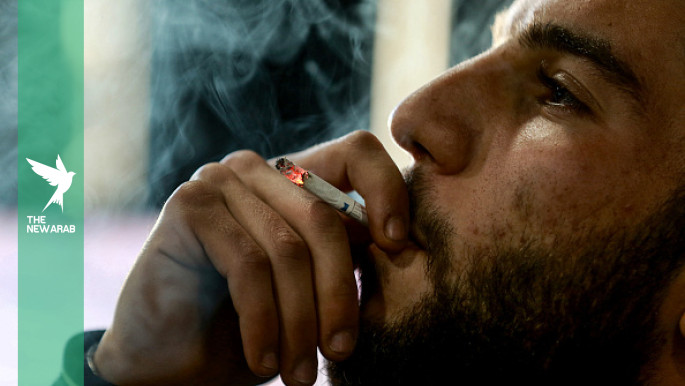
In the war-torn Gaza Strip, jute mallow—known locally as “Molokhia” and once associated with slow-cooked family meals—is now being dried, crushed, mixed with improvised liquids, and rolled into cigarettes as an alternative to tobacco, which some residents smoke on the streets and in tents.
What began as an improvised response to scarcity has evolved into a fragile and unregulated micro-market.
In the absence of affordable tobacco and amid restrictions on imports, including cigarettes, Palestinians who smoke have turned to plant-based substitutes as a way to cope with addiction under extreme economic pressure.
The result is a parallel economy of so-called “alternative cigarettes” that reflects both the depth of deprivation and the erosion of normal consumer life.
Local estimates suggest that before Israel’s current genocidal war, Gaza was home to nearly 250,000 smokers. However, vendors and residents say smoking habits have not disappeared; rather, they have mutated.
After what is basically a one-sided ceasefire was declared in October 2025, Israeli restrictions on goods entering the Strip remain largely in place, according to local accounts, sustaining a chronic shortage that continues to shape everyday survival.
Tobacco, when available, has become prohibitively expensive, with prices reportedly rising to nearly 40 times pre-war levels.
Improvisation
In a narrow alley in Gaza City, Abu Yahya Sarsour sits behind a small, improvised stall surrounded by displacement tents and the ruins of damaged buildings.
On a plastic sheet in front of him are transparent bags filled with dried molokhia, alongside small bottles containing nicotine liquid of uncertain origin.
With practised movements, he mixes the ingredients inside a plastic bag, shakes it, and begins rolling crude cigarettes for waiting customers.
“These are not cigarettes in the usual sense […] We use molokhia mixed with nicotine liquid. People have no choice. Before the war, a cigarette cost one shekel. Today it can cost forty times more; if you even find it,” he told The New Arab.
Molokhia is not the only substitute circulating in this informal market, according to Sarsour.
“When it is unavailable, other plant leaves, including fig and castor leaves, are sometimes used instead. The substitutions are driven less by preference than by necessity and availability,” he said. “I know that it is harmful for the health, but we do not have any alternatives […] We are stuck here under the Israeli war. Every day, Israel is killing Palestinians, so I do not think the cigarettes will kill us.”
“Molokhia or fig leaves are not designed to be burned and inhaled. The combustion produces compounds that have not been medically studied for respiratory exposure,” stressed Saeda Ayyash, a doctor in Gaza, to TNA.
“No one knows the concentration of nicotine or the composition of other substances. This creates unpredictable and potentially severe health consequences,” she added.
Smoking under siege
In a displacement tent in Khan Younis, 53-year-old Akaber al-Aasi says she used to start her day with a hot cup of coffee and a cigarette.
“During the war, we lost everything. All our daily routines and even our passion in life, so the only thing that we can, at least, get rid of part of our daily pressure is smoking, even if it is just molokhia,” the mother of five told TNA. “I used to smoke a pack a day for twenty years. Now I smoke whatever I can find. It tastes bad, it smells worse, but sometimes I need a moment of ‘calm’.”
52-year-old Abu Mohammed al-Arabeed, another Palestinian man from al-Nuseirat refugee camp, describes a similar reality with quiet resignation, saying, “I don’t enjoy it anymore […] I hold it and exhale. It’s a habit. This is not the time to quit. The pressure we live under cannot be described.”
“We tried not to adopt such criteria, but we do not have any other alternatives,” he said.
But the situation is completely different for Radi Kamal, a Gaza-based father of six, who managed to stop smoking entirely.
“Prices became impossible. I couldn’t afford a single pack. In the end, I quit not by choice, but by necessity,” he told TNA. “My children need the money I would spend on molokhia and cigarettes more. I can buy them food instead. It’s not cheap, and it causes health problems. I can’t afford it right now, given the current situation.”
Medical warnings and lived reality: when risk becomes relative
Health professionals in Gaza are increasingly concerned about the spread of these practices. Samir al-Najjar, a Khan Younis-based pulmonologist, warned that burning plant material for inhalation carries risks that remain largely unstudied.
“Jute mallow and other plant leaves are not meant for combustion and inhalation,” he told TNA. “We are dealing with substances whose chemical behaviour under burning conditions has not been properly examined. When unknown liquids are added, especially those containing nicotine or other compounds, the risks multiply.”
He pointed to possible consequences, including chronic respiratory inflammation, worsening asthma, allergic reactions, and long-term damage that remains uncertain due to the lack of clinical research under such conditions.
Yet these warnings often meet a different interpretation among residents shaped by years of war and exposure to multiple layers of environmental danger.
“They say it is harmful. But is it more dangerous than the smoke of rockets and bombs? We have lived through gases and explosions whose composition we don’t even know. At least this is something we understand,” Abu Yahya remarked.