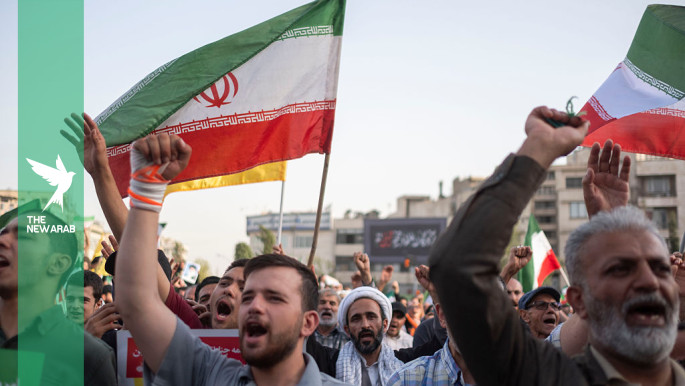
Massive nighttime rallies by supporters of the Islamic Revolution have continued in Tehran and other cities, turning evenings into an open socio-political space where participants express their positions on war, negotiations, and domestic issues. [Getty]
Since the start of US-Israeli military action against Iran on 28 February, and over nearly two months later, the Iranian public sphere has witnessed what participants describe as “revolutionary nights”.
Massive nighttime rallies by supporters of the Islamic Revolution have continued in Tehran and other cities, turning evenings into an open socio-political space where participants express their positions on war, ceasefire, negotiations, and domestic developments.
This public mobilisation, particularly during the war’s most intense moments, has been described as a key factor in reinforcing the internal front and deterring unrest that the parties to the conflict had anticipated.
Over time, the rallies have evolved into broader political, social and cultural gatherings. Iranian leaders, including Supreme Leader Mojtaba Khamenei, have called for their continuation until the “final victory” is achieved.
Where the field and diplomacy were once considered the two pillars of Iranian foreign policy, the recent war has introduced a third: the street. A new equation has emerged, combining the field, diplomacy and street mobilisation as central elements in managing confrontation with “enemies”.
However, the announcement of a ceasefire on 8 April and the launch of negotiations between Iran and the United States in Pakistan have exposed divisions within the pro-government street base. A significant segment of participants in these “revolutionary nights” reject negotiations outright, arguing that power lies in the field rather than diplomacy.
According to reporting by The New Arab from Tehran, the overall atmosphere at the rallies recently has been tense and strongly opposed to negotiations. Speakers were reportedly reluctant to express support for talks amid fear of counter-chants. Slogans were raised criticising negotiations and targeting senior officials, including the parliamentary speaker and head of the negotiating team, Mohammad Bagher Ghalibaf, a leading conservative figure.
Amir Hossein, a man in his twenties attending gatherings in Enghelab Square since the beginning of the war, told The New Arab, “There should be no negotiations. How do we negotiate with those who killed our imam (late leader Ali Khamenei) and our people?”
“Whoever goes to negotiate with the Great Satan betrays the blood of the imam and the martyrs. The field will decide the battle,” another young man said.
At another point in the square, university student Zahra told The New Arab she attends daily to show support for the armed forces, adding, “Negotiation now means retreat after victories. People here want continued pressure until the end.”
Ahmad Reza, in his fifties, speaking from Sadeghiyeh Square in western Tehran, said, “We know America well. All its negotiations are a deception. The street is the guarantee of the revolution, and we will not allow what has been achieved to be lost.”
Negotiations and internal tensions
Conservative activist Hatif Salehi told The New Arab that the ceasefire on the military front with the US and Israel coincided with the end of calm in Iran’s political space.
He attributed this to two main factors: Ghalibaf’s entry into the negotiations as head of the delegation sent to Pakistan, and a decline in political patience within certain domestic factions.
Salehi said the opposition to negotiations includes hardline figures who have long rejected diplomacy in favour of resolving disputes via the battlefield. He linked this tendency to former Supreme National Security Council secretary Saeed Jalili, saying his approach to negotiations focused on statements and moral discourse rather than resolution.
He added that this current belief is that delaying negotiations increases Iran’s leverage, while noting that wars, including the Iran-Iraq war, were ultimately concluded through diplomacy.
Salehi also said that criticism of Ghalibaf is partly driven by electoral calculations ahead of municipal elections and, later, presidential elections. He argued that some groups are seeking to prevent any political or diplomatic success being attributed to Ghalibaf, fearing it could strengthen his future political prospects.
He said parts of the current protest and media pressure appear organised, with some platforms during night rallies linked to these networks, promoting anti-negotiation messaging and demanding direct announcements from leadership.
Salehi added that this current does not accept even Supreme National Security Council statements and continues to interpret official positions independently.
He stressed that foreign policy decisions are taken at the highest levels under the Supreme Leader and that the current negotiating track was approved after a comprehensive review of national interests.
However, Salehi argued that portraying Ghalibaf as having initiated negotiations independently was “dangerous” and had placed pressure on him, reducing his willingness to continue the process, though it did not lead to his resignation. Reports of his resignation were recently denied by parliament.
Salehi said negotiations are based on give-and-take and must serve the national interest, adding that Ghalibaf has become a “permanent target” regardless of the outcome.
He warned of a shift by “enemies” from military confrontation to what he described as “cognitive warfare” aimed at division within the state and society.
He outlined three objectives: short-term fragmentation of officials, medium-term weakening of social cohesion, and long-term destabilisation of the state, stressing the need for internal unity.
Conservative press criticism
In a notable development, conservative media outlets also criticised participants in the night rallies.
The Kayhan newspaper said in its last Sunday edition that some individuals appear at gatherings posing as “revolutionaries” and attempt to inflame political tensions, particularly over negotiations, through radical slogans.
It called on citizens to counter such efforts through chants promoting unity and to undermine what it described as “suspicious plans”.
Separately, a Javan newspaper published a critical article addressing what it described as widespread “non-specialist reactions” to military, diplomatic, security and religious issues.
It said many individuals comment on military operations, diplomatic negotiations, official visits, and even the Supreme Leader’s religious rulings on issues such as nuclear policy and the Hajj pilgrimage without sufficient knowledge.
The paper added that some go so far as to accuse the system or call for the suspension of Hajj rituals without understanding religious or security considerations. Conservative factions have previously criticised sending Iranian pilgrims to this year’s Hajj season amid regional conflict.
Roots of an influential current
Iranian expert Ahmad Zeidabadi told The New Arab that the authorities previously developed a counter-movement to reformist currents with intellectual backing from the late cleric Mohammad Taqi Mesbah Yazdi and his students.
He said the ideology of this movement rejects any process leading to the “normalisation” of domestic conditions.
Zeidabadi added that, over time, this current became a key support base for the regime, particularly on the streets, and that its continued presence has been linked to political stability.
He said it no longer only supports official policy but also influences political direction through “coordinated networks”.
He said this “special group” is linked to conservative forces associated with the Islamic Revolution Endurance Front, which he described as a hardline group with influence across state institutions.
The Islamic Revolution Endurance Front, known as the “Endurance Front” (Jebhe Paydari), is an Iranian political group with a conservative orientation and has been described as “the most right-wing of Iranian parties”.
The Front was founded in 2011 by former ministers from the government of the conservative Iranian president Mahmoud Ahmadinejad.
The late cleric Mohammad Taqi Mesbah Yazdi was considered the spiritual leader of the group.
Zeidabadi said some official media outlets are now distancing themselves from this current, either under instruction or due to a perceived need for flexibility to ensure survival.
However, he added that it continues to use its street presence to pressure pragmatic actors within the Iranian regime.
He concluded that this current represents a “major challenge” for the state, which must either broaden its social base towards more moderate groups or find itself constrained in its steps and initiatives across various fields, which could leave heavy consequences amid current economic conditions and ongoing external threats.
Article translated from Arabic by Afrah Almatwari. To read the original, click here.