Powergas and digital infrastructure projects show how Washington and Abuja are aligning national interests through commercial statecraft
The US wants exports, jobs, strategic influence, and trusted infrastructure markets. Nigeria wants energy reliability, digital resilience, jobs, and projects that strengthen growth and stability. That overlap is where the real national interest and assistance story lies.
That is why the latest moves by the US Trade and Development Agency, or USTDA, matter. The agency is not just funding projects. It is using early-stage assistance to shape which infrastructure gets built, who gets to build it, and what standards govern it. In Nigeria, that approach is now visible in energy, digital infrastructure, and health.
On 9 July, at a Washington RoundTable event, Thomas Hardy, USTDA’s chief operating officer and deputy director, described the USTDA agency as “foreign assistance with a purpose.” He said USTDA supports development in partner countries, but does so in ways that advance US national security and trade interests. That is a useful way to understand what Washington is trying to do now: to use foreign assistance not only to help but also to position American firms and American technology in markets that matter.
Nigeria is a good place to see that logic in action. The country needs infrastructure that works — energy systems that support industry, resilient digital systems, and infrastructure facilities that expand access and capacity. USTDA-backed projects do not solve all those problems, but they can help close gaps where financing is difficult, and the need is urgent.
One of the clearest examples is Powergas. USTDA has supported a small LNG terminal project designed to strengthen the virtual pipeline to northern Nigeria. According to the agency, the project is meant to help address an energy security gap while creating space for US companies to provide trusted technology. Mr Hardy put it simply, stating that more consistent energy in northern Nigeria can also mean greater security across the country.
That matters because energy in Nigeria is not just an economic issue. It is also a security issue. When gas supply is more reliable, industry can plan better, transport becomes easier to manage, and pressure on communities can ease. For the United States, that is important because a more stable Nigeria is a more strategic partner in a region where insecurity can spread quickly.
The same logic applies to digital infrastructure. USTDA has also supported the Medusa submarine cable study, which could extend trusted digital infrastructure along Africa’s Atlantic coastline. The project is designed to improve connectivity, strengthen network resilience and reduce exposure to cyber threats and interference from malign actors. For Nigeria, that means more reliable access to a critical digital backbone. For the United States, it means an opportunity to help shape future infrastructure through trusted technologies and standards.
USTDA’s health projects also add weight to the relationship. Mr Hardy recalled the Lagos Teaching Hospital project, which helped make a new oncology treatment centre possible. That example is important because it shows the agency’s work is not abstract. It has visible public value. A cancer treatment centre in Lagos is not just a diplomatic talking point. It is a concrete investment in Nigeria’s health system and a reminder that infrastructure is not only about roads and power lines.
This is why USTDA is best understood as a commercial-statecraft tool rather than a conventional aid agency. Mr Hardy explained how it uses relatively small amounts of public funding to prepare projects and crowd in larger financing from institutions such as the US Development Finance Corporation, the Export-Import Bank, and private lenders. That makes it a quiet but powerful part of U.S. foreign policy.
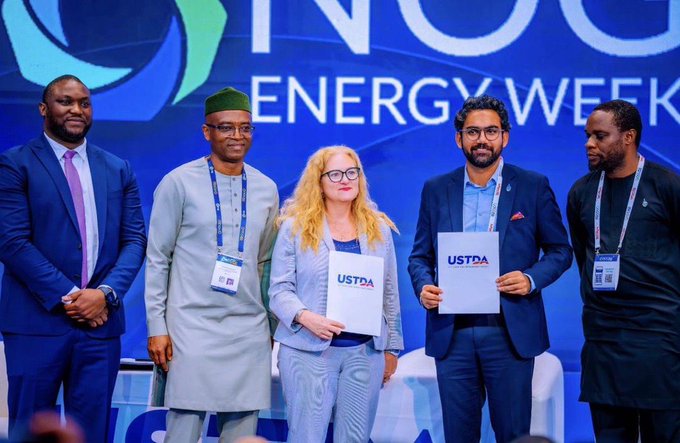
It also explains why the US Embassy’s recent messaging around Powergas and USTDA was notable. On Tuesday, the embassy in Nigeria said Assistant Secretary Frank Garcia had a productive meeting with Nigeria’s Minister of State for Foreign Affairs, Sola Enikanolaiye, and described Nigeria as a strategic partner across numerous sectors. Embassy officials also attended what they described as a “landmark” grant financing agreement between Powergas Nigeria and USTDA. In other words, the relationship is not only diplomatic. It is becoming practical and project-driven.
For Nigeria, the benefits are clear. Better energy supply supports industry and stability. Better digital infrastructure supports connectivity and resilience. Better health facilities support human capital and public confidence. For the United States, the benefits are also clear. Export opportunities for American firms, stronger market access for trusted technologies, and a more stable partner in a strategically important region.
The bigger point is that US foreign assistance is now being used explicitly. It is not just about generosity. It is about alignment. The US wants projects that help Nigeria grow, but it also wants those projects to advance American trade and security interests. Nigeria, meanwhile, wants projects that solve real problems and expand its options.
That is why the USTDA model deserves attention. It shows how foreign assistance can serve two national interests at once. And in this case, it suggests that America First and Nigeria’s national interest need not pull in opposite directions. When the project is right, they can meet in the same place — at the point where growth, security and infrastructure converge. That is why this US foreign assistance model matters — it is not aid for aid’s sake, but rather cooperation in energy, digital infrastructure, and other areas that can deliver real value on both sides.
Pearl Matibe is a Washington, D.C.-based geopolitical analyst and correspondent with expertise in foreign policy and international security, regularly covering the Pentagon and White House. Follow her on Twitter: @PearlMatibe.