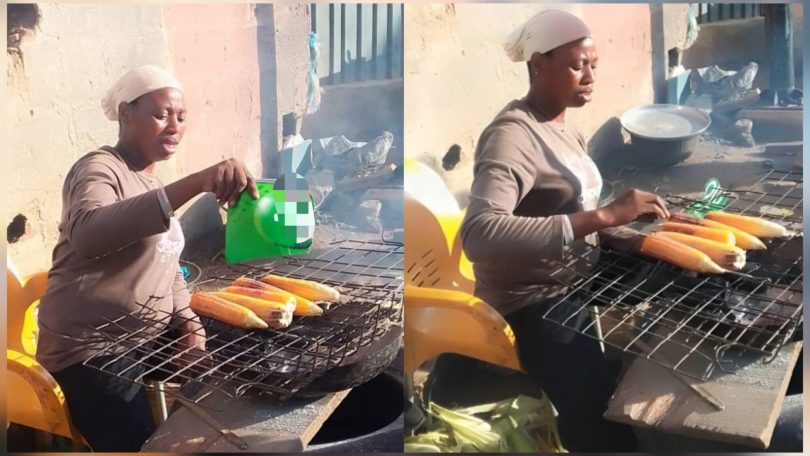
A roadside roasted corn seller in Ibadan, Mrs. Lateef Rukayat, has shared how switching from hairdressing to the roasted corn business transformed her family’s finances, revealing that the venture now generates about ₦750,000 monthly and has enabled her to sponsor two of her six children in higher institutions.
Speaking during an interview with Tribune On The Street, Rukayat explained that she abandoned her hairdressing profession after the business slowed down.
She said the decision to start selling roasted corn in 2021 has helped her provide for her family despite the country’s economic challenges.
From hairdressing to roasted corn
Rukayat described hairdressing as her first profession and a lifelong dream, but said she had to explore another means of livelihood when it no longer generated enough income.
“Hairdresser is my hard-earned work; it’s my early dream work, and I did freedom after completion,” she said. “I started roasting corn when my hairdressing business was not moving. All my children are in school, with two of them in higher institutions.”
She disclosed that she started the roasted corn business in January 2021 with money borrowed through a local lending scheme known as “Network.” According to her, the loan, despite attracting interest, gave her the capital needed to purchase her first bag of corn.
Rising costs make business more challenging
The businesswoman dismissed the belief that roasted corn trading requires little capital, saying inflation has significantly increased operating costs.
She explained that beyond buying corn, traders must also pay for transportation, charcoal and packaging materials, making it more expensive to enter the business than many people assume.
Rukayat also noted that corn prices have remained unstable since she began the venture, making it difficult for traders to plan their expenses.
Daily sales support children’s education
Sharing her earnings, she said a ₦20,000 investment in corn often produces daily sales of between ₦25,000 and ₦27,000, with the profits helping to fund her children’s education.
“With God’s mercy, on a daily basis, if I borrowed money and got like ₦20,000 to buy corn, I used to earn about ₦25,000 to ₦27,000 daily. From the earnings, I contribute and that’s what I collect in supporting my children’s schooling,” she said.
However, she admitted that the business comes with risks because roasted corn must be sold fresh. Unsold corn quickly loses its taste, making it difficult to attract buyers the following day.
She recalled a period when soaring costs forced her to increase the price of roasted corn from ₦200 to ₦400, but the decision backfired as customers stayed away, leaving her with little or no profit.
Appeal for support
Rukayat said she has never benefited from any government grant or financial assistance.
She appealed to the government to introduce measures that would reduce the cost of goods and provide financial support for small-scale traders.
According to her, such interventions would help entrepreneurs sustain their businesses while meeting the needs of their families.