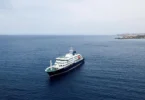

There have been eight cases of hantavirus reported (Image: AFP via Getty Images)
A doctor on the hantavirus-stricken cruise ship has highlighted one major concern surrounding the rapidly developing disease.
American physician Dr Stephen Kornfeld boarded the MV Hondius in Argentina expecting a peaceful holiday, only to find himself at the centre of a hantavirus outbreak on board.
Eight cases have been reported thus far, including three fatalities. Five of those cases have been confirmed as hantavirus, a collection of viruses primarily carried by rodents and transmitted through contact with their urine, faeces and saliva. Human-to-human transmission remains extremely rare.
The MV Hondius departed from Argentina a month ago, with Dr Kornfeld among those who boarded there. He spoke to CNN about the profound “fear” associated with the illness.
He revealed he “sort of fell into the role of becoming the ship’s doctor” after the vessel’s own medic was struck down by the virus, reports the Daily Mirror.

The MV Hondius set sail from Argentina on April 1 (Image: AFP via Getty Images)
Dr Kornfeld said: “There are three patients who seemed to be getting ill around the same time. One of them, very non-specific symptoms, a lot of confusion, and a lot of weakness. And she ultimately passed away relatively quickly.
“The two other gentlemen, quite a bit younger including the doc, just had a lot of viral symptoms, a lot of fever, fatigue, flushing, some GI (gastrointestinal) issues, some shortness of breathe.
“At the time neither one of them looked critically ill but the fear with hantavirus is you can go from seriously ill to critically ill very quickly.
“The ability to treat someone here on the ship in that critical state is non-existent. Now they’ve been evacuated they’re getting magnificent care.
“What happens with hantavirus, ultimate survivability is really dependent on your ability to get critical care at the right time. On the boat, that would not be possible.”

Three people suspected of having the disease have died so far (Image: AFP via Getty Images)
The luxury cruise, operated by Oceanwide Expeditions, departed on April 1 from Ushuaia, located on Argentina’s southern tip. The vessel is scheduled to reach Spain’s Canary Islands on Sunday (May 10).
Approximately 150 passengers and crew from 28 nations were reported to have originally embarked on the voyage, though dozens disembarked on April 24 at St Helena, a British Overseas Territory situated in the South Atlantic Ocean.
All British passengers and crew aboard the vessel are being instructed to self-isolate for 45 days upon returning to the UK, under close supervision from health authorities. Three Britons are confirmed or suspected to have contracted hantavirus. One is receiving treatment in the Netherlands, another man is being cared for in South Africa, while a third remains on the Atlantic island of Tristan da Cunha.
Governments in Singapore, Argentina, South Africa, the Netherlands and the UK have all confirmed in recent days they are tracing individuals connected to the vessel.

The incubation period for the disease can be up to six weeks (Image: ANP/AFP via Getty Images)
The outbreak aboard the Hondius has triggered international concern as health agencies scramble to track the potentially fatal human-to-human strain. World Health Organization (WHO) Director General Tedros Ghebreyesus revealed that the initial two patients with confirmed hantavirus cases had been travelling across Argentina, Chile and Uruguay on a bird-watching expedition. Their itinerary included locations inhabited by the rat species known to transmit the virus.
Given the virus can have an incubation period of up to six weeks, additional cases may emerge in the coming weeks.
Dr Kornfeld discussed whether he fears contracting hantavirus himself, considering his direct contact with patients and the potentially lengthy incubation period.
He told CNN: “Early on, we didn’t know it was hantavirus until maybe May 2, 3. We started treating people thinking, ‘this could be infectious.’ So in the beginning we were being careful with masks and gowns, and once we found out it was hantavirus and a second case happened, making it seem likely, I was able to find some aprons and some goggles. I did a lot of hand washing and clothes washing. I think hantavirus is hard to spread even though on this ship it seemed to spread.
“I may be in a different boat to the other passengers as I’ve had a lot of contact with the sufferers. We’ve been on this boat for five weeks and the original patient episode was many weeks ago.”