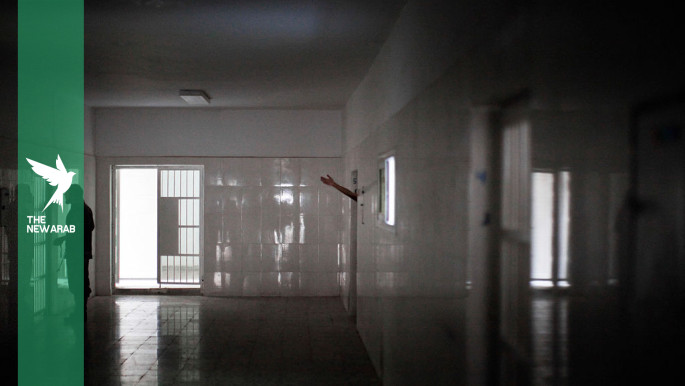
Rights groups have linked Hishri to crimes allegedly committed at Mitiga prison near Tripoli [Getty]
A former Libyan militia commander accused of war crimes, including murder, rape, enslavement and torture, in detention centres has appeared before the International Criminal Court (ICC) on Tuesday, in what human rights groups say is a “breakthrough moment” for accountability.
Khaled Mohamed Ali El Hishri, a former senior figure in Libya’s Deterrence Apparatus for Countering Terrorism and Organized Crime (RADA), faces charges of crimes against humanity and war crimes allegedly committed between May 2014 and June 2020. The RADA force is affiliated with the Tripoli-based Presidential Council.
Nicknamed the “Angel of Death”, he was “widely known as a notorious torturer at the help of Mitiga prison”, said ICC deputy prosecutor Nazhat Shameem Khan in the opening of the case for the prosecution. She quoted a witness who described the ex-commander as being “amongst the worst instigators of violence”.
The ICC issued an arrest warrant in July 2025, accusing Hishri of murder, rape, enslavement, torture and other inhumane acts, primarily against detainees held at the notorious Mitiga prison, where prosecutors say the 47-year-old oversaw the women’s wing. Rights groups have long documented widespread abuses and arbitrary detention at the facility.
Hishri was arrested in Germany in July 2025 and later surrendered to the ICC. Judges found “reasonable grounds” to believe he bears individual criminal responsibility, including for directly committing, ordering, or overseeing crimes.
Following three days of hearings concluding on 21 May, judges will have 60 days to assess whether prosecutors have sufficient evidence to proceed to trial.
Wasil Schauseil, press officer at search-and-rescue NGO SOS Humanity, said the case marks a significant step after years of stalled accountability efforts.
Hishri is the first suspect to face ICC proceedings linked to crimes in Libya since the 2011 uprising, despite arrest warrants issued for 13 individuals, eight of whom remain at large.
“This is another hallmark in a long sequence of evidence collected over the years showing how systematic these crimes in Libya are,” Schauseil told The New Arab.
Step towards accountability
Dozens of civil society organisations welcomed the proceedings earlier this month, calling them “an important step closer to justice” for victims of Mitiga prison.
For survivors, the moment carries deep symbolic weight.
“Hishri’s arrest bridges a distance many of us survivors of crimes at Mitiga thought would never close,” a South Sudanese survivor said in the joint statement. “We now carry renewed trust in the possibility of justice.”
Yet rights groups stress that abuses remain ongoing, rooted in a system marked by fragmented authority and overlapping networks of militias and state-linked actors.
SOS Humanity says refugees and migrants intercepted at sea by the so-called Libyan Coast Guard are routinely returned to detention, where they face torture, exploitation and extortion.
“We hear accounts of boats being intercepted violently, people pushed overboard, people shot at, boats being rammed,” Schauseil told The New Arab. “This is clearly a violent and systematic pattern.”
He added that there are indications that Libyan actors are aware of departures in advance, raising concerns about collusion and coordination.
Inside detention centres, survivors describe what Schauseil called an “extortion industry”, where detainees are filmed being tortured and the footage sent to relatives to extract ransom payments.
“We’ve heard stories of entire families selling their homes to buy someone out of detention,” he said. “And even then, many feel the only option left is to attempt the Mediterranean crossing again.”
The scale of the crisis remains stark. More than 27,000 people were intercepted and returned to Libya in 2025, with over 1,300 reported dead or missing on the central Mediterranean route, according to the International Organization for Migration (IOM). So far this year, at least 6,800 people have been intercepted, including 143 children, while more than 800 have died or gone missing.
Despite mounting evidence, accountability within Libya remains virtually absent, with authorities failing to investigate or prosecute abuses linked to detention centres and affiliated armed groups.
European complicity
Rights groups argue that European policies have contributed to entrenching this system.
Over the past year, the EU and its member states have expanded cooperation not only with western Libyan authorities but also with eastern actors, including forces linked to Khalifa Haftar, in an effort to curb migration.
Schauseil said the ICC case should be seen not only as a legal milestone but also as a warning about the broader system enabling such abuses.
“It is an important signal showing how systematic this violence has become,” he said. “But we cannot stop here. This is a symptom of a system that has been entrenched, including through European support.”
In Germany, Hishri’s arrest has sharpened scrutiny of government policy. Berlin has faced criticism for backing EU cooperation with Libyan actors, including support linked to the so-called Libyan Coast Guard, while simultaneously acknowledging the risks they pose.
“The German government is exposing glaring contradictions,” said Marie Michel, policy expert at SOS Humanity. “On the one hand, it supports actors responsible for systematic human rights violations. On the other hand, it recognises their danger and contributes to prosecuting individuals like El Hishri.”
Berlin has also stopped short of formally declaring Libya an unsafe place for disembarkation, despite repeated warnings about conditions on the ground.
Schauseil argued that the system has become deeply entrenched, benefiting a network of actors across Libya and Europe.
“I don’t see how things will change quickly on the ground,” he said. “But it can strengthen advocacy and awareness of how grave these crimes are.”
For SOS Humanity, the solution lies in shifting away from deterrence-based policies.
“The only way forward is safe passage for people who need protection,” Schauseil said. “If Europe continues financing and supporting these actors, it risks becoming increasingly complicit in a system that amounts to crimes against humanity.”