French Guiana, an overseas territory of France, shares its eastern border with Dutch-speaking Suriname, which in 2021 signed a border demarcation agreement with its South American neighbour that included measures to curb illegal gold mining. However, Suriname has yet to ratify the agreement, and illegal mining activities continue unabated on……
French Guiana, an overseas territory of France, shares its eastern border with Dutch-speaking Suriname, which in 2021 signed a border demarcation agreement with its South American neighbour that included measures to curb illegal gold mining.
However, Suriname has yet to ratify the agreement, and illegal mining activities continue unabated on its side of the Marowijne River, which separates the country from French Guiana, where strict laws prohibit unauthorised gold extraction.
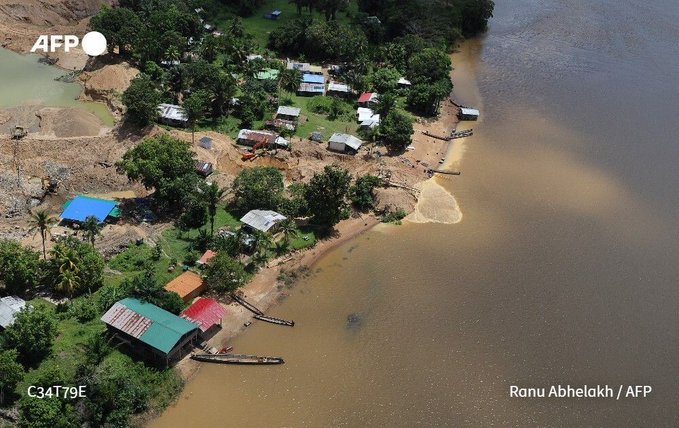
During a recent press tour organised by the French Guiana-based Mining Activity Observatory (OAM), AFP journalists flew over areas heavily affected by illegal mining.
From the air, vast open pits scarred the landscape on the Surinamese side of the silt-laden Marowijne River, highlighting the scale of the illicit gold extraction operations.
READ ALSO: Adamawa Bans Illegal Mining in Lamurde
Mercury levels in the area are 8,469 times above the World Health Organization limit, Indigenous rights activist Jupta Itoewaki told AFP.
And arsenic levels have risen 4,623 times above the limit, said Itoewaki, who hails from the 1,000-strong Wayana community.
“The entire community is exposed daily through water and food,” she said, calling on Surinamese authorities to investigate the issue.
“The government itself is part of the problem,” she added.
The OAM has documented how Surinamese, French Guianese and Brazilian miners work secretly in streams near the border, where they extract gold using methods that contaminate the soil and the water with mercury.
Companies such as SIAL meanwhile mine legally in French Guiana, without the use of mercury and within French regulations.
France’s ambassador to Suriname, Nicolas de Bouillane de Lacoste, flagged an “alarming deterioration in the state of the river” partly due to illegal mining.
The ambassador reiterated France’s call for Suriname to ratify the 2021 deal.
“A border agreement on its own will not put an end to illegal gold extraction. However, it will provide legal certainty to jointly combat irregular mining,” he told AFP.
‘Losing battle’
French authorities say they have deployed some 500 soldiers on land, at sea and in the air to combat illegal mining.
A border dispute makes the already challenging task even harder, said France’s defense attache, Lieutenant-Colonel Emmanuel Rigault.
“Because the border has not yet been demarcated, it is difficult to determine which country an island belongs to,” he said, explaining that these circumstances make it easier for miners to escape from justice.
“This prevents us from taking effective action,” he said.
Ambassador De Bouillane de Lacoste called it a “losing battle.”
“If we do nothing, the situation could really spiral out of control,” he said.
He warned that pollution affects “aquatic biodiversity as well as the health and living conditions of riverside populations,” and even child development.
From the air, AFP observed shops, mostly Chinese-owned, dotted along the Surinamese riverbank and flanked with legions of fuel barrels used to supply illegal miners.
Surinamese Foreign Minister Melvin Bouva earlier in July pledged to ratify the agreement with French Guiana, without specifying a date.
For Itoewaki, ratification “is a necessary first step, not a solution.”
“Ratify the protocol and recognize our land rights. Otherwise, nothing will change in the water,” she said.
AFP