Follow our live coverage here.
WASHINGTON – President Donald Trump views himself as the master of coercive diplomacy, forcing his opponents to capitulate quickly to US demands or face the threat of attack.
But in dealing with Iran over the past six weeks, Mr Trump has discovered that he is up against a nation that prides itself on resilience and delay.
And never has that been more obvious than in recent days, when Mr Trump has tried jawboning the Iranians by contending that they already surrendered – they “agreed to everything” he insisted on April 17, including turning over their “nuclear dust” – only to discover that patter doesn’t work with Iranian officials, who took to social media to declare he had made it all up.
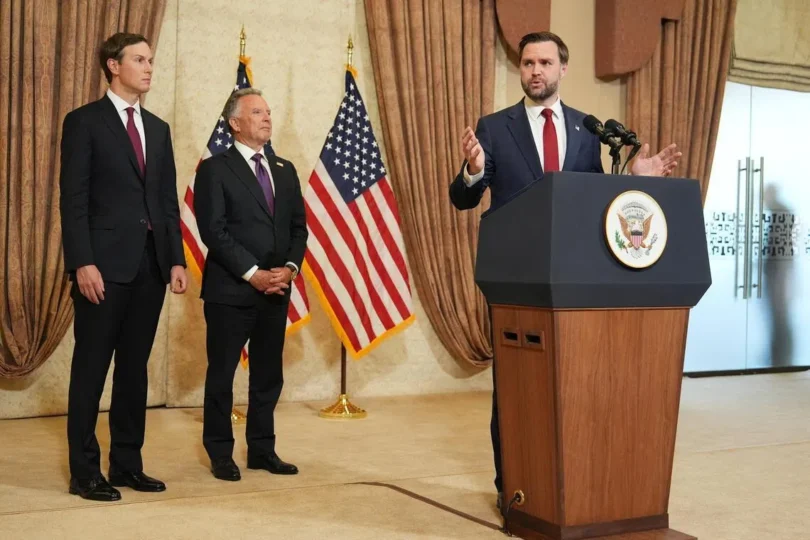
So over the next few days, assuming that Vice-President JD Vance leaves for Islamabad on April 21 for a second shot at agreeing to a “framework” for a deal, the two approaches are about to come into direct collision.
If the stakes were not sky-high – the prospect of renewed combat in the Middle East, global energy shortages and the very real possibility that the surviving Iranian leaders emerge convinced they need a nuclear weapon more than ever – it would be a classic case study in negotiation styles.
“Trump is impulsive and temperamental; Iran’s leadership is stubborn and tenacious,” said Mr Robert Malley, who negotiated with the Iranians in the lead-up to the 2015 nuclear deal and again in a failed effort by the Biden administration.
“Trump demands immediate results; Iran’s leadership plays the long game,” Mr Malley continued. “Trump insists on a flashy, headline-grabbing outcome; Iran’s leadership sweats every detail. Trump believes brute force can compel obedience; Iran’s leadership is prepared to endure enormous pain rather than concede on core interests.”
There is a reason the last big negotiation, completed 11 years ago, took the better part of two years, moving from secret talks with a then-new Iranian president with a pragmatic bent to a full-scale negotiation involving scores of meetings.
The final agreement ran more than 160 pages long, including five technical annexes that defined the limits on Iran’s nuclear activities, the pacing of sanctions relief and, most importantly, Iran’s obligations to comply with inspections by the International Atomic Energy Agency.
Every page, and most provisions, triggered an argument; just when old issues were resolved, and some kind of agreement seemed in place, Iranian negotiators would arrive with new demands.
The Iranians have their own complaints about the Americans. The accord that was ultimately reached – not signed, because it was not a formal treaty – in 2015 was overturned by Mr Trump in 2018.
Ever since, the Iranians have made the point that it is pointless to negotiate with one president if the next one is going to scrap the resulting agreement.
More recently, Iranian officials have noted that twice in a row, in June 2025 and again in February, Mr Trump has ordered attacks on Iran in the midst of diplomatic negotiations.
The Iranians cast this as perfidy, evidence that Mr Trump is not a reliable interlocutor.
And the distrust turned into gunfire over the weekend, near the Strait of Hormuz.
Iranian boats opened fire on two freighters that they said were breaking out of the Revolutionary Guard’s strict control of who can, and cannot, sail through the strait.
On April 19, the US Navy shot out the engine room of a huge Iranian-flagged container ship, which the Navy has now seized.
Mr Trump noted that the ship had been sanctioned by the Treasury in 2020, at the end of his first term, for a “prior history of illegal activity”.
“We have full custody of the ship, and are seeing what’s on board!” Mr Trump wrote on social media.
One way to interpret these moves is that they are efforts to shape the negotiating sessions, just as generals try to shape the battlefield.
The Iranians are demonstrating that no matter what happens or what they give up, they will be able to control commerce across the strait and charge millions of dollars for passage. The Trump administration is demonstrating that it is willing to reopen hostilities if negotiations fail.
Mr Trump reinforced that point on April 19, writing that a good deal is on the table.
“I hope they take it because, if they don’t, the United States is going to knock out every single Power Plant, and every single Bridge, in Iran. NO MORE MR. NICE GUY.”
It was the latest example of how Mr Trump has veered from complimenting Iran’s new leaders, who replaced those killed in the strikes that began Feb 28, as “more reasonable” than their predecessors, to warning them of more violence ahead if he doesn’t get his way.
But while that is a new element in the talks, the cultural divide in how to negotiate is not.
That divide was evident 11 years ago, in the gilded halls of the 160-year-old Beau-Rivage Palace Hotel in Lausanne, Switzerland, where secretary of state John Kerry and his counterparts from five other countries struggled to close a preliminary agreement with Iran.
It was, perhaps, the closest analogue to what is unfolding now in Islamabad.
Every day the US delegation would speak about how many centrifuges had to be disassembled and how much uranium needed to be shipped out of country.
Yet when Iranian officials – including Mr Abbas Araghchi, now the Iranian foreign minister, stepped out of the elegant, chandeliered rooms to brief reporters, most of the questions about those details were waved away. The Iranians talked about preserving respect for their rights and Iran’s sovereignty.
“I remember we finally got the parameters agreed upon at the hotel,” Ms Wendy Sherman, the chief US negotiator at the time, said on April 20.
“And then a few days later the supreme leader came out and said, ‘Actually, some very different terms were required.’”
Ms Sherman, who went on to become deputy secretary of state in the Biden administration, would go into these negotiations with a large posse.
She often had the CIA’s top Iran expert in the room, or nearby. So was the energy secretary, Mr Ernest Moniz, an expert in nuclear weapons design.
Proposals floated by the Iranians would be sent back to the US national laboratories, where weapons are designed and tested, for expert analysis of whether the agreements being discussed would keep Iran at least a year away from a bomb.
But Mr Trump’s negotiating team travels light, with no entourage of experts and few briefings. Mr Jared Kushner and Mr Steve Witkoff, the president’s son-in-law and the special envoy, learned their negotiating skills in New York real estate and say a deal is a deal. They say they have immersed themselves in the details of the Iran programme, and know it well.
Moreover, even if the issues they are facing are very much the same ones that the Obama-era negotiators faced, Mr Kushner and Mr Witkoff see little value in spending hours poring over the diplomatic history, especially given what Mr Trump had to say about the resulting agreement.
But Mr Trump is clearly sensitive about the coming comparisons. “The DEAL that we are making with Iran will be FAR BETTER than the JCPOA,” he said, using the acronym for the Joint Comprehensive Plan of Action, the formal name for the 2015 accord.
“It was a guaranteed Road to a Nuclear Weapon, which will not, and cannot, happen with the deal we’re working on.”
And with that, Mr Trump set up the test that his own negotiation, if successful, may be measured by. NYTIMES