PM Narendra Modi has also secured a $5 billion investment pledge from the Emirates
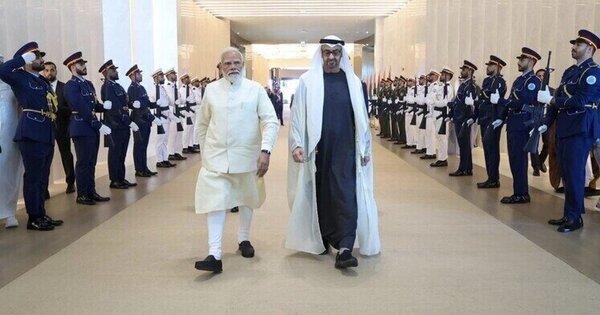
India and the United Arab Emirates have inked energy and defense pacts during Prime Minister Narendra Modi’s trip to the Gulf nation on Friday.
Modi started his five-nation tour with a brief visit to the UAE, after which he will head to the Netherlands, Sweden, Norway, and Italy.
The UAE alsopledgedinvestments in India worth $5 billion, including the investment of $4 billion by Emirati financial entities in Indian banks and $1 billion pledge by the Abu Dhabi Investment Authority (ADIA) with the National Infrastructure & Investment Fund of India (NIIF) in priority infrastructure projects in India.
Pacts on a defense partnership framework, strategic petroleum reserves, and an agreement for the supply of liquefied petroleum gas (LPG) were also signed, according to the statement by Modi’s office. The energy pact includes potential collaboration in liquefied natural gas and liquefied petroleum gas storage facilities in India.
A memorandum of understanding to build a ship repair cluster at Vadinar in the western state of Gujarat was also signed. An understanding has also been reached to establish a supercomputer cluster.
During the meeting with UAE President Sheikh Mohammed bin Zayed Al Nahyan, Modi also condemned the attacks on the UAE amid the Middle East conflict. “We strongly condemn the attacks on the UAE and denounce the way the UAE has been targeted. This is unacceptable in any form,” he said.
“India has always vouched for dialogue and diplomacy,” he said, adding, “our priority is to keep Hormuz free and safe. We have to follow international laws.”
He also lauded “the restraint and maturity” shown by the UAE in these difficult circumstances.
READ MORE: The war on Iran may become a turning point in the post-Cold War order
The transit of energy vessels through the chokepoint controlled by Iran has been a main point of contention between Tehran and Washington. The US has enforced a blockade of the Strait, through which a fifth of the world’s crude supplies were routed before the conflict began.
(RT.com)