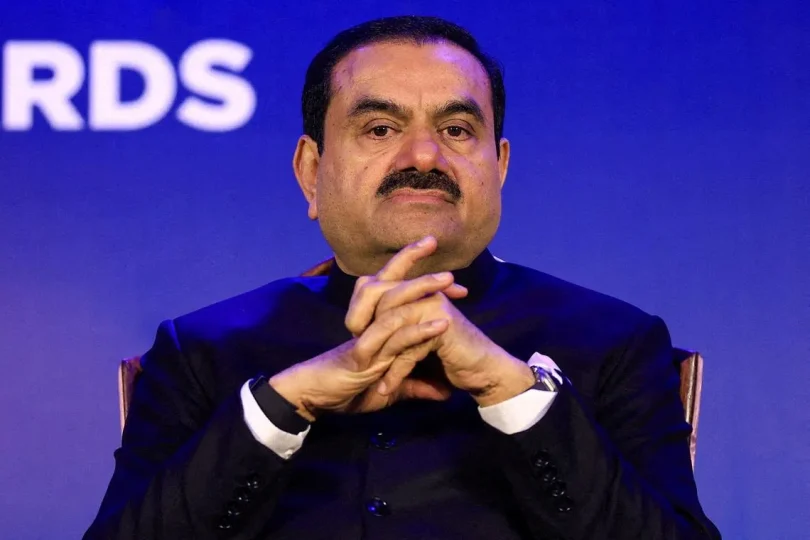
NEW YORK – India’s wealthiest man, Gautam Adani, acknowledged on July 15 that he had offered to invest US$10 billion (S$12.9 billion) in the United States as part of the resolution of his criminal case, but said it ultimately played no role in the Justice Department’s decision to abandon its prosecution against him.
His comments came in a legal filing ordered by a federal judge in Brooklyn, Nicholas G. Garaufis, who has raised concerns about the Justice Department’s request in May to dismiss the indictment.
In a highly unusual move last week, Garaufis asked Adani to say in a sworn affidavit if he was aware of “any agreement exchanging anything for the dismissal” of the charges.
Adani is represented by Robert J. Giuffra Jr, who is also a personal lawyer for President Donald Trump. Giuffra had proposed the US$10 billion investment “if that was what the DOJ or SEC wanted”, Adani wrote, referring to the Justice Department and the Securities and Exchange Commission.
Adani had been facing federal criminal and civil cases in the United States, which accused him of fraud, bribery and corruption in Indian business deals.
The New York Times previously reported that Giuffra, who is also co-chair of the firm Sullivan & Cromwell, made the US$10 billion offer in a meeting in April at the Justice Department in Washington.
In a separate filing on July 15, Giuffra quoted from an e-mail he received from the Justice Department, which stated that the investment proposal did not factor into the decision to drop the case.
The offer to resolve the criminal charges “by, in part, a general proposal to invest $10 billion in the United States is categorically rejected by this office”, according to the e-mail, which was sent by Joseph Nocella Jr, the US attorney for the Eastern District of New York.
The July 15 filings were the latest twist in a high-profile case that has unravelled in a peculiar way.
After prosecutors moved to dismiss the indictment against Adani and his co-defendants, Garaufis pressed them to explain their justification for doing so, leading to a public and occasionally rancorous battle.
Judges have little ability to bar prosecutors from abandoning a case. And it is uncommon for judges to question defendants who are set to have their charges dropped.
But during Trump’s second term, judges across the United States have increasingly probed the rationale behind such decisions.
A notable example came in 2025, when the judge overseeing the federal corruption case against Eric Adams, then the mayor of New York City, strongly criticised the Justice Department for its reasoning in dropping the prosecution.
A spokesperson for the US attorney’s office in Brooklyn declined to comment.
Adani, an industrial titan in India and a close ally of Prime Minister Narendra Modi, was indicted in November 2024 along with seven others. The indictment said Adani paid bribes to Indian officials to secure solar energy contracts for one of his companies.
The offer from Adani’s lawyers echoed a public pledge Adani had made after Trump won the 2024 election.
A week before he was indicted, Adani posted on the social platform X congratulating Trump and saying that his company was committed to investing “$10 billion in US energy security and resilient infrastructure projects”.
In the July 15 filing, Adani said that he was not aware of the indictment when he made the post. But by then, Bloomberg News had already reported that federal prosecutors were investigating Adani.
Compared with the case against Adams, the Justice Department has offered a more substantive basis for abandoning the prosecution against Adani, even as his offer to invest in the United States has concerned Garaufis and lawmakers on Capitol Hill.
Though the bribes were said to have taken place in India, federal prosecutors had argued that Adani was subject to US law because his company solicited money from American investors.
But in a letter in July, Trent McCotter, a top Justice Department official, described the indictment as a “foreign case” that was outside his agency’s purview.
McCotter added that he had decided to dismiss the case before Adani’s investment was discussed.
In his filing on July 15, Giuffra noted that Adani and two of his co-defendants had submitted hundreds of pages of “law, facts, expert testimony and argument” between February and April.
On two occasions, the defence lawyers told Justice Department officials that the Adani Group would be “amenable to following through” on Adani’s public pledge to invest US$10 billion as part of the case’s resolution, Giuffra wrote.
Adani and his nephew ultimately paid an US$18 million fine to resolve the SEC case, and one of his companies reached a US$275 million settlement to resolve a separate investigation by the Treasury Department.
The move to dismiss the charges has led to internal discontent within the Justice Department. McCotter has accused current and former officials of acting “unethically” and leaking information to the media.
Days after the decision, two prosecutors publicly withdrew from the case. NYTIMES
This article originally appeared in The New York Times.