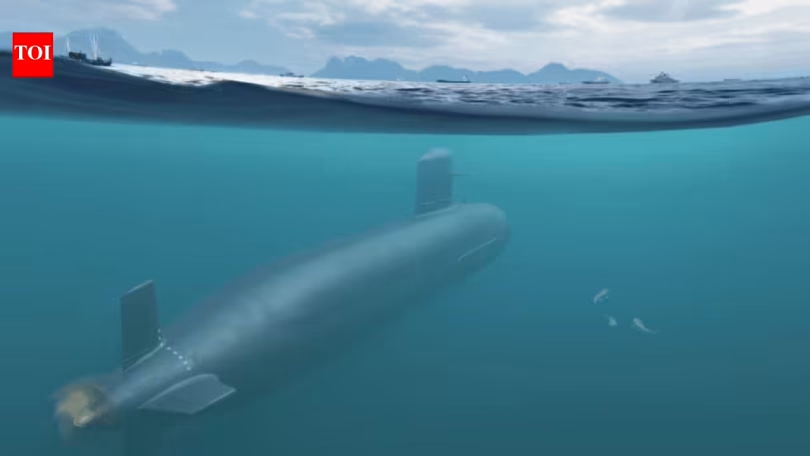
Indonesia is moving into a new phase of its submarine development plans as domestic construction of the first Scorpène Evolved submarine is set to begin this month at PT PAL Indonesia’s shipyard in Surabaya, East Java. The project marks a major step in Jakarta’s effort to strengthen local naval manufacturing capabilities while expanding its submarine fleet with more advanced platforms.As reported by The Naval News, the construction programme carried out with France’s Naval Group under the Scorpène Republik Indonesia (SRI) initiative will see two submarines built locally for the Indonesian Navy (TNI AL). Beyond acquiring new vessels, the project is designed to develop industrial skills, expand the local defence supply chain and build long-term expertise in submarine production and maintenance.
Indonesia starts submarine construction with first steel cutting planned
Preparations for the programme were showcased on July 2 when PT PAL Indonesia and Naval Group hosted a media visit to the company’s submarine construction and maintenance facilities in Surabaya. Representatives from both organisations highlighted the progress made in upgrading infrastructure, preparing workers and establishing the production process needed for the new submarines.Naval Group’s SRI Programme Director Vincent Vimont said the first steel cutting ceremony for the lead submarine is scheduled for July 2026. The vessel is expected to enter testing and sea trials between 2030 and 2032 before being handed over to the Indonesian Navy in 2032.The second submarine will follow a year later, with construction expected to begin in 2027. Its testing phase is planned for 2031 to 2033, leading to delivery in 2033. PT PAL and Naval Group intend to build both submarines at the same facility with a one-year gap between production starts. Company officials said the schedule could potentially be shortened if construction progresses faster than expected.
Submarine programme brings jobs, training and production experience to Indonesia
The Scorpène Evolved programme is also expected to have an impact beyond shipbuilding. PT PAL and Naval Group estimate that around 2,250 jobs will be supported through the project, covering construction activities, supporting industries and future maintenance work.Further submarine orders could increase employment opportunities as Indonesia develops a larger industrial base around underwater defence technology. Naval Group is also bringing experience from other Scorpène programmes around the world. Some members of its Indonesian team previously worked on local production projects in India and Brazil, giving the programme access to knowledge gained from earlier efforts to manufacture the submarines outside France.PT PAL’s existing facilities have been prepared to support multiple submarine activities at the same time. Agus Rifai, head of PT PAL’s submarine division, said the company’s production area can handle construction or maintenance, repair and overhaul (MRO) work for up to four Scorpène submarines simultaneously. The company will also draw on experience gained from operating and maintaining the German-designed Type-209 submarines, which Indonesia has used for decades.
Inside the technology powering Indonesia’s next-generation submarines
The Scorpène Evolved represents an updated version of Naval Group’s conventional submarine design, incorporating newer systems aimed at improving endurance, detection capabilities and operational flexibility.According to Naval Group, the submarine will feature acoustic reduction technology derived from experience with France’s nuclear-powered ballistic missile submarine fleet. It will also use the SUBTICS combat management system, integrated sonar and sensor systems, and improved signal-processing capabilities. A key feature of the Indonesian variant will be a full lithium-ion battery configuration. Naval Group said this arrangement will allow the submarine to remain deployed for missions lasting up to 80 days.The submarine will carry a combination of weapons, including heavyweight torpedoes and anti-ship missiles. It will be capable of carrying up to 18 heavyweight torpedoes and SM39 Exocet missiles. Naval Group also confirmed that the design will be compatible with the next-generation submarine-launched Exocet missile, known as the SM40, which is currently being developed by MBDA.
Scorpène Club membership marks Indonesia’s push to build deeper submarine capabilities
Indonesia became the newest member of the international Scorpène operator group in 2025, joining countries including Brazil, Chile, India and Malaysia.The membership, known as the Scorpène Club, provides a platform for operators to exchange experience related to submarine operations, maintenance and training. For Indonesia, the move comes as the country seeks to deepen its knowledge of submarine technology rather than remain solely an end-user of imported platforms.
Long-term ambition for indigenous submarines
The Scorpène Evolved programme is linked to Indonesia’s broader National Submarine Technology Mastery Programme, which aims to gradually develop domestic submarine design and manufacturing capabilities.PT PAL’s RDI Programme Director, Rear Admiral (Retired) Wiranto, who previously served aboard Indonesia’s Whiskey-class and Type-209 submarines, said the Scorpène project represents the second phase of this national effort. The long-term objective is for Indonesia to gain the ability to design, construct and potentially export its own submarines between 2042 and 2050.The partnership with Naval Group is therefore viewed as a technology-building opportunity rather than only a procurement project.
Possible future role as regional production hub
PT PAL and Naval Group have also discussed the possibility of Indonesia becoming a future location for joint Scorpène submarine production for other customers, as well as a maintenance centre for existing Scorpène operators.However, Naval Group clarified that such an arrangement would require a separate agreement. The current contract for Indonesia’s submarines does not include permission for PT PAL to market or export Scorpène submarines to third countries. The two companies are continuing discussions on wider cooperation beyond the submarine programme. Naval Group has offered possible technology partnerships involving other defence systems, including missile and torpedo technologies.Additional Scorpène Evolved submarines for the Indonesian Navy are also being considered, although negotiations on any future orders are still underway. For Indonesia, the first locally built Scorpène submarine will represent more than a new naval asset. It will be a test of the country’s ability to move from operating advanced underwater platforms towards becoming a producer of them.