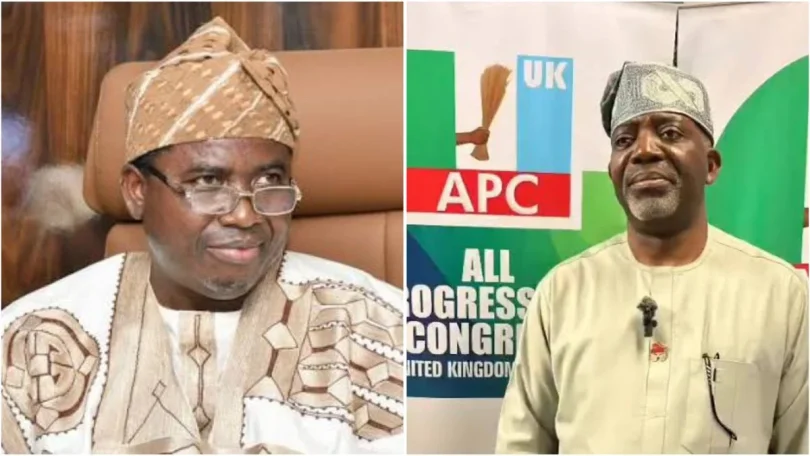
The Chairman of the Independent National Electoral Commission (INEC), Professor Joash Amupitan, has come under criticism following his meeting with the United Kingdom chairman of the All Progressives Congress (APC), Tunde Doherty, during his official visit to London.
Social media activist, VeryDarkMan, questioned the circumstances surrounding the meeting, expressing concerns about the relationship between the head of Nigeria’s electoral commission and a prominent member of the ruling party.
The controversy emerged after videos and photographs from Amupitan’s visit to the United Kingdom circulated online, triggering reactions over the presence of APC-linked individuals around the electoral chief during his official engagement.
Some social media users had also accused the INEC chairman of wearing an APC-branded cap during the visit.
The allegation raised criticism, with several Nigerians questioning whether his actions could affect public confidence in the commission’s independence ahead of the 2027 general elections.
However, VeryDarkMan, while reacting to the controversy, said he had watched the circulating footage and could not establish that Amupitan wore the party-branded cap.
He explained that the individual seen wearing the cap was Tunde Doherty, the APC chairman in the United Kingdom, and not the INEC chairman.
“I watched the video carefully and I didn’t see where the INEC chairman was wearing APC cap,” he said.
Despite correcting the allegation about the cap, the activist maintained that the circumstances surrounding the meeting deserved public attention.
He questioned why the chairman of an independent electoral commission would be seen associating with a senior official of the ruling party during an official assignment abroad.
In a related development, Politics Nigeria had reported the recent confrontation between Amupitan and some Nigerians in the United Kingdom.
On Thursday, November 12, the INEC chairman attended an engagement at Chatham House in London, where he participated in a discussion on Nigeria’s 2027 elections, democratic development and regional stability.
The event provided an opportunity for him to address questions about the country’s electoral process and the commission’s preparations for the forthcoming general elections.
However, his appearance at the venue was followed by a protest from a group of Nigerians who gathered outside the building as he was leaving.
The demonstrators surrounded the vehicle conveying Amupitan and demanded that he come out to address their concerns about the electoral commission.
Some protesters were heard shouting, “Why are you running? Come out and talk to us,” while others called for his resignation.
The demonstrators raised concerns about alleged irregularities in the preliminary voters’ register, including suspected duplicate registrations, questionable photographs believed to have been generated using artificial intelligence and the presence of polling units they considered suspicious.
They also questioned the commission’s neutrality and accused it of favouring President Bola Tinubu and the ruling APC.
Some of the protesters described INEC as a “criminal organisation” and displayed placards demanding accountability from the electoral body.
Amupitan, however, remained inside the vehicle as the demonstrators continued to surround it.
Videos of the incident subsequently circulated across social media platforms, attracting further reactions from Nigerians.
The protest came amid growing scrutiny of the preliminary voters’ register following concerns about questionable entries discovered during the Continuous Voter Registration exercise.
INEC has acknowledged irregularities in some registration records and disclosed that it had commenced efforts to identify and remove invalid entries.
During his recent engagements, Amupitan also addressed the commission’s preparations for the 2027 elections.
He acknowledged that technical problems experienced during the transmission of results in the 2023 general elections had affected public confidence in the electoral process.
He maintained that the commission was taking steps to prevent a recurrence of such problems and improve the credibility of the forthcoming elections.