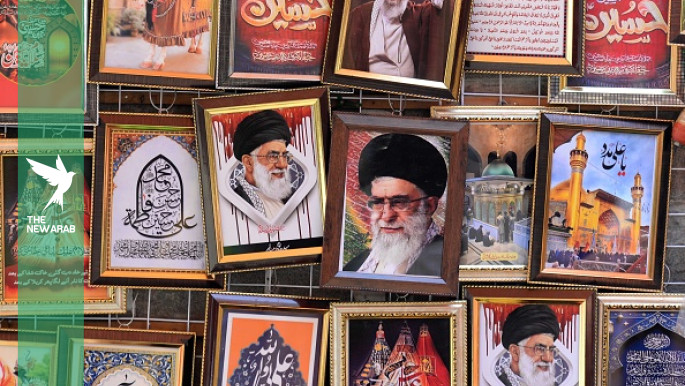
Former Iranian Supreme Leader Ali Khamenei, whose funeral ceremonies are set to begin in July more than 100 days after his assassination. [Getty]
Tehran is preparing for the funeral of Iran’s late Supreme Leader Ali Khamenei in what authorities are portraying as both a historic farewell and a demonstration of national unity under the country’s new leadership.
More than 100 days after Khamenei was assassinated in his office in southern Tehran on 28 February, the first day of the US-Israeli military campaign against Iran, officials have announced a series of funeral ceremonies expected to draw millions of mourners from across Iran and abroad.
The funeral comes at a pivotal moment for the Islamic Republic, following the war with Israel and the United States and the recent memorandum of understanding signed between Tehran and Washington.
Funeral ceremonies to begin in July
The office responsible for publishing Khamenei’s works announced on 13 June that the funeral ceremonies will begin on 4 July and continue for five days across several Iranian cities before his burial.
According to the programme, public farewell ceremonies will take place on 4 and 5 July at Tehran’s Imam Khomeini Grand Mosalla, followed by the main funeral procession in the capital on 6 July.
Khamenei’s body will then be transferred to the holy city of Qom, where further ceremonies will be held before the final funeral rites in the northeastern city of Mashhad on 9 July.
He will be buried in the Razavi Shrine complex near the tomb of Imam Reza, the eighth Imam in Twelver Shia Islam.
Family members to be buried alongside him
Iranian authorities said the funeral would also include members of Khamenei’s family. Those named include his son-in-law, Mesbah al-Hoda Bagheri Kani; his daughter, Boshra Hosseini Khamenei; Zahra Haddad Adel, the wife of the current Supreme Leader, Mojtaba Khamenei; and his granddaughter, Zahra Mohammadi Golpayegani.
Special memorial ceremonies for Khamenei’s family were previously held in the city of Rey, south of Tehran, in late May.
Foreign delegations expected
Iranian officials say foreign dignitaries, political figures and popular delegations from various countries, particularly neighbouring states, are expected to attend.
Foreign Minister Abbas Araghchi previously said embassies would begin issuing visas to participants once the funeral schedule and capacity arrangements were finalised.
Mohammad Reza Aref, Iran’s first vice president and head of the funeral committee, said several neighbouring countries had reported that more than one million of their citizens had applied to attend the ceremonies.
However, he acknowledged that Iran’s capacity would not allow all applicants to participate.
Iran’s Civil Aviation Organisation has begun special arrangements to transport visitors and guests between Tehran and Mashhad during the funeral period.
Why was the funeral delayed?
Iranian officials have not given a single formal reason for the delay, but political and security considerations appear to have been central.
Several earlier dates for public farewell ceremonies were announced and later cancelled amid concerns related to the ongoing conflict and the possibility of renewed fighting.
Officials have suggested that security concerns during the war and uncertainty surrounding negotiations with Washington made it difficult to organise an event of such scale.
The recent US-Iran agreement and the subsequent easing of tensions are seen as having created more favourable conditions for holding the funeral.
The delay mirrors that of former Hezbollah Secretary-General Hassan Nasrallah, whose funeral took place several months after his death due to wartime security concerns.
Authorities expect millions to attend
Iranian officials have predicted one of the largest funerals in the country’s modern history.
Tehran Mayor Alireza Zakani said between 15 and 20 million people could participate in the ceremonies, describing them as a potentially “historic and unique” event.
Meanwhile, officials in Mashhad said they expect between 10 and 12 million mourners to take part in the final burial ceremonies.
Authorities have launched extensive logistical and media preparations aimed at ensuring what they hope will be the largest public mobilisation since the funeral of Ayatollah Ruhollah Khomeini in 1989.
A show of unity under Iran’s new leadership
Iranian officials widely view the funeral as more than a religious or commemorative event. Authorities see it as an opportunity to demonstrate continuity within the Islamic Republic following Khamenei’s death and the appointment of his successor, Mojtaba Khamenei.
Former Islamic Revolutionary Guard Corps commander Hossein Kanaani Moghadam said the funeral would send a message that Iranians remain united behind the political system, the Islamic Revolution and the country’s new leadership.
Officials also hope the event will reinforce the legitimacy of the leadership transition following months of political tensions, anti-government protests and the recent war.
The comparison frequently drawn by Iranian officials is to the 1989 funeral of Ayatollah Khomeini, which marked the beginning of Ali Khamenei’s era as supreme leader.
Why is the funeral taking place during the Islamic month of Muharram?
The ceremonies will take place during Muharram, the holiest month in the Shia religious calendar.
Muharram culminates in Ashura, which commemorates the killing of Imam Hussein at the Battle of Karbala and occupies a central place in Shia religious and political identity.
Holding the funeral during Muharram allows authorities to connect Khamenei’s assassination to broader themes of sacrifice, resistance and martyrdom that feature prominently in Iran’s revolutionary narrative.
Officials also hope the timing will encourage greater participation from mourners already engaged in Muharram commemorations.
Funeral slogan and symbolism
The funeral committee has adopted “We Must Rise” as the central slogan for the ceremonies.
The official symbol will be a clenched fist, inspired by remarks made by Supreme Leader Mojtaba Khamenei after viewing his father’s body.
In his first message after assuming office, Mojtaba Khamenei said he saw his father lying with his healthy hand tightly clenched, describing it as a symbol of steadfastness and resistance.
According to the funeral committee, the clenched fist represents strength, defiance and continuity, and is intended to embody the values that Iranian authorities associate with Khamenei’s political and religious legacy.