
“What we are saying is that they should give us a chance to sell in the market; let them go somewhere else, and they also have shops. We didn’t say they should go out of Nigeria; they should just go out of here,” an auto spare parts trader said.
The recent protest by some automobile spare parts retailers of Auto Spare Parts and Machinery Dealers Association of Nigeria (ASPAMDA) at Lagos International Trade Fair Complex, revealed varying demands between Nigerian retailers and Chinese businesses operating in the market.
The protesters had called for Chinese businesses to leave the market, accusing them of selling directly to customers and competing with local retailers.
The protesting traders held placards, some of which read, “Chinese must go” and “They should go far from our market environment and not be taking our customers,” according to a video that circulated online.
While normalcy has since returned at the market after the protest, the accounts of traders and other stakeholders show that concerns over the relationship between Chinese wholesalers and Nigerian retailers remain.
However, stakeholders at the market said the protest was mainly about the boundaries between wholesale and retail activities, rather than a demand for Chinese businesses to leave Nigeria.
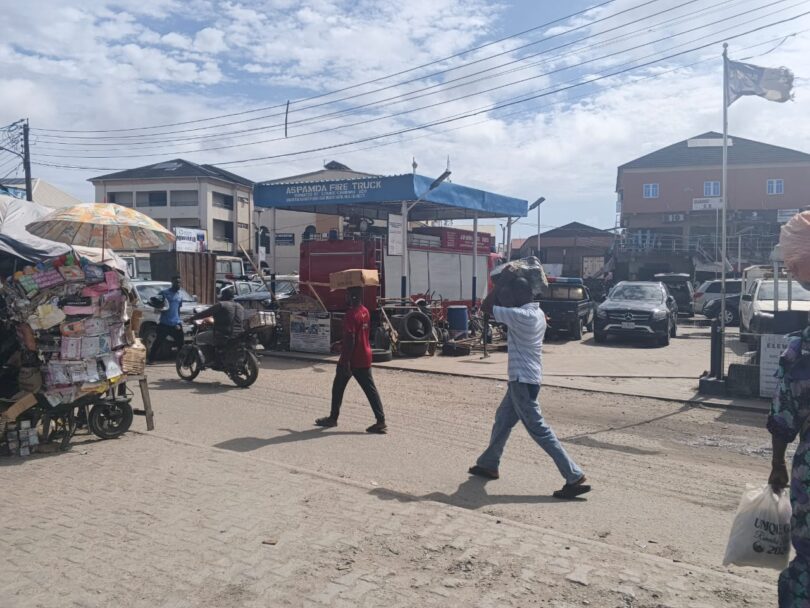
During a visit to the market following the protest, business activities had returned to normal, with traders attending to customers.
Ngozi Emechebe, National President of ASPAMDA, told PREMIUM TIMES on Thursday that the association had brought the situation under control following intervention by the police and local government authorities.
“I’m happy you heard our press conference with the local government chairman. We have it under control already,” he said.
Mr Emechebe said the call for Chinese businesses to leave the market was not an option, adding that the police were investigating the circumstances surrounding the protest.
“This is the first type of protest, but that ‘Chinese must go’, it’s not possible,” he said.
When asked about the update concerning the issue, the market association president said the police had promised to investigate the root cause of the protest and establish how it started.
Mr Emechebe declined to comment extensively on the complaints raised by the protesters, saying the matter should be allowed to take its course.
“I will not dig deep into this thing because the rumours are still out. Let’s just allow the Nigerian police to investigate and get to the root of the matter. How it started,” he said.
He, however, said the association had already been working on the issue of separating the activities of Chinese wholesalers from those of Nigerian retailers.
“What they are asking for is a very small thing that we have been doing ourselves, and we are implementing it,” he said.
According to him, Chinese businesses in the market could be seen conducting transactions with Nigerian traders, even after the protest.
“If you go around the market, you can see the Chinese doing business just with Nigerians,” he said, adding that the police report would provide more clarity on the dispute.
Similarly, Paulinus Ojukwu, Chief Security Officer of ASPMDA, said the protesters did not notify market authorities before embarking on the demonstration.
Mr Ojukwu said security personnel intervened to prevent the situation from escalating, confirming that business activities resumed after security officials’ intervention.
“We called them to order and made sure nothing was destroyed during the protest, but everything is back to normal now,” he said.
John Chidebere, a motor spare parts retailer, said the protesters were concerned about the effect of direct sales by Chinese businesses on local retailers.
He said Nigerian importers typically incur costs and wait several months for goods imported from China to arrive in the country, while Chinese businesses operating in the market could sell directly to customers.
“If we import from China, we will have to wait for two to three months before it gets to Nigeria. And if you calculate both the money you used for clearance, your profit will not be more than N1,000, and you will also want to add to it to gain profit.
“But as Chinese people enter the market, they will sell it directly to our customers with the same amount we get from them, so there’s no money for house rent or upkeep,” he said.
Mr Chidebere also alleged that some Chinese traders sell products in smaller quantities directly to customers, a practice he said puts pressure on local retailers.
“They even sell in bits to the customers and they will even reduce their quality before selling for us again,” he said.
He said the protesters were seeking a resolution to their complaints rather than trying to cause damage.
“To me, the protest is based on complaints about what they are doing to us. We are not doing it by our own power, and even starters need money to do well. People even think we include additional prices on what we sell, not knowing that we sell the same amount we buy,” he said.
Another auto spare parts dealer, who identified himself as Chief Osigwe, said the concern among retailers was that Chinese importers were selling directly to the same customers they supplied.