
…Seeks Tougher Penalties for Vandals, Improved Welfare for Personnel
For three months, officers of the Nigeria Security and Civil Defence Corps (NSCDC), FCT Command, tracked a syndicate specialised in excavating and selling stolen government armoured cables worth hundreds of millions of naira. The operation led to the recovery of compressed cables linked to a network involving vandals and foreign collaborators.
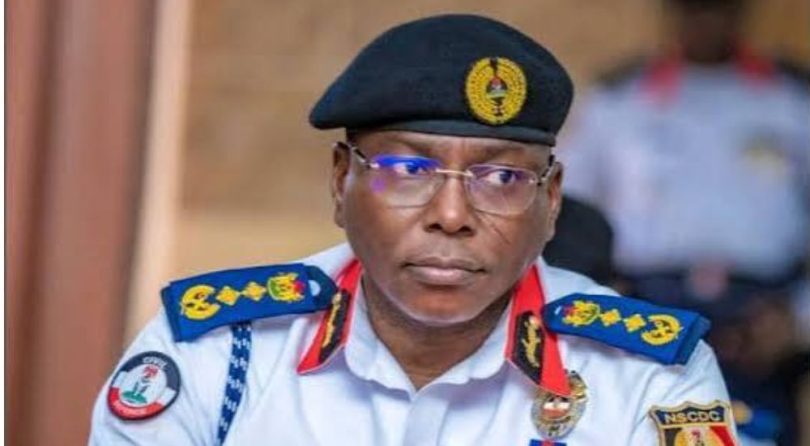
In this interview with Justina SIMON of THE WHISTLER, the FCT NSCDC Commandant Dr. Olusola Odumosu, explained how the syndicate was uncovered and why scrap markets remain a major driver of infrastructure vandalism. He also spoke on what the NSCDC is doing to combat human trafficking, illegal mining and other emerging security threats across the Federal Capital Territory. Excerpt…
When You Assumed Office As FCT Commandant, What Security Threat Did You Find More Serious Than You Had Expected?
Let me begin by saying that the narrative that the FCT is secure is not just a perception; it is the reality. This is because the NSCDC works closely with other security agencies, including the Police, the Department of State Services (DSS), and the military.
We have a strong synergy, and this collaboration has strengthened our operations to ensure the safety of lives and property, particularly the protection of critical national assets and infrastructure. As the lead agency responsible for safeguarding these assets, I can confidently say that incidents of infrastructure vandalism have reduced drastically.
What surprised me, however, was not necessarily the security situation itself but the level of criminality and the unpatriotic attitude displayed by some Nigerians. People often accuse the government of not doing enough, but we also need to hold ourselves accountable.
For example, we carried out an intelligence-led operation within the FCT that lasted almost three months before we were able to uncover a syndicate involved in vandalising government cables and those receiving the stolen items.
The company specialised in buying vandalised armoured cables. These are very expensive public assets that criminals excavate, cut, and sell. Our investigation revealed that some Nigerians were working with foreign collaborators to receive the stolen cables.
After months of surveillance, my officers carried out a coordinated operation on the company. We recovered a huge quantity of compressed armoured cables valued at hundreds of millions of naira.
That operation showed the extent of the problem. It does not mean the government is not working. Rather, there are individuals who sponsor vandals, purchase the stolen materials, compress them, and, in some cases, export them abroad, where they are melted for reuse.
For me, that was shocking because public infrastructure belongs to all Nigerians. While the government and security agencies are making efforts to provide and protect these facilities, some people deliberately destroy them for personal gain, ultimately undermining national development.
The FCT Is Undergoing Infrastructure Development. What’s The NSCDC Doing To Safeguard These Public Assets?
The FCT is witnessing unprecedented infrastructure development. Anyone who has not visited Abuja in the last three or four years could easily lose their way because of the level of transformation taking place.
The Honourable Minister of the FCT is widely recognised for driving infrastructure development across the territory. Roads, bridges, and other public facilities are springing up in virtually every part of the FCT.
Our responsibility is to ensure that all these facilities are adequately protected. Through our Critical National Assets and Infrastructure Protection Department, we maintain 24-hour patrols across vulnerable locations.
Wherever there is infrastructure requiring protection, our personnel are deployed to secure it, monitor activities, and arrest anyone attempting to vandalise government property.
What Reforms Are Needed To Curb Infrastructure Vandalism?
Personally, I believe that if we successfully address the activities of scrap dealers, we would solve about 70 per cent of the challenges associated with infrastructure vandalism.
That conviction informed the proposal I presented during one of the FCT Security Council meetings last year. I recommended that scrap markets should either be properly regulated or, where necessary, shut down completely.
I do not believe the problem can be solved without stricter regulation.
During our investigations, we discovered that many of the vandals we arrested sold stolen government property directly to scrap dealers. Whether the items were cables, manhole covers, or other public infrastructure, we consistently traced them back to scrap markets.
This clearly indicates that these markets serve as the receiving point for vandalised government property. Criminals know they have a ready market where they can quickly dispose of stolen items whenever they need money.
I am pleased that the Honourable Minister accepted our recommendation and directed security agencies to regulate scrap markets across the FCT.
Following that directive, we profiled operators across the territory, engaged market leaders, and introduced stricter operational guidelines. We also warned that any market found dealing in vandalised government property would be shut down.
Since those measures were introduced, we have recorded noticeable improvement in the protection of public infrastructure. Scavengers were also prohibited from operating within the city centre and restricted to designated dump sites.
However, regulation alone is not enough. We also need tougher penalties for convicted vandals.
Many of the sentences currently handed down by the courts are discouraging for security personnel. Some offenders are fined as little as N2,000, N3,000, or N5,000, while others are simply ordered to perform community service before returning to the streets.
Such penalties are not sufficient to deter criminal activities. There is a need for stricter punishment if we truly want to reduce vandalism.
Why Has Is The FCT Becoming Attractive To Human Trafficking Syndicates?
We have dismantled a number of human trafficking networks operating within the FCT, and some of those cases are still fresh in our memory.
However, it is important to understand that Abuja is a cosmopolitan city. It is bordered by Kogi, Niger, Nasarawa, and Kaduna states, and because of its central location, there is a constant influx of people into the FCT.
As the nation’s capital, many people believe relocating to Abuja automatically translates into better opportunities. Unfortunately, traffickers exploit that perception by luring people with false promises of jobs, wealth, and a better life.
Some victims are brought into Abuja before being transported to other parts of the country, while others are moved through the FCT before being taken outside Nigeria.