
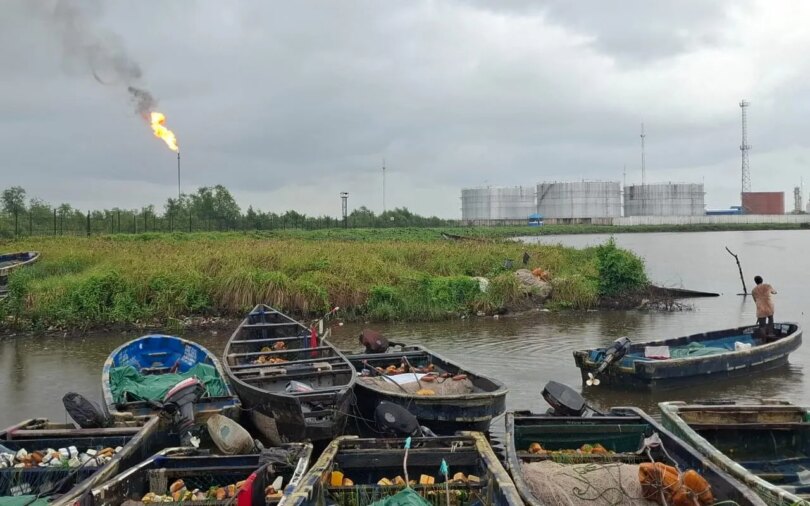
In this second and last part of this investigation, PREMIUM TIMES reports that nearly five years after Nigeria enacted its anti-flaring law, regulatory delays, weak enforcement, and gaps in methane measurement have left communities exposed.
When Nigeria enacted the Petroleum Industry Act (PIA) in August 2021, it sought to close one of the country’s longest-running environmental failures and reduce methane among other emissions.
The PIA, rather than relying solely on penalties, created a legal framework for planning, commercialisation and regulatory enforcement.
Key among the requirements was that every producer of natural gas had to prepare a Natural Gas Flare Elimination and Monetisation Plan (FEMP) showing exactly how it intended to end gas flaring.
The law also empowered the Nigerian Upstream Petroleum Regulatory Commission (NUPRC) to seize flare gas and allocate it to investors capable of converting it into useful products such as electricity, liquefied petroleum gas (LPG), compressed natural gas (CNG) and fertiliser.
Nearly five years after the Act came into force, PREMIUM TIMES found that implementation has fallen far short of the law’s ambition.
This investigation examined whether NUPRC, the regulator responsible for enforcing Nigeria’s anti-flaring laws and reducing methane emissions, has fulfilled its legal obligations.
The findings indicate that the biggest obstacle to ending gas flaring and reducing methane emissions is the failure to implement that legislation.
Section 108 of the PIA provides that every licensee or lessee producing natural gas shall, within 12 months of the Act’s effective date, submit a Natural Gas Flare Elimination and Monetisation Plan prepared in accordance with regulations issued by the NUPRC.
The law commenced in August 2021. Meaning, under the Act, operators had until August 2022 to submit the plan. However, the regulations required to guide the preparation of those plans did not yet exist.
The NUPRC only signed the Gas Flaring, Venting and Methane Emissions (Prevention of Waste and Pollution) Regulations in May 2023, almost two years after the PIA became law.
The regulations were later gazetted in July 2023 and by then, the statutory twelve-month period contained in the Act had already expired by 11 months.
Rather than implement the timeline contained in the Act, Section 3(2) of the regulation introduced a fresh deadline, giving companies six months from the commencement of the regulation to submit their FEMP.
With the new deadline, the NUPRC effectively reset the clock outside the August 2022 deadline provided in the Act. That sequence raises a key legal question. Can a regulation issued by an agency effectively extend a timeline already fixed by an Act of the National Assembly?
To understand the implications, PREMIUM TIMES sought the opinion of an Akwa Ibom-based legal practitioner, Ekemini Udim.
He said the NUPRC’s delay fundamentally weakened the law’s implementation. “It is disturbing that a provision of an Act of the National Assembly could be frustrated in this manner,” he said.
“The Act clearly envisaged that regulations would already exist before the deadline for submitting FEMP.”
According to him, the responsibility rested squarely with the regulator. “The companies can legitimately argue that they were waiting for the commission to issue the regulations required by the Act. If the commission had acted promptly, companies would have had no excuse.”
Mr Udim said the failure should, therefore, be viewed primarily as a regulatory failure rather than a corporate one.
“It is the commission that failed to put the legal machinery in place within the timeline established by Parliament.”
Mr Udim’s interpretation raises uncomfortable questions. If the regulator itself failed to comply with the implementation timetable created by the PIA, can it effectively sanction companies for delays that flowed partly from its own inaction?
On 28 July, PREMIUM TIMES sent a detailed media enquiry to the Head of Media and Strategic Communications of NUPRC, Eniola Akinkuotu, asking the commission to explain why the regulations were issued almost two years after the PIA came into force and whether the delay contributed to non-compliance by operators.
The commission acknowledged receipt of the enquiry. When reminded on 4 August, its spokesperson said the questions had been forwarded to the relevant departments and that responses were still being compiled.
No substantive response has been received as of the time of this report.
Long before the first permit was issued under the revived Nigerian Gas Flare Commercialisation Programme (NGFCP), the PIA had already handed the NUPRC powers over flare gas.
Section 105(2) of the Act provides that the commission “shall have the right to take, free of charge, natural gas that is destined to be flared at the flare stack.”
Instead of allowing operators to continue burning associated gas into the atmosphere, the law authorises the regulator to take ownership of that gas and allocate it to third-party investors capable of converting it into electricity, cooking gas, CNG, fertiliser and other industrial products.
The legal mechanism is intended to achieve the objectives of eliminating gas flaring and unlocking economic value from a resource that had for decades gone up in flames.
The 2023 Gas Flaring, Venting and Methane Emissions Regulations reinforced the provisions by setting out the operational framework through which the commission could exercise them.
Yet PREMIUM TIMES reported that the NUPRC only issued flare-gas permits in December 2025 to 28 companies, more than four years after the PIA became law.