
Greek tragedies are incontestably enduring, and Euripides’ play Iphigenia in Aulis, first produced in 405 BC and touching on themes of war, family, and sacrifice, is no exception. So, does Iphigenia need a contemporary reworking, like the one currently running at the Arcola Theatre, to be relevant today?
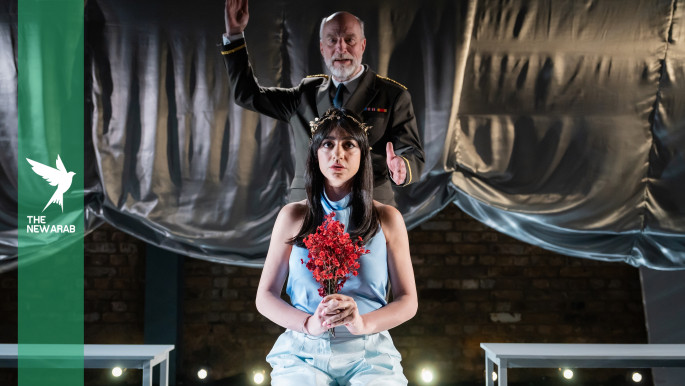
At the play’s start, we are on the sea’s verge, a mottled blue-and-white rug unfurled atop a reflective pool. High-sheen silver-blue curtains serve as a backdrop; between them, a faceless portrait of a military man in a modern, formal uniform jacket and cap.
When we meet Greek commander Agamemnon (played by Simon Kunz, wearing similar military attire for most of the play), he is agonising over a decision he feels he has no real choice in: he must sacrifice his firstborn daughter, Iphigenia (Mithra Malek), to appease goddess Artemis and be granted the wind his army needs to set sail for Troy and save Greece.
Turkish director Serdar Bilis’ adaptation of Iphigenia weaves video testimonies from women of different cultures around the world (to replace the traditional chorus) and real-life anecdotes from the actors themselves into the play.
A more traditional adaptation might leave us feeling that Agamemnon’s decision and Iphigenia’s fate are predestined and sealed, but the women’s video testimonies addressing parenthood, sacrifice, and war, as well as the impassioned pleas of Iphigenia and her mother Clytemnestra (Indra Ové) to reconsider, are interjections that call his motivations and his supposed lack of agency into question; “There are decent men who will disobey,” Clytemnestra says as she tries to persuade him to change his mind.
Later, as her rage and sense of powerlessness grow, she throws accusations at him like “the only god you believe in is power and money,” jabs we, the audience, could surely throw at today’s warmongers.
Serdar uses real-life anecdotes from the actors themselves to bring us back to the present day, or at least to a much more recent past.
All the anecdotes are somewhat tied to the theme of sacrifice; Mithra breaks character to tell us about her mother’s recurring acts of patience and presence that helped ease her separation anxiety.
“It was important to the director that we share real stories,” Mithra tells The New Arab.
“It just adds a different layer to the story we’re telling, and a different layer of meaning to the play as a whole.”
This and the video testimonies are directional risks that could pull the audience out of enthralment for the sake of added modern relevancy, but Mithra tells The New Arab that they serve a good purpose.
“Iphigenia is someone who probably feels like she should escape but can’t,” she says.
“I connected to that feeling of claustrophobia and being trapped, and that allowed me to move more seamlessly from the character Iphigenia to myself telling that story and connecting to those emotions I felt as a teenager at school.”
Iphigenia reimagined
With a cast of only three, we see Agamemnon not at war with the Trojans, accompanied by his fleet, but against himself and his family.
A long, heated argument after Clytemnestra learns of Agamemnon’s decision, him batting away her impassioned accusations, culminates in an act of physical violence by the patriarch, the violence of battlefield war bleeding into the domestic.
The video testimonies from women in the UK, Turkey, Ukraine, and Lebanon are projected onto the curtains, mimicking the sun on the horizon over water.
These women become increasingly open and heartfelt in what they share with us as Iphigenia nears her tragic fate.
Some mourn late fathers and offer a bitter retrospective for their perceived failures as daughters; others tell of not just the physical but the psychological violence of living under bombardment; another says her parents would be proud of her if she sacrificed herself for her country.
For Mithra, the switch to these testimonies offers “a chance to connect with the people giving testimonies and connect to the themes of the play — family, love, loss, grief… It’s something that helps me transition into different modes of emotion that I need to be in.”
Iphigenia is graceful and dignified throughout, even in the face of her death at the hands of her father.
At the end, doubt is cast on her ultimate fate; decision-maker Agamemnon offers his grieving wife a soothing and surprising account of what happened at their daughter’s execution, one she immediately dismisses as a lie.
His is an account Clytemnestra, and the audience cannot rely on or verify as true, and it is a feeling reminiscent of how many of us feel when encountering war victims’ stories now, Mithra says.
“I think recently the barrier between victims and us and their voices seems to be getting wider,” she says of this parallel between the play’s ending and reality.
“With social media, it is in some ways more direct, but when it comes specifically to journalism and reporting, that gap has felt wider recently. People understand that we can’t rely on traditional news outlets to be able to hear the truth anymore,” Mithra adds.
“It also brings into question the role of theatre and how it deals with what people are going through right now, and to what extent the theatre can really connect to that and inform us.”
And with productions at British theatres also subject to censorship and smear campaigns when it comes to war victims’ voices, Greek mythology can be an effective vehicle (say, a Trojan horse) for messaging on some of the most burning issues of our time.
“Going so far into the past can give us perspective,” Mithra says. “We can ask questions about how much has really changed.”
Iphigenia runs at the Arcola Theatre in London until 2 May.
Shahla Omar is a freelance journalist based in London
Follow her on Instagram: @shahlatan