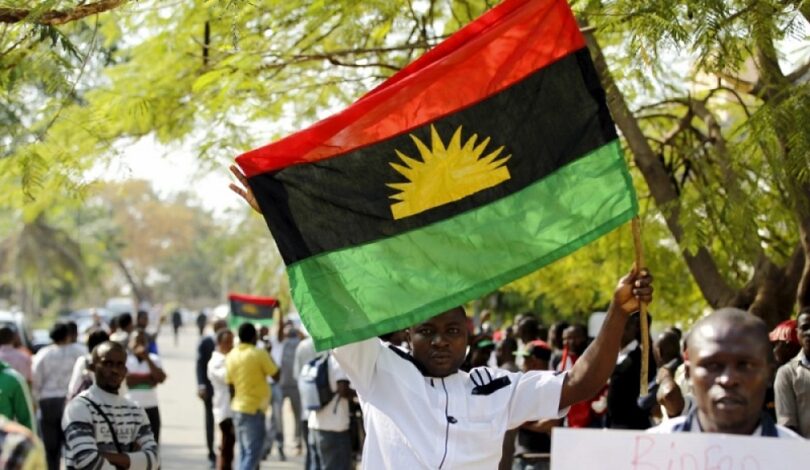
The Indigenous People of Biafra (IPOB) has challenged the Nigerian government and the international community to produce evidence of terrorist activities allegedly committed by the group between August and September 2017.
IPOB made the demand in a statement by its Media and Publicity Secretary, Comrade Emma Powerful, on Tuesday.
The group questioned the events between August 30, 2017, when the South-East Governors Forum met with IPOB leader Mazi Nnamdi Kanu in Enugu, and September 15, when the governors announced the proscription of IPOB activities.
According to IPOB, the August 30 meeting was described by the then Ebonyi State Governor, Dave Umahi, as a peace meeting.
Powerful said Kanu demanded development, economic renewal, justice and respect for the rule of law, including the reopening and revitalisation of the Igweocha (Port Harcourt), Calabar and Warri seaports.
“He demanded the reopening and revitalisation of the Igweocha (Port Harcourt), Calabar and Warri seaports; dredging of the River Niger; direct international flights from Europe and the United States into Enugu, Igweocha and Calabar,” Powerful said.
He added that Kanu also demanded completion of the Second Niger Bridge, upgrading of Owerri Airport into a functional cargo airport, functional railways, reliable electricity, primary healthcare and the revival of abandoned heavy industries.
“These were demands for productive infrastructure, industrialisation, employment, economic opportunity, justice and lawful governance,” he said.
Powerful said Kanu also demanded respect for court orders, the release of detainees including Sambo Dasuki and Ibrahim El-Zakzaky, as well as investigations into killings of IPOB members and supporters.
He, however, said the situation changed on September 14, 2017, when the Nigerian military invaded Kanu’s home at Afaraukwu, Umuahia.
“The military went there to kill him. It failed. Onyendu survived,” Powerful alleged.
According to him, Umahi announced the proscription of IPOB activities the following day.
Powerful questioned the basis and timing of the proscription, noting that the governors’ resolution also appealed to then President Muhammadu Buhari to withdraw the military from the South-East, called for investigations into killings and other alleged unlawful conduct, and urged residents to remain law-abiding.
He asked, “Where was the terrorism between the peace meeting of 30 August and the proscription of IPOB on 15 September? What terrorist activity by IPOB happened in-between?”
Powerful also questioned how demands for infrastructure and economic development became associated with terrorism.
“Igbo politicians must answer how demanding for seaports, airports, railways, electricity, industrialisation, youth employment and healthcare transformed to terrorism,” he said.
He further asked, “Where was the terrorism in demanding justice, obedience to court orders and investigations into killings?”
Powerful also questioned the justification for the military operation at Kanu’s residence, asking, “Where was the terrorism that justified invading Onyendu’s home?”
He said the group wanted authorities to explain the evidence that transformed what it described as a political movement into a terrorist organisation.
“And where was the evidence that transformed a political movement making these demands into a terrorist organisation?” he asked.
Powerful also referred to the September 15, 2017 categorisation of IPOB as a terrorist organisation by the Nigerian military.
He alleged that the South-East governors and Nigerian Army worked together to bring what he described as “death and military terrorism” to the region.
The statement further cited comments attributed to former Senate President Bukola Saraki on September 18, 2017.
According to Powerful, Saraki declared that the military’s categorisation of IPOB and the South-East Governors’ proscription were unconstitutional and did not follow due process.
“Saraki was not speaking from a position outside the Nigerian constitutional system. He was the President of the Senate,” Powerful said.
Powerful urged the government and international community to examine the chronology of events, including the August 30 peace meeting, Kanu’s demands, the military invasion, the September 15 proscription, Saraki’s objection and subsequent court proceedings.
“IPOB does not ask the world to accept a slogan. We ask the world to examine the record,” he said.