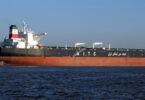

Liquefied natural gas (LNG) carriers have transited the Strait of Hormuz five times over the past two weeks, maritime tracking firm Kpler said Thursday.
That was up from just one between March 1 and April 21, after the Middle East war largely halted traffic through the strategic waterway.
Normally in peacetime, 20 percent of global seaborne LNG passes through the Strait of Hormuz.
“LNG operators have remained highly cautious about transiting the strait given the high value of the vessels and the relatively limited size of the global LNG fleet,” Laura Page, Kpler analyst told AFP.
The five crossings recorded since April 22 have involved four LNG tankers linked to the United Arab Emirates (UAE).
All kept their transponders off as they navigated the strait.
Two of them — the Mubaraz on April 23 and the Mraweh on April 27 — were carrying cargo.
The Mubaraz switched its signal off on March 28 after loading an LNG cargo on March 2 at Das Island in the UAE.
The ship switched its signal back on when it was off southern India on April 27, tracking data from Global Fishing Watch and Bloomberg shows.
The Mraweh switched off its transponder on April 19 east of the strait near Khor Fakkan in the UAE, switching it back on Wednesday near the Strait of Malacca while sailing towards Japan.
The vessel’s shipping history since 2020 shows it exclusively transports LNG cargoes from Das Island, generally to China, India or Japan, according to Kpler.
This time, Kpler believes it entered the Gulf through Hormuz on April 22, loaded its cargo on April 24 and exited the Gulf on April 27 — all without transmitting its position.
According to Kpler, two other empty LNG carriers — the Al Hamra on April 25 and the Marigold on May 4 — entered the Gulf through the strait with their signals off.
Both vessels have not turned their transponders back on and are still in the Gulf, according Kpler.