
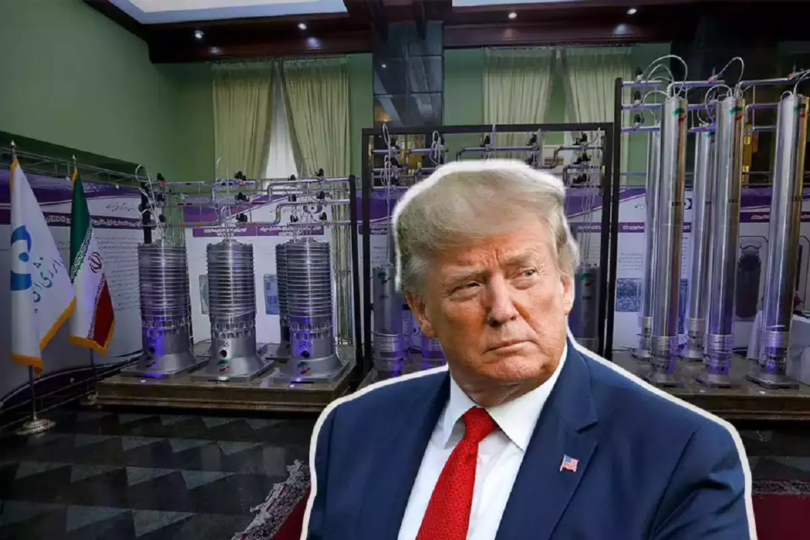
As talks due to open in Islamabad, three American and regional diplomatic sources tell Israel Hayom that Iran has agreed to hand over all the enriched uranium in its possession, though it is still unclear who will receive the material. The options are Russia, which has already expressed willingness to do so; the International Atomic Energy Agency, which would have to locate a site to store and process the material; or the United States itself.
The Americans are demanding to take part in the operation to locate the enriched uranium, but Iran has not yet agreed to that and is prepared only to allow International Atomic Energy Agency personnel to do so. This progress in contacts over recent weeks between the Americans and Iran is the source of the optimism shown by President Donald Trump, but several fundamental disputes still remain.
One is the missile project, which the Islamic Revolutionary Guard Corps refuses to discuss limiting. The second concerns assistance to regional terrorist organizations. Here, too, there has been progress, but Iran is demanding that it be allowed to provide nonmilitary aid to those organizations, such as rebuilding the homes of Hezbollah terrorist operatives in Lebanon.
The demand: Unfreeze assets
Another dispute concerns Iran’s frozen funds. The Americans are prepared to unfreeze about $20 billion in the first stage, on condition that the money be used for civilian purposes after agreements are reached. Iranian officials say the amount is insufficient for the most urgent civilian needs and are refusing oversight of how the money is spent.
On the issue of the Strait of Hormuz, Iran appears set to back away from its demand to collect transit fees there, but because of opposition from senior Revolutionary Guards officials, it is conditioning the reopening of the strait on a parallel lifting of the American blockade.

If the talks in Pakistan continue Iran’s trend toward flexibility, the US will announce an extension of the ceasefire to allow the completion of the negotiations. At the same time, the Americans, as reported in Israel Hayom, are demanding a commitment from all parts of the regime to the agreements, since in earlier stages, leaders of the Revolutionary Guards overturned understandings reached by the political echelon conducting the negotiations.
In Washington, officials attribute Iran’s greater flexibility to economic pressure and the dangerous depletion of the regime’s cash reserves. The economic picture, which looked very bad even before the war, has worsened further with the spread of poverty across the country. No small share of the blame lies with the regime itself, whose shutdown of the internet since the start of the unrest has led to the collapse of the digital economy.
According to official estimates published by the Iranian authorities, more than 10 million people in Iran earn their living directly through the internet, and all of them have been left with almost no income since the beginning of the year and the blocking of internet access. In January, the regime paid unemployment benefits, which officially stood at about 15% before the war and in practice were far higher. But even before the war, those payments stopped, and all salaries for public sector employees were cut.
Even among those who had continued to receive salaries until now, namely Revolutionary Guards personnel who effectively run a parallel economy, wages have been cut, causing internal unrest. Severe damage to critical economic infrastructure, including major petrochemical industries and steel production in many cities, has disrupted the supply of raw materials, causing ripple effects across many other sectors. The result has been a broad wave of layoffs and a sharp rise in unemployment.
Massive loss of income
The American closure of the Strait of Hormuz has cut off oil exports, Iran’s main source of revenue, amounting to a loss of $100 million to $150 million a day. The official figure for the cumulative damage stands at about $270 billion, three times the government’s annual budget, and it is a figure that conceals no small part of the damage and does not take indirect losses into account.

Iran’s economy has now entered a period of stagflation, combining high inflation, more than 100% for basic goods, with economic stagnation and rising unemployment. Even if the conflict ends in the near term, economists warn that recovery will be prolonged and uneven. The meaning is that social unrest in the country is expected to intensify and spread to many sectors, including regime supporters, and the internal ferment could lead to a renewal of protests.