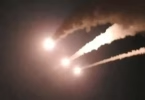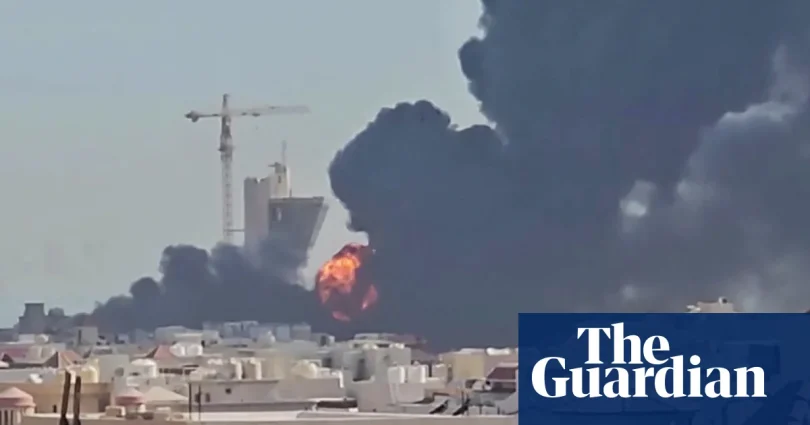
Iran launched a wave of attacks against US allies in the Middle East, as the renewal of US strikes on Iran entered a second week and fighting escalated over the strait of Hormuz.
Kuwait has accused Iran of targeting civilian sites and vital infrastructure in the country, such as a power and water desalination plant. Kuwait, which is extremely arid, relies on desalinated water for about 90% of its drinking water.
The country was forced to briefly close its airspace as it intercepted Iranian missiles and drones, and said several Kuwaiti firefighters and a worker were injured while battling blazes sparked by Iranian strikes.
Bahrain also activated its air sirens on Saturday, warning residents to shelter after it detected possible incoming drones or missiles, while Jordan’s state-run Petra news agency said that the kingdom’s air defence systems had downed Iranian missiles.
The Iranian attacks on US allies in the region came in response to US attacks on civilian infrastructure including bridges and power facilities.
The secretary-general of the Gulf Cooperation Council condemned the attacks, saying strikes on civilian infrastructure amounted to “war crimes”.
“Iran’s actions constitute a highly dangerous escalation, a grave violation of international law and the United Nations (UN) Charter, as well as war crimes requiring international accountability and prosecution, given the deliberate targeting of infrastructure and civilian facilities,” Jasem Mohamed al-Budaiwi said in a statement.
Reports also indicate Iranians targeted an oil facility in Kuwait, resulting in a number of injuries and “significant material losses”, the Kuwait Petroleum Corporation told reporters.
“The repeated targeting of these vital facilities reveals a systematic hostile approach targeting civilian sites and vital infrastructure that endangers the lives and safety of civilians,” the foreign ministry of Kuwait said.
Late on Friday, Iran’s Revolutionary Guard Corps (IRGC) said two oil tankers directed by “deceptive American intelligence agencies” had exploded after hitting mines in the strait of Hormuz. The US military said that claim was false.
The IRGC also said on state television they had “stopped” four ships trying to transit the critical waterway, and had destroyed at least two US fighter aircraft and three other aircraft during a missile and drone attack early on Saturday on a US base in Azraq, Jordan.
A US military support centre at Camp Arifjan in Kuwait was hit and a US radar facility at Ali Al Salem airbase in the country was destroyed, the IRGC said.
The IRGC also targeted a site in Bahrain where US combat aircraft were gathered at Sheikh Isa airbase and an intelligence datacentre, Iranian state media reported.
after newsletter promotion
US Central Command said that its strikes, which began at 7pm last night for the seventh consecutive night, were designed to “continue degrading Iranian military capabilities”.
The US managed to hit Iranian “surveillance sites, military logistics infrastructure, underground weapons storage, and maritime capabilities” overnight, US military said on Saturday morning.
Iranian media reported explosions heard or strikes carried out in the cities of Sirik, Ahvaz and Yazd.
US strikes have killed 50 people and wounded more than 500 since hostilities resumed, according to Iran’s health ministry. The country acknowledged there had been successful US “attacks on power infrastructure” for the first time on Friday when the Iranian energy ministry issued a call for people to use less power in southern provinces “experiencing extreme heat”. The ministry did not specify what was hit.
Maj Gen Mohsen Rezaee, a senior military adviser to Iran’s supreme leader, said Tehran will resume “full-scale offensive operations” if US strikes against it continue for another two or three days.
“Iran will no longer limit itself to retaliatory, like-for-like responses … and no political border will be safe,” Rezaei said, according to the Iranian news agency IRIB.