Iran is smuggling at least 6 million liters of fuel each day to neighboring Pakistan, traders and transporters in the South Asian country told RFE/RL, in violation of US sanctions on the Islamic republic.
Fuel trafficking is a lifeline for cash-strapped Iran, which is under a US naval blockade that has disrupted its lucrative oil exports. Weeks of US-Israeli bombing has also left the Middle Eastern countrys key infrastructure and industries in tatters.
Iran has smuggled gasoline and diesel to Pakistan since around 2013, when the United States significantly tightened economic sanctions against Tehran. But there are signs that the volume of fuel that Iran is trafficking has increased since the war began on February 28.
In response to the US-Israeli bombing campaign, Iran closed the Strait of Hormuz, a key artery for global oil supplies, triggering a surge in world fuel prices and upending the global economy.
Pakistan, a US ally, could come under pressure to clamp down on the smuggling of Iranian oil, experts say. Islamabad has acted as a mediator in negotiations between Washington and Tehran to end the war.
Smuggling Routes
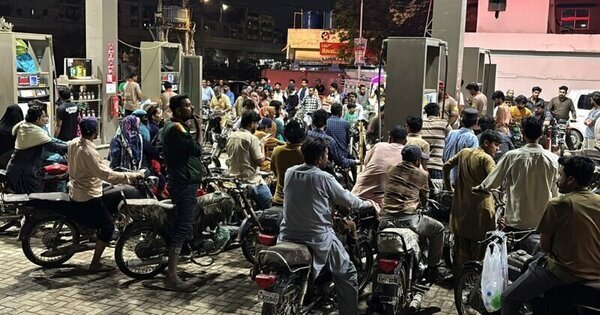
Iranian fuel is transported to the nearly a dozen crossings along the porous 900-kilometer-long border with Pakistan. The gasoline and diesel are then loaded on to hundreds of pickup trucks and even motorcycles in cannisters before they are transported across Pakistans vast and impoverished province of Balochistan and beyond.
Akbar Notezai, a journalist in Balochistan, said each cannister can carry around 60 liters of fuel. A pickup truck can transport up to 30 cannisters, or 1,800 liters, he said. Motorcycles can each carry several fuel cannisters.
Iranian fuel is also smuggled by sea in boats to Pakistans Gwadar port, according to experts. It is unclear how the US naval blockade of Iran has affected the maritime trafficking.
A Pakistani Army personnel looks on during the opening of a trade project in Gwadar port, some 700 kilometers west of Karachi in 2016.
In May 2024, aleaked reportwritten by two Pakistani intelligence agencies suggested that Iran smuggled over $1 billion worth of petrol and diesel into Pakistan annually.
The report said up to 6 million liters of smuggled Iranian fuel was entering Pakistan daily, accounting for around 14 percent of the countrys annual consumption.
About 2,000 vehicles and 1,300 boats were involved in the daily smuggling of fuel, the report said, adding that Iran was paid through hawala, an informal system of lenders. Using individual brokers rather than banks, the system is difficult to trace and has been used by armed groups.
Pakistans military spokesman, Ahmed Sharif Chaudhry, told a news conference in August 2024 that consistent efforts were being made to enhance security along the country’s border with Iran to restrict oil smuggling.
If you look at the numbers, [the fuel smuggling] has come down from 15-16 million liters per day to 5-6 million liters per day, Chaudhry said.
A Pakistani oil trader, who spoke to RFE/RL on condition of anonymity, said currently around 300 vehicles are loaded with fuel at each of the crossings along the Iran-Pakistan border every day. That is down from around 600 vehicles before a clamp down by Pakistani authorities in 2024, he said.
Shahzada Zulfiqar, an analyst based in Quetta, the provincial capital of Balochistan Province, said there are indications that the smuggling is again increasing.
Previously, he said the smuggling network was active for five days a week. After the Iran-US war, the dealers continue the business seven days a week.”
SEE ALSO:
Iranian Foreign Minister Says US Seeking Continued Talks
Turning A Blind Eye
Traders, transporters, experts in Pakistan say local and provincial officials turn a blind eye to the trafficking of fuel.
The smuggling provides Pakistan with cheap fuel. The South Asian country of some 240-million people has witnessed fuel shortages since the start of the war in the Middle East. Prices have soared from around 250 rupees ($0.90) to over 400 rupees since early March.
The smuggling is also a key source of income for the Baluch, an ethnic group that straddles the Iran-Pakistan border. Pakistans volatile Balochistan Province has been the scene of a low-level insurgency for years.
Syed Ali Shah, a journalist in Quetta, told RFE/RL that the government has been unable to generate sufficient employment opportunities in Balochistan, the countrys most underdeveloped province.
As a result, the authorities have tolerated oil smuggling as a means of sustaining livelihoods in the border regions, he said.
Iran, too, benefits from fuel smuggling. Tehran has for years used trafficking and shadow fleets to circumvent crippling US sanctions and export its oil, the lifeline of its economy.
The smuggling networks are overseen by Irans Islamic Revolutionary Guards Corps, a key political and economic player in the country, according to experts.
Experts say Islamabad could come under US pressure to crack down on fuel smuggling from Iran.
Washington has intensified the economic pressure on Iran by imposing a naval blockade since April 13, as part of an attempt to force Tehran to agree to a peace deal on its terms.
There could be objections [from the United States], said Mehtab Haider Syed, an Islamabad-based analyst. But the counterargument is that this is a long porous border where security has been a serious matter.
Iran Is Smuggling Millions Of Liters Of Fuel To Pakistan Every Day
Share
Share
Copy link
Facebook
X (Twitter)
LinkedIn
Email
Share
Share
Copy link
Facebook
X (Twitter)
LinkedIn
Email