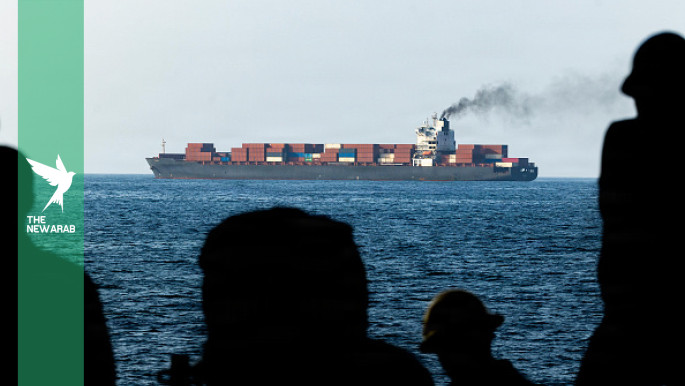
Iran’s Revolutionary Guards said on Wednesday their naval forces had seized two container ships seeking to cross the blockaded Strait of Hormuz, after US President Donald Trump announced he was extending a ceasefire but maintaining the US blockade on Iranian shipping.
UK-based maritime security monitors confirmed that three commercial vessels had reported incidents involving gunboats in the strait, the international gateway for the Gulf oil and gas industry, which US and Iranian forces are battling to control.
“The Islamic Revolutionary Guard Corps naval force this morning identified and stopped in the Strait of Hormuz two violating ships,” the Guards said in a statement. “The two offending ships… were seized by the IRGC’s naval forces and directed to the Iranian coast.”
They identified one ship as the Panama-flagged container ship MSC Francesca and the Liberia-flagged Epaminodas. The tracking site Marine Traffic showed the last known positions of both vessels closer to the Iranian coast of the strait, northeast of Oman.
Earlier, the British maritime security monitor UKMTO said one container ship reported it was fired upon by an Iranian Revolutionary Guards (IRGC) boat 15 nautical miles northeast of Oman, causing damage to the bridge but no casualties.
Separately, a third ship was fired upon and stopped in the water eight nautical miles west of the Iranian coast, UKMTO said, without identifying the attackers.
British Security firm Vanguard Tech identified it as the Panama-flagged containership Euphoria, which it said was “transiting outbound of the Strait of Hormuz”.
The US Navy is attempting to block vessels heading to and from Iranian ports, while Tehran has said vessels must seek permission to leave or enter the Gulf through Hormuz, a route that in peacetime accounts for a fifth of the world’s oil and gas exports along with other vital commodities.
The morning attacks by Iran’s Revolutionary Guard Corps (IRGC) came after President Donald Trump said the US would indefinitely extend the ceasefire with Iran, which had been due to expire on Wednesday, to give Tehran time to come up with a “unified proposal” ahead of possible negotiations.
Iran has offered no formal acknowledgement of Trump’s ceasefire extension.
Pakistan’s Prime Minister Shehbaz Sharif thanked Trump for agreeing to the extension, saying it would buy time for ongoing diplomatic efforts.
UK hosts talks on Hormuz re-opening
London will host military planners from over 30 countries for two days of talks starting Wednesday on the idea of establishing a multinational mission led by the UK and France to protect navigation in the Strait of Hormuz, the defence ministry said.
The ministry said the meeting would “advance detailed planning” on reopening the Strait when conditions allow, following “progress” at talks in Paris last week.
“The task today and tomorrow is to translate diplomatic consensus into a joint plan to safeguard freedom of navigation in the Strait and support a lasting ceasefire,” Defence Minister John Healey said in a statement.
He said he was confident “real progress can be made”.
The conference comes after UK Prime Minister Keir Starmer and French President Emmanuel Macron co-chaired international talks on the strategic strait in Paris on Friday that brought together over 40 countries.
The UK and France said the force would be entirely defensive and only deployed once a lasting peace in the region was agreed, although the US and Iran, as warring parties, did not attend the talks.
President Trump said on Tuesday that Iran was “collapsing financially” over the closure of the Strait of Hormuz.
“Iran is collapsing financially! They want the Strait of Hormuz opened immediately,” he wrote on Truth Social, adding that the Islamic Republic was “starving for cash”.
Trump posted earlier that Tehran said it supported the closure of the strait to “save face” under the US blockade of Iranian ports.
Clionadh Raleigh, CEO of conflict monitor ACLED, believes the US blockade has emerged from Washington’s assessment that it can’t immediately address the crisis in the Strait of Hormuz, while also putting Iran on a “back foot”.
“The US is really responding to the fact that they don’t believe they can take the Strait. They don’t believe they can sort out this mess that has, that has emerged in the Strait, but the blockade is doing that in a way, and is also really pushing Iran,” Raleigh told The New Arab.
“It has placed Iran on the back foot, which is, I think, exactly what the US needed to do in order for Iran to start making concessions,” she added, highlighting that Iran’s refusal to attend the Pakistan talks on Tuesday indicated its acknowledgement of its weakened negotiating position under the US blockade.