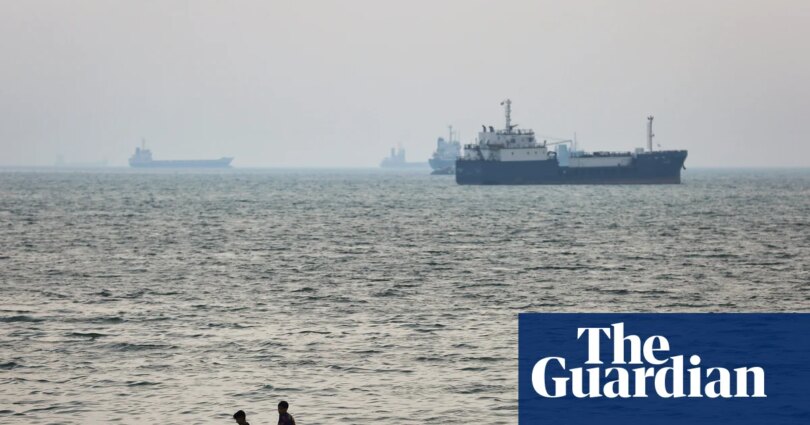
Iranian forces have seized two ships in the strait of Hormuz, as the US and Iran doubled down on imposing separate blockades of the critical shipping waterway that have choked global energy markets.
The standoff over the narrow waterway – through which about 20% of the world’s oil and liquefied natural gas passed through during peacetime – raised doubts about whether stalled peace negotiations would resume.
Iran’s Revolutionary Guards forces said on Wednesday that their naval forces halted two ships attempting to cross the strait and brought them to shore.
“The Islamic Revolutionary Guard Corps naval force this morning identified and stopped in the strait of Hormuz two violating ships,” the Guards said in a statement. “The two offending ships … were seized by the IRGC’s naval forces and directed to the Iranian coast.”
A UK-based maritime security monitor reported attacks on ships in the waterway on Wednesday, including an incident in which a vessel was approached by an Iranian gunboat “that then fired upon the vessel which has caused heavy damage to the bridge”.
The seizures mark the first time Iran has taken control of ships since the beginning of the war, which started on 28 February, and comes after the US fired on and seized an Iranian cargo vessel and boarded a Iranian oil tanker in the Indian Ocean.
In the latest in a series of about-turns, Donald Trump threatened violence on Tuesday just hours before announcing he was unilaterally extending a ceasefire. “I expect to be bombing because I think that’s a better attitude to go in with,” Trump said in an interview with CNBC’s Squawk Box on Tuesday. “We’re ready to go. The military is raring to go.” Later on Tuesday, he said he would not attack but continue the blockade.
The US president has been unable to contain the global economic and diplomatic crisis that erupted out of a US-Israeli war, which did not overthrow the anti-US regime or end Iran’s nuclear ambitions. Instead, it led to Tehran’s effective forced closure of the strait of Hormuz, which has caused a spiralling global economic crisis.
Facing calls to reopen the waterway, Trump put pressure on Iran to end its blockade, but failed and later decided to impose his own blockade, leading to more fuel price hikes, and threats of long-term inflation.
Countries in Asia – which are dependent on Gulf oil – have been badly hit, with shortages of fuel, fertiliser and other raw materials that pass through the strait. While the west is seen as better insulated, it is not immune.
Germany, Europe’s largest economy, halved its 2026 growth forecast to 0.5% on Wednesday, while Greece announced €500m (£434m) in extra aid to households and farmers. “The nation’s economy is holding up and doing better than expected,” said Prime Minister Kyriakos Mitsotakis. “However, the stress of the supermarket, the expenses of children, more expensive fuel and the care of the elderly remain.”
Meanwhile, the head of the UN maritime agency has appealed for help for thousands of seafarers stranded in the Gulf by the effective closure of the strait of Hormuz. About 20,000 seafarers and 2,000 ships have been stranded, according to the International Maritime Organization (IMO).
Over the weekend, Iran said it had received new proposals from Washington, but also suggested a wide gap remains between the sides. Pakistan has acted as mediator, but a luxury hotel in Islamabad that was cleared out for more talks remained empty on Wednesday. Iran has never publicly accepted the invitation and the US delegation led by vice-president JD Vance never left Washington.
“We had prepared everything. We were all prepared for the talks, the stage was set,” a Pakistani official briefed on the preparations told Reuters. “If you ask me honestly, it was a setback we were not expecting, because the Iranians never refused, they were up to come and join and they still are.”
In his first term as president, Trump withdrew from an agreement that limited Iran’s nuclear enrichment programme. He disliked the pact, which was signed by Barack Obama, and was discouraged from diplomacy by Israel, Iran’s arch-enemy. For years, Israel pushed the US to bomb Iran but no administration in Washington agreed, seeing it as counterproductive and fearing the chaos that is now playing out.
Adding to the bloodshed and instability, Israel and the Iranian proxy group, Hezbollah, have fought a second front in Lebanon, where a tenuous 10-day ceasefire that expires on Sunday was just about holding.
Israeli strikes killed three people in Lebanon on Wednesday, Lebanese state media said. Hezbollah said it carried out an attack on northern Israel in response to what it called “flagrant” violations of the ceasefire.
At least 2,454 people have been killed in Lebanon in Israeli attacks since the start of the war, according to Lebanese authorities.
Lebanese president Joseph Aoun said preparations are under way for negotiations between Lebanon and Israel on Thursday.
The talks are significant as the countries have not maintained diplomatic relations with each other. For decades, Israel has repeatedly bombed, invaded and occupied Lebanon, while the Lebanese government has failed to contain Hezbollah, which has fired rockets at Israel.
Reuters, the Associated Press and Agence France-Presse contributed to this report