ISTANBUL – On state television, there is bluster and boasting, the Iranian regime brimming with confidence, and girding for a fight with the US. “The criminal America has threatened Iran’s nuclear and sensitive centres with an attack,” the Revolutionary Guard’s headquarters declared in a statement on July 21.
“If that country’s invading and terrorist army enters such a stage, we will consider it an expansion of the war in the region, and all US interests, as well as those of its rebellious, wicked accomplices and supporters, will be targeted.”
But on the ground among ordinary Iranians, especially in the country’s south, where many of the US air strikes have been focused, there is a far greater sense of fragility. In social media posts and in discreet conversations over messaging apps, Iranians voiced fear not only of US attacks, but also the destruction of infrastructure in a region that has long been neglected and marginalised.
“When you watch Channel 6 news of Iran, they announce attacks on US bases in Jordan, in Kuwait, in Bahrain, and whatnot, and basically portraying it as revenge for the attacks that are taking place in Iran,” said Mehran Haghirian, a Paris-based analyst at the Bourse & Bazaar Foundation, a think-tank focused on Iran’s economy. “But when we look at the attacks that are taking place in Iran, it’s the infrastructure, unfortunately, the civilian infrastructure that is really disconnecting towns that are all over the south of Iran.”
Iran’s south stretches from the marshy oil-rich south-west toward the mountainous, arid cliffs along the Persian Gulf, passing through major cities such as Bushehr, Bandar Abbas and Chabahar, Iran’s most important Gulf of Oman port, near the Pakistani border.
It includes key islands such as Qeshm, which abuts the Strait of Hormuz, the freewheeling Kish resort and free trade zone, as well as several uninhabited islands that are also claimed by the United Arab Emirates.
The population is an ethnic mix of the Persian majority, as well as ethnic Arabs, Baluch, and Afro-Persians, who are descendants of sub-Saharan African slaves. They live off an economy highly dependent on the commercial ports, as well as trade with the other Persian Gulf littoral states.
Residents contacted through messaging apps in the southern cities of Bushehr and Bandar Abbas were fearful about speaking with a foreign journalist. One, an employee at a hotel that has had few customers for months, said many lived in fear of both the government and the US attacks, and were suffering infrastructure failures and increasing shortages.
“In the intense heat of the south, the people wait for hours every day in lines at fuel stations just to receive 20 litres of gasoline,” he said. “The long queues have become a repetitive scene in this city.”
Explosions going off in Iran’s major port city of Bandar Abbas, on July 8.
PHOTO: AFP
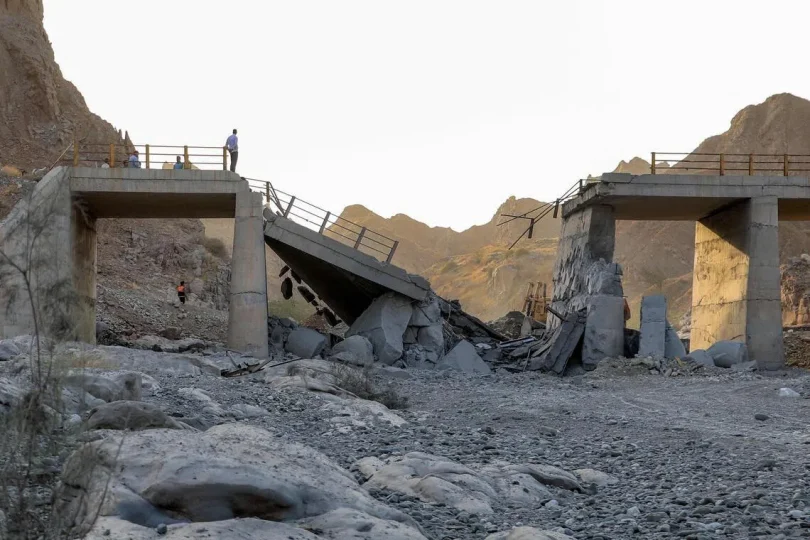
Over more than a dozen or so days of warfare in July, the Americans have struck bridges, roadways, water desalination facilities, and power plants as well as military radar, missile launch sites, and military barracks, according to Iranian and US reports.
But in contrast to the open-ended first phase of the war, the current round of escalation by the US is focused on reopening the Strait of Hormuz by degrading Iran’s military capabilities in the country’s south, especially near the narrow choke point leading in and out of the Persian Gulf.
On July 23, Iranian news outlets reported US attacks on Ahvaz, in the country’s south-west, as well as Bandar Abbas and the coast of Qeshm Island.
In the days before, Iran’s communications minister said the US strikes had temporarily cut off some of the country’s southern islands from the mainland. Residents on Qeshm Island reported being cut off from natural gas lines and struggling to obtain water. Electric power is frequently cut off.
State media also said dozens of civilians had been killed.
In a social media post, Iranian journalist Negin Bagheri described a July 12 attempt by three Hormuzgan province telecommunications workers to restore a 30m-high telecommunications tower destroyed by the Americans. As two climbed onto the tower and the third worked controls inside a nearby cabin, two US missiles struck, killing all three, she wrote.
The US focus on the south could expose some of Iran’s weaknesses, including an impoverished, sparsely populated, and ethnically diverse south.
Even if Iran is hitting back at US interests in the Gulf, the destruction of transport infrastructure and desalination plants has had a devastating impact on the south, said Haghirian. “There’s no way to really view Iranian attacks against US bases in other countries as a compensation for what’s going on within Iranian territory.”
In contrast to the north, many Iranians in the south have extended families spread across different towns, sometimes hundreds of kilometres apart, making them especially dependent on transport infrastructure.
“What is different from the south and elsewhere in the country is that actually people move around quite often between towns and that’s because of their culture as well as the lack of some basic necessities or even schooling for people,” said Haghirian, an Iranian who grew up in the country’s south and maintains ties to the southern region through family and friends.
Haghirian said the areas suffering the brunt of the attacks around the Strait of Hormuz tend to have a high concentration of ethnic Arab Iranians with ties to the Gulf states, where wealthy Arabs of Iranian descent live.
He noted that the regime violence that quelled citizen protests in January has stopped locals from voicing their anger about bearing the consequences of the conflict.
Nahid Siamdoust, a professor of Middle East studies at the University of Texas, noted that Iranians of the south had suffered the worst civilian atrocity in the war so far, in the alleged Feb 28 US attack on a primary school in the southern city of Minab which killed 120 schoolchildren and 48 parents and educators.
“They are the ones who have taken the brunt of all these attacks, both in the 40-day war and now especially when the south is being bombed,” she said. “They are the ones who lost their six- and seven-year-olds in that school bombing.”
“The economy is also in shambles,” Haghirian said. “Nothing has been going on for years, but particularly for the past year. So the resentment has been there, obviously, for quite a long time. I think the resentment continues to grow. It’s this shadow of the worst time that we’re in.”
Many analysts have been surprised by Iran’s resilience in the resumption of hostilities, following an earlier phase of warfare that ended in a shaky ceasefire in early April.
Tehran appears to have caught some US officials and analysts off guard with its ability to conduct precision strikes as far away as bases used by the US in Jordan. On July 21, it reportedly targeted a hotel in Bahrain used by US intelligence and military officials after their bases were destroyed by Iranian missile drone strikes.
It also appears to have maintained or even improved its intelligence capabilities, though in a dangerous escalation, Bahrain and Kuwait were reported to have secretly sent jets to attack sites inside Iran earlier in July.
Even as Iran seems to be digging in for the long haul against the US and its Gulf allies, experts warn that it could face unrest at home.
“The concentration of US attacks on Iranian intelligence, surveillance and reconnaissance capabilities along the southern coastline, combined with the naval forces the US still has in the CENTCOM (US Central Command) area of operations, could create serious long-term vulnerabilities,” said Hamidreza Azizi, an Iran expert at the German Institute for International and Security Affairs in Berlin.
“This risk may be compounded by the growing willingness of US allies in the Gulf to cooperate more closely with Washington, driven by the heightened threat perception created by Iranian attacks,” he said. “Over time, these dynamics could generate major challenges for the Iranian government’s ability to maintain effective control over the south.”

Iranian officials appear to have recognised the danger in the geographical concentration of the attacks. Video footage posted online appeared to show Iranian tank-carrying trucks transporting armoured military vehicles toward the south, in possible preparation for any US ground incursion.
State-controlled media has been quick to document not just damage to civilian infrastructure by the US, but rapid efforts by the government to restore services such as bridges and roadways. Earlier this week, it organised a human chain along a coastal roadway to protest against the war and symbolically protect the Strait of Hormuz.
“We condemn in the strongest possible terms the attacks on civilian infrastructure, medical facilities, bridges, and civilian services upon which people’s lives depend,” Iranian foreign ministry spokesman Esmail Baghaei said on Monday. “Today we stand beside the people of Iran’s south, not as a slogan, but as a matter of conviction, because the south is Iran itself.”