Iraqi officials and members of Iran-aligned Iraqi militias have denied allegations that Iran’s Islamic Revolutionary Guard Corps (IRGC) established secret cells in Iraq to carry out drone attacks on neighbouring Arab states hosting US forces, following a Reuters report published on Friday.
Reuters, citing Iraqi military and security officials as well as leaders of armed groups, reported that the IRGC had created three or four covert cells in Iraq, each comprising around 10 fighters.
According to the report, the units carried out at least seven drone attacks from desert areas near Basra and Samawah between 20 April and 17 May, targeting locations in Kuwait, Saudi Arabia and the UAE.
The report further alleged that some members of the cells belonged to the “Islamic Resistance in Iraq”, an umbrella grouping of Iran-aligned factions, but operated outside its normal command structure and reported directly to the IRGC.
In the first official Iraqi response to the allegations, the head of Iraq’s Security Media Cell, Lieutenant General Saad Maan, told The New Arab that Baghdad would not permit Iraqi territory to be used for hostile operations.
“Government directives are firm and clear regarding the prevention of any hostile activities or actions on Iraqi territory by any party whatsoever,” Maan said.
He added that “Iraq’s sovereignty stands above all other considerations, despite the difficult and complex circumstances in the region, whose consequences have intensified in recent times”.
Maan further stressed that “government and security directives are clear in absolutely not allowing Iraqi territory to be used as a launching point for any activity or military presence, by any party”.
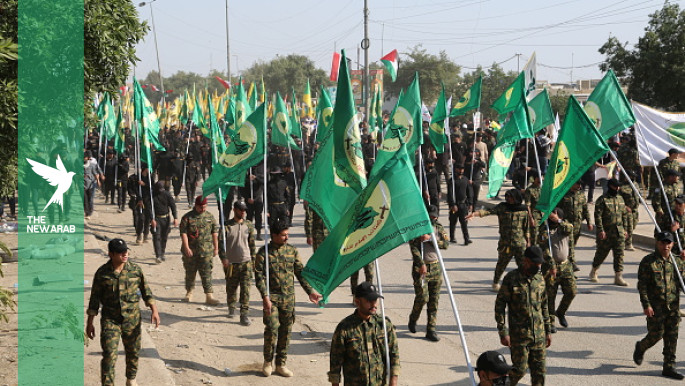
The New Arab also spoke to a senior figure within one of the factions that form part of the “Islamic Resistance in Iraq”, who rejected the suggestion that secret IRGC-linked cells were operating in the country.
The commander, who requested anonymity, noted that Iraqi factions had publicly claimed attacks against US interests in Kuwait, Saudi Arabia, Jordan and Syria as part of the “duty to defend the Islamic Republic”.
“Each faction has a special operations unit. This is well known and distinct from other formations. It is responsible for specialised operations and missions. They cannot be considered special cells, if that is what the agency’s report meant,” he said.
Rejecting Reuters‘ allegations, he added: “The matter does not require hidden or secret IRGC cells. We openly announced the operations. The narrative of secret Iranian cells in Iraq supports the enemy Israeli narrative.”
The commander further said that recent rumours about the presence in Iraq of operatives from Hezbollah, the Houthis and Hamas was helping create a justification for future Israeli action inside Iraq.
“In recent days, particularly after the agreement between Iran and the United States was signed, Israeli officials and Western media have intensified discussion of the presence of representatives of Hezbollah, the Houthis and Hamas in Iraq,” he said.
“These claims have promoted the idea of a security threat in Iraq, threats to Western interests, and the possibility of strikes against the Israeli entity. These allegations are merely the beginning of a phase that may be used by the Israeli enemy to justify attacks on Iraqi areas or the targeting of faction leaders. We are prepared for any emergency.”
Iraqi affairs researcher Abdullah al-Rikabi also questioned the central premise of the Reuters report, arguing that the IRGC already maintains extensive links with Iraqi factions and political actors.
“The Revolutionary Guard has relationships with Iraqi factions and political forces in general, and it has representatives here acting as advisers. It has no need for secret cells to carry out any type of attack, particularly as there is no realistic prospect of government forces obstructing or preventing them,” al-Rikabi told The New Arab.
“The period of war directly affected Iraq. The factions that became involved are the same groups known to be closest to Iran. They publicised and claimed responsibility for operations through official statements, including Kataib Hezbollah, Harakat al-Nujaba, Al-Awfiya and Sayyid al-Shuhada, among others,” he said.