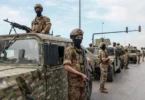
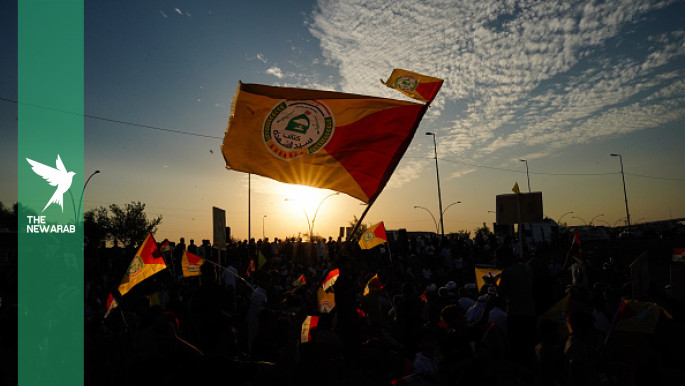
Baghdad is weighing plans for a new ministry to unify armed forces under state control, including the PMF, amid domestic debate and international pressure. [Getty]
Iraq is considering the creation of a federal security ministry that would restrict the activities of the Iran-backed Popular Mobilisation Forces (PMF), in what could become the country’s most significant security restructuring since the 2003 US-led invasion.
Three sources in Baghdad told The New Arab that the proposal is being examined by the government of recently appointed Prime Minister Ali al-Zaidi.
Officials are reportedly exploring plans to bring all armed formations outside Iraq’s regular military structure – primarily the army and police- under a unified framework, including the PMF and affiliated groups.
The proposal remains at a preliminary stage and its outcome is uncertain, amid ongoing US and Western pressure on Baghdad to ensure all weapons come under state control, while also avoiding confrontation with armed factions opposed to disarmament efforts.
According to the sources, the plan goes beyond the establishment of a purely administrative body.
It would create a new security structure with defined powers, potentially incorporating the Kurdish Peshmerga, the PMF, the Rapid Intervention Division and the Federal Police.
According to the sources, the aim would be to address long-standing fragmentation within Iraq’s security apparatus, particularly in the aftermath of the war against Islamic State.
The proposal has reportedly received cautious support from some Shia political parties, while others remain hesitant.
Influential blocs within Iraq’s Coordination Framework are said to be carefully weighing the initiative, with some viewing it as a way to reduce the risk of US sanctions. Armed factions, however, have signalled opposition to any restructuring that could alter their status.
Some political actors also fear the plan could dilute the PMF’s ideological and organisational identity, transforming it from an influential hybrid military-political force into a conventional state-controlled institution.
The proposal is understood to have emerged from a series of compromise options aimed at responding to international pressure on Baghdad to reduce the influence of armed groups within state institutions and consolidate weapons under central authority.
Under Iraq’s 2005 constitution, the Kurdistan Region has authority to organise its own security forces within its territory, although the Kurdish term “Peshmerga” is not explicitly mentioned.
Baghdad does not exercise direct control over these forces, which clashed with the Iraqi army in Kirkuk in 2017.
Separately, Iraq’s parliament passed the Popular Mobilisation Forces Law in 2016, which formally integrated the PMF into the state’s military structure and placed it under the authority of the prime minister as commander-in-chief, rather than the defence ministry.
A senior Iraqi security official told The New Arab that the proposal “has not yet been finalised and remains undisclosed”, implicitly confirming that discussions are ongoing.
Mehdi Taqi Amerli, head of the Badr parliamentary bloc, said discussions were continuing but remained at an early stage.
He said some political forces within the Coordination Framework had “clear reservations” due to the PMF’s sensitive role in Iraq’s political and security landscape.
“Any step related to restructuring security institutions requires broad political understandings and national consensus, especially given the current complexities,” he said.
He added that some groups fear the proposal could be interpreted as an attempt to weaken or dismantle the PMF, while others argue that restructuring is necessary to strengthen state authority and unify security decision-making.
A senior member of the Iran-backed Al-Nujaba Movement rejected the proposal, saying it reflected US pressure.
“We regard any initiative concerning the structure or management of the Popular Mobilisation Forces as stemming from American pressure and therefore representing an Israeli agenda rather than an Iraqi decision,” he said.
Analysts said the proposed Federal Security Ministry could represent Iraq’s most significant security restructuring since 2003, particularly if it is accompanied by a redistribution of authority between the defence and interior ministries and agencies linked to the prime minister’s office.
However, they cautioned that success would depend on Baghdad’s ability to balance state-building priorities, international expectations and the interests of powerful political and armed groups.
Military expert Major General Jawad al-Dahlaki said the plan reflects efforts to reorganise Iraq’s security system under growing domestic and international pressure.
He said Western governments increasingly support limiting weapons to state control and integrating armed groups into formal institutions with clear command structures.
Al-Dahlaki said a federal security ministry could help streamline decision-making and reduce institutional overlap, but warned the issue remains politically sensitive.
“Any move in this direction will neither be easy nor quick,” he said.
“Baghdad is attempting to maintain internal stability and avoid confrontation with armed factions, while also responding to international pressure.”
The proposal comes as Iraq’s Coordination Framework said it would continue efforts to finalise the cabinet of al-Zaidi after the Eid al-Adha holiday beginning on 27 May, following what it described as an “important and urgent” meeting in Baghdad.