
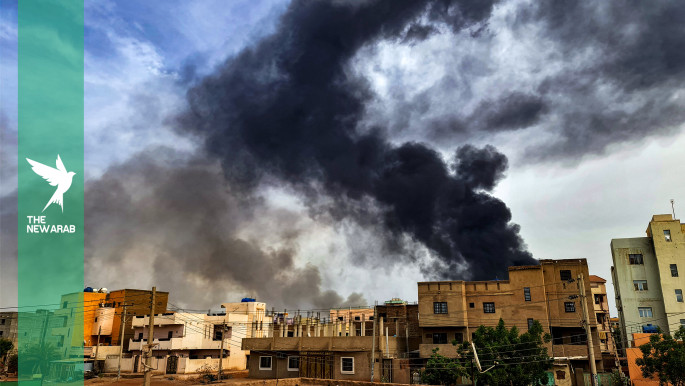
On 4 May, a barrage of drones struck Sudan’s international airport and several military installations in the capital of Khartoum. Sudan’s official army, known as the Sudan Armed Forces (SAF), blamed Ethiopia and the United Arab Emirates (UAE) for the attacks.
However, both countries denied responsibility for the attack despite reportedly backing the Rapid Support Forces (RSF), a paramilitary-turned-rebel group at war with SAF since April 2023.
While no independent body has been able to verify the accusations, the SAF recalled its ambassador to Ethiopia, while Addis Ababa accused the SAF of backing “hostile” forces in its own country.
“Sudan and Ethiopia have this classic cross-border proxy war where both are facing internal conflict and see the other as supporting their own internal armed opposition,” Alan Boswell, an expert on the Horn of Africa with International Crisis Group (ICG), told The New Arab.
“As a result, both sides feel encircled and under pressure,” he added.
As tensions simmer between the two sides, Ethiopia faces the prospect of a renewed war in its northern Tigray region. The day before drone strikes hit Khartoum, a faction from the Tigray People’s Liberation Forces (TPLF) reasserted control over Tigray province, kicking out a pro-government rival.
The manoeuvre risks torpedoing a peace agreement that ended the two-year conflict, which dragged on from November 2020 to 2022. Analysts warn that a new conflict in Tigray could embroil Sudanese communities and SAF-aligned fighters.
In response, Ethiopia could deepen its support for the RSF in Sudan.
“The dispute between the federal government and a faction of the TPLF is one of those fissures in the region that is most combustible,” said Michael Woldemariam, an expert on the Horn of Africa and an associate professor at the University of Maryland.
“There is a risk of escalation and hostilities and then a direct spill over (into Sudan),” he told The New Arab.
Cross-border alliances
Throughout Sudan’s civil war, SAF has deepened ties with Ethiopia’s two biggest foes: fighters from the TPLF and Eritrea. TPLF fighters took refuge in eastern Sudan during the first Tigray war. Some are now fighting with SAF and threatening others with deportation back to Ethiopia unless they enlist.
Some of these fighters, said Woldemariam, could cross into northern Ethiopia from eastern Sudan to aid their kin against the federal government.
“One dimension of a spillover is that there are TPLF units fighting in Sudan, and their presence is facilitated by SAF. One could imagine these fighters being activated in the context of a new war in northern Ethiopia,” he told The New Arab.
Other catastrophic scenarios involve Eritrea: a small nation that fought a 30-year war for independence against Ethiopia.
In 2020, Eritrea allied with Ethiopia’s federal government to attack the TPLF, previously the ruling party in Ethiopia from 1991 to 2018. Eritrean fighters helped Ethiopian federal troops impose a suffocating siege and commit atrocities in Tigray, according to Human Rights Watch (HRW).
But in a staggering shift, Eritrea is now backing the TPLF against the Ethiopian federal government. Eritrea’s tactical alliance aims to form a buffer against a possible invasion of its own territory, said Woldemariam.
Over the last two years, Ethiopia’s Prime Minister Abiy Ahmad has issued veiled threats to recapture Eritrea’s Assab Port in order to regain direct Red Sea access. Ethiopia became landlocked when Eritrea seceded with the port 35 years ago. Abiy has called Ethiopia’s landlocked status a “historical mistake”.
Meanwhile, Eritrea is training SAF-aligned militias on its soil. Some hail from eastern Sudan’s Beni Amer and Habab communities, which speak Tigre – a language shared by Tigre communities in Eritrea that make up 30 percent of the population.
A new Tigray war could draw in Eritrean troops and make Eritrea a direct target of reprisal. Yet any Ethiopian assault on Eritrea risks compelling Beni Amer and Halab fighters from eastern Sudan to get involved to aid their Eritrean kin.
“There is a very high-risk of direct Ethiopia-Eritrea hostilities. If that happens, then I find it really difficult for there not to be a broader regional conflict,” warned Boswell, from ICG.
Ethiopia’s response?
The web of cross-border alliances cuts both ways, say analysts. Ethiopia also has strong historical ties with the Sudan People’s Liberation Movement – North, headed by Abdel Aziz al-Hilu.
This faction is allied with the RSF and is operating along the shared Ethiopian-Sudanese border in southern Sudan. In addition, news reports and investigations have uncovered at least two RSF training bases in Ethiopia’s lawless Benishangul-Gumuz region.
Both the RSF and SPLM-N (AH) are exploiting their wide operational manoeuvre to attack SAF in Sudan’s strategic Blue Nile region, which straddles the Ethiopian border.
Kholood Khair, an expert on Sudan and the founder of the Confluence Advisory think-tank, believes this front will eventually reach and destabilise east Sudan, irrespective of possible fighting in neighbouring Eritrea or northern Ethiopia.
“I think eastern Sudan will be the next front and we’ll see that much more clearly when the next dry season comes around, especially with Ethiopia now entrenching its support for RSF,” she told The New Arab.
While analysts agree that both sides will continue supporting each other’s opponents, they say it is unlikely for SAF and Ethiopia’s federal government to face off directly. Both are too bogged down in their own internal conflicts to attack one another.
Abiy and SAF’s leader Abdel Fattah al-Burhan appear to recognise their shared interest in de-escalating tensions.
On 9 May, Burhan sent his Vice President, Malik Agar, to meet with Abiy in Djibouti. According to Boswell, the fact that a high-level meeting took place shortly after the SAF accused Ethiopia of firing drones at Khartoum is a “good sign,” adding that Sudan and Ethiopia have historically managed to avoid direct confrontation.
Still, conflicts in Ethiopia and Eritrea threaten to merge with the already devastating civil war in Sudan.
“We live in a horn of Africa today that is very different from the 1990s. Cooler heads do not prevail, and the logical ways of seeing things through are not often taken,” said Khair.
“Regional war has become a first – not last – resort,” she added.
Mat Nashed is an award-nominated journalist who has covered the MENA region since the Arab Spring
Follow him on X: @matnashed
Edited by Charlie Hoyle