The joint Egyptian-Pakistani military drills currently underway in the south Asian country are not unprecedented.
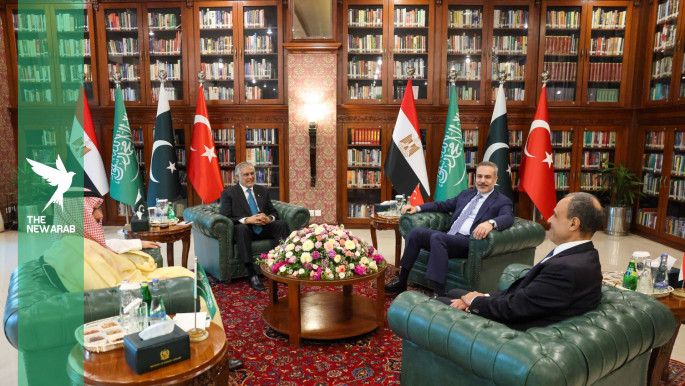
But the two-week exercises bringing together special combat forces come as Pakistan, Egypt, Turkey, and Saudi Arabia edge towards a growing security alliance.
The quartet of countries has taken a series of steps in recent months to coordinate on pressing security and defence issues, including through intensified high-level contacts and meetings, a strategic alignment initially fuelled by Israel’s airstrikes on Doha, Qatar in September 2025.
That attack, analysts say, widened the boundaries of the regional threat posed by Israel, while raising questions about the reliability of external security guarantors.
“Soon after those strikes, Arab states, especially in the Gulf region, realised that they would never be immune from Israeli attacks,” Islam Mansi, an independent Egyptian political analyst, told The New Arab.
As a result, Israel’s aggression against a major non-NATO ally, which was at the time mediating a ceasefire in Gaza, prompted regional states to reassess their security calculus.
A common defence pact between Saudi Arabia and Pakistan and a strategic defence partnership between the United Arab Emirates (UAE) and India were a direct consequence.
The US-Israel war on Iran launched on 28 February has produced additional shifts in the strategic thinking of key regional capitals, who see the conflict as a final stop on Israel’s journey to establish military hegemony in the Middle East.
The de facto annexation of the West Bank, together with calls to re-establish Israeli settlements in Gaza, and settler incursions into both Lebanon and Syria, have also fuelled fears of territorial expansionism under the vision of ‘Greater Israel’, which Netanyahu himself endorsed last year.
The fallout from the Iran war
The war against Iran has thrown into sharp relief the lengths Israel is willing to go to militarily to achieve its objectives.
In the process, the entire Middle East has been held hostage, with Gulf countries, especially, suffering huge economic losses amid Iranian attacks, shattering the image of stability and growth carefully developed over decades.
The war has also disrupted the entire global economy, causing oil prices to soar and jeopardising international supply chains.
This, analysts say, has underscored the need for regional powers to stabilise regional security and protect against future threats.
“Regional states, especially major ones, cannot keep standing idly by and watch while regional security is jeopardised for the pleasure of some radicals bent on changing regional maps and moulding the regional system to suit their wildest dreams,” Saudi political analyst Omar Saif said.
Speaking to TNA, he added that an alliance among Pakistan, Egypt, Turkey, and Saudi Arabia would have its own unique strategic weight given their distinct capabilities.
“The same alliance can put the brakes on Israel’s regional ambitions,” Saif said.
A 17 April meeting of the fledgling quartet’s foreign ministers on the sidelines of the Antalya Diplomacy Forum in Turkey was only the latest in a series of meetings between them in recent months, including throughout the US-Israel war on Iran.
Following talks, Egyptian Foreign Minister Badr Abdelatty said his country was working with its three other partners on creating post-war regional security arrangements. The four states had already played key roles in paving the way for the Pakistan-mediated ceasefire.
Regional uncertainty
These efforts by Islamabad, Cairo, Ankara, and Riyadh are rooted in a general sense of uncertainty regarding the trajectory of Israel’s ambitions in the region.
In addition to a multi-front war since 2023, talk of a new “Turkish threat” has been echoed by several Israeli officials, while Netanyahu outlined plans in February to form a regional coalition against “radical Shiite and Sunni axes” in the Middle East.
The quiet alignment of an ‘Islamic quartet’ would give rise to a significant power bloc with a combined population of 500 million people and a GDP of $3.87 trillion, in addition to military power and key geostrategic assets.
“Such an alliance would introduce a balance of power that the region is badly in need of,” Mansi said.
“By joining forces, the four states will send a message that they will not allow Israel to copy the Iran adventure anywhere else in the region.”
Challenges remain
Nevertheless, there would also be key challenges to practically enforcing any strategic alignment of four states.
Before the Iran war, members of the potential alliance had only recently buried their own differences after years of diplomatic tensions.
Amid a changing political, economic, and security landscape, Turkey and Egypt ended a decade-long rift in 2024, marked by a high-level visit from President Recep Tayyip Erdogan to Cairo.
Ties between Ankara and Riyadh, meanwhile, had been strained since 2018 over the killing of journalist Jamal Khashoggi, before they began to repair relations in 2022.
The four countries also each have their own bilateral military commitments, especially Saudi Arabia and Egypt, which have a longstanding strategic partnership with the US.
Pakistan’s balancing act in the face of Iranian attacks on Saudi Arabia also demonstrated the complexity and limits of the defence pact the two countries signed last year.
Furthermore, whether the US would allow the four countries to initiate a formal alliance that inherently acts to challenge Israel is also an important part of the calculus surrounding the possible bloc, experts say.
However, Turkish political analyst Firas Ridvan Oglu said the potential coalition would create an important balance of power in the region that could consequently serve the interests of the US.
“After all, Washington wants to avoid the eruption of another regional war,” Ridvan Oglu told TNA.
“By creating a mechanism for the enhancement of their strategic and security coordination, the four states will prevent such a war, which will in the end rescue regional security and stability in the face of threats posed by Israel’s regional policies.”
Amr Emam is a Cairo-based journalist. He has contributed to the New York Times, San Francisco Chronicle and the UN news site IRIN
Edited by Charlie Hoyle