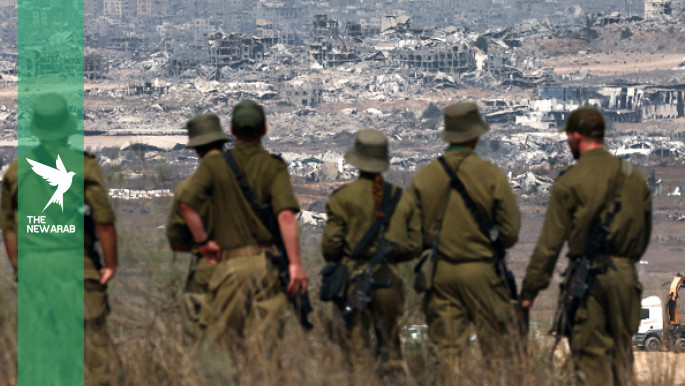
Israel seems to be gearing up for another devastating offensive in genocide-ravaged Gaza [Getty]
Senior Israeli military officials are pushing to resume full-scale war on Gaza, arguing that current conditions are “the most suitable” to do so, according to reporting by Israeli Army Radio.
In closed-door discussions, members of the Israeli army’s General Staff have called for a renewed offensive aimed at “decisively defeating Hamas”, with officials saying that “the mission in Gaza has not been completed, and the Israeli army is compelled to return [to war] and target Hamas, due to its continued refusal to disarm”.
‘Destroying Hamas’ as a pretext for genocide
The push comes despite a ceasefire formally in place since October 2025, which Israel itself declared had ended the war without fully dismantling Hamas’s capabilities. Israeli officials claim Hamas has “continued to strengthen its control”, but critics dispute this, pointing to Gaza’s devastation and blockade as limiting any such capacity.
They argue that Hamas remains not because it has strengthened, but because Israel has failed to eliminate it, focusing more on killing and displacing the civilian population and destroying large parts of the enclave within the scope of its genocidal assault.
Some Israeli ministers have also openly advocated reasserting long-term Israeli control over Gaza, fuelling claims that the war’s objectives extend beyond defeating Hamas.
Since the start of the war, Israel has launched several large-scale operations, most notably Operation Gideon’s Chariots in 2025, alongside earlier and subsequent ground offensives in northern Gaza, Khan Younis and Rafah.
These campaigns involved mass displacement of civilians and widespread destruction of residential areas and civilian infrastructure. Israel has consistently said these operations were aimed at “destroying Hamas”, but the group remains intact.
Expanding control
At the same time, Israel has been expanding its territorial control inside Gaza during the ceasefire.
By pushing what is known as the “yellow line” further west, Israeli forces now control roughly 59% of the Strip, up from around 53% when the ceasefire came into effect.
Did the war ever stop?
However, for Palestinians in Gaza, the war has not meaningfully ended during the ceasefire.
Despite the ceasefire, Israeli airstrikes, shootings and targeted killings have continued on a near-daily basis, with Palestinians killed in multiple incidents across the territory.
Israel killed three Palestinians on Saturday alone, while reports suggest hundreds more have been killed since the ceasefire took effect, alongside repeated violations of its terms.
The Israeli military has also intensified operations in recent weeks, killing over 100 Palestinians and increasing the pace of strikes and assassinations compared to the early ceasefire period.
Preparations for a wider escalation also appear to be underway.
The army has reduced its troop presence in southern Lebanon and redeployed regular brigades to Gaza and the occupied West Bank, while its Southern Command has completed operational plans for a renewed ground offensive, pending political approval.
Israeli divisions
Still, there are divisions within Israel’s military leadership. Some officials have raised concerns about launching a major ground operation without mobilising additional reserve forces, warning of the strain on troops who have already completed around 80 days of service this year.
Others have suggested delaying any large-scale offensive for several months to avoid placing further pressure on reservists.
Meanwhile, indirect talks between Hamas and mediators have continued in Cairo, though Israeli officials claim the group has refused to move forward with the second phase of the ceasefire, which includes disarmament.
However, Hamas has said it would only be discussed after Israel fully implements its own obligations under the agreement.