
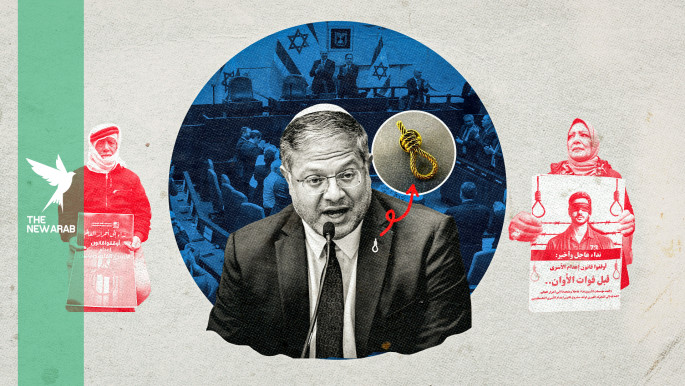
Israel’s death penalty law targeting Palestinians became fully operational on Sunday evening and was extended to the occupied West Bank following an order signed by Israel’s Central Command chief, Major General Avi Bluth.
The move has triggered outrage among Palestinian rights groups and legal experts, who say the law entrenches apartheid and places executions within Israel’s military rule over Palestinians in the occupied West Bank.
Far-right National Security Minister Itamar Ben-Gvir celebrated the law taking effect, declaring: “We promised and we fulfilled.”
The order follows the passage of the law in Israel’s parliament in March, when 62 Knesset members voted in favour of introducing the death penalty for Palestinians accused under Israel’s terrorism laws, sparking international condemnation.
“So far, there is still no clear timeline for the actual implementation. However, what is dangerous is that the matter has now moved into the framework of military rule and military courts in the West Bank, meaning that the death penalty is being carried out within the logic of colonial military judiciary, not merely as a political debate inside Israel,” Shadi Shurafa, researcher in Israeli affairs, told The New Arab.
Questions over execution methods
Questions over the method of execution have also emerged, with debate growing over how Israel would carry out death sentences.
“Itamar Ben-Gvir has appeared more than once, showcasing the noose symbol, even placing a miniature noose badge on his lapel, in what appears to be a clear message. But this does not necessarily mean that hanging will be the official method, even though this does exist historically in Israel law,” Shurafa said.
The law states that military courts must impose the death penalty for killings classified as acts of terrorism under Israeli law.
According to Shurafa, Israel has already carried out forms of extrajudicial execution against Palestinians for years through assassinations, army shootings and settler killings carried out with impunity.
“Formally introducing the death penalty does not so much mark the beginning of a new phase as it represents an attempt to provide legal and judicial cover for policies of killing that already exist within the system of occupation and colonialism,” he said.
What does the law actually say?
Under the law, executions must be carried out after 90 days of sentencing, with no possibility of pardon.
The legislation also states that death sentences can be handed down by a simple majority vote rather than requiring a unanimous decision, while appeals will be severely restricted.
“Since the law is quasi-mandatory, military courts are allowed to impose a life sentence instead of the death penalty only in unspecified exceptional cases, which fails to meet international standards,” Miriam Azem from the Adalah legal centre told The New Arab.
The wording and terms of the law have raised alarm among human rights experts, who say Israeli authorities will exploit it against Palestinians living under occupation.
The law states that the death penalty can be imposed if a detainee accused of carrying out an attack “negates the existence of the State of Israel or the authority of the military commander in the area”.
“This effectively turns a political position, or a reality connected to occupation, into a crime punishable by death. The problem here is not merely legal; it lies in the fact that a state militarily occupying a people simultaneously seeks to punish that people for not recognising the legitimacy of its occupation,” Shurafa said.
He added that the aim of the law is not just about punishing individuals, but rather “attempting to deter an entire people and break their political will”.
In both the West Bank and Israel, courts can impose the death penalty even if it has not been requested or supported by prosecutors.
Media representatives are also barred from attending executions.
Many Palestinians who could face the death penalty are currently forcibly disappeared, held incommunicado and denied access to relatives or lawyers, while lacking the facilities needed to prepare a proper legal defence.
The law has been widely condemned as a form of apartheid because it applies only to Palestinians and not to Jewish Israelis accused of similar crimes.
The UN Committee on the Elimination of Racial Discrimination warned earlier this month that the law perpetuates racial discrimination against Palestinians and amounts to a “grave erosion of human rights”.
Violation of international law
More than a dozen UN experts issued a formal communication last week warning that the law violates international law on several grounds.
“It is prohibited to impose the death penalty based on vaguely defined criminal provisions,” the statement stated.
The experts also warned that Israeli military trials of Palestinians routinely fail to meet international fair trial standards.
“We are concerned that, because Israeli military trials of civilians typically do not meet international fair trial standards under human rights law and humanitarian law, any resulting imposition of the death penalty would be arbitrary in violation of article 6 of the ICCPR,” the statement added.
The UN experts further highlighted allegations of torture, forced confessions, denial of adequate legal representation, inadequate facilities to prepare a defence and the lack of impartiality in Israeli military courts.