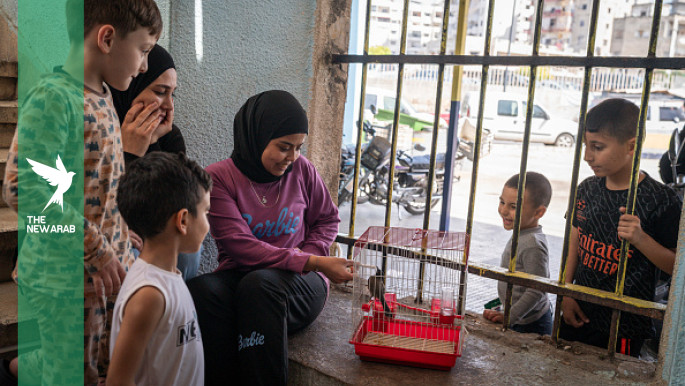
A group of children play with a bird inside a cage in a shelter for internally displaced people in the southern coastal city of Sidon [Getty]
Israel’s offensive on Lebanon this year has killed hundreds of children, who continue to face the devastating repercussions of war despite a ceasefire agreed last month, two children’s welfare groups have told The New Arab.
Earlier this week, UNICEF said 200 children have been killed and 806 injured since fighting resumed between Hezbollah and Israel on 2 March – equating to nearly 14 casualties every day.
These figures were released in a 13 May report, however, Israeli attacks on southern Lebanon have since killed and injured more children.
“This ‘so called’ ceasefire that still sees more than four children killed or injured every day is not a ceasefire for children,” UNICEF Representative in Lebanon Marcoluigi Corsi told TNA.
“Attacks on civilians have not stopped – they have simply continued under another name. Colleagues have told me that the airstrikes feel more intense in some areas than they ever did before.”
Since the 17 April truce was announced, Israel has killed at least 23 children and wounded 93 others, according to the Lebanese health ministry.
Israel has also continued to issue evacuation orders for towns and villages in southern Lebanon despite the truce, which was extended a second time on Friday following direct talks between Lebanese and Israeli officials in Washington.
“Families are trapped in repeated cycles of displacement, return, and renewed displacement, while homes, schools, hospitals, and water systems continue to be damaged or destroyed,” Corsi told TNA.
He said that in many areas, but particularly in the south where fighting has raged, basic services remain severely limited, healthcare facilities are damaged, and there are ongoing risks from unexploded ordnance.
UNICEF estimates that more than 770,000 children are experiencing heightened distress linked to fear, loss, and uncertainty.
“What children need most right now is safety. The ceasefire must hold, civilians and civilian infrastructure must be protected, and humanitarian organisations must have safe and unimpeded access to affected areas to deliver lifesaving assistance,” Corsi added.
“At the same time, restoring education, healthcare, water systems, and protection services is essential to help children recover and rebuild their lives.”
Around one million people have been displaced by Israeli attacks since March, mostly from southern Lebanon and Beirut’s southern suburbs. Families are sheltered in schools, sports stadiums, and other government-run shelters, with some in street tents.
Many people who were displaced when the cross-border clashes began in October 2023, which escalated into a full-blown war a year later, had not even returned before the resumption of fighting in March.
Save the Children says those displaced include around 400,000 children.
“Children are not safe until there is a permanent and definitive ceasefire with no violations,” Nora Ingdal, Save the Children’s Lebanon country director, told TNA.
“With further peace talks taking place to determine next steps between Lebanon and Israel, Save the Children is calling on the international community to urgently work toward a permanent and definitive ceasefire and ensure flexible and sustained funding to protect children and allow families to return home to resume their lives,” she said.
She says the charity’s staff are working tirelessly on the ground to distribute hygiene, food kits, and bedding in collective shelters, and are helping to support children’s education and mental health.