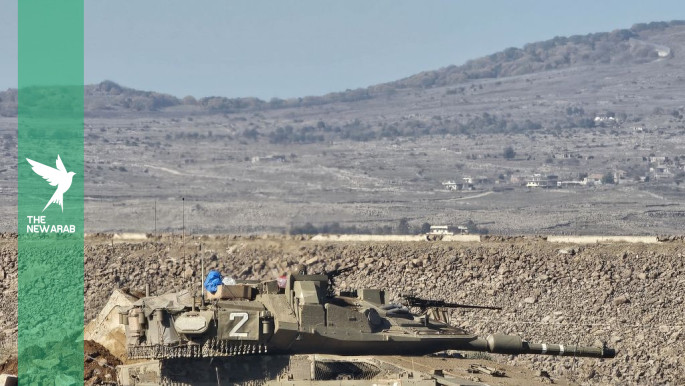
The Israeli army has invaded and occupied southern Syria following the ouster of the Assad regime in December 2024 [Getty/file photo]
Israeli forces are still continuing with incursions into Syrian territory, amid an escalation in Israeli violations and raids in the southern part of the country.
On Monday, three Israeli military vehicles entered the Wadi al-Raqad area in western Daraa countryside, where they established a temporary checkpoint on the valley’s bridge, Syria TV reported.
According to the Army of Free Tribes, a rebel coalition affiliated with the Free Syria Army, the incursion lasted only a short time before the forces withdrew from the area, without any reported arrests or clashes with local residents.
On Sunday, the Israeli military reportedly advanced further into southern Syria. Soldiers reportedly pushed forward towards the Yarmouk Basin area in the Daraa countryside, activists told The New Arab, after witnessing an Israeli patrol consisting of five vehicles arriving at the Jamla outpost, a former regime military position in the area.
Muhammad al-Masalmeh said that the Israeli force remained inside the outpost for some time before withdrawing towards the Saida-Hanout-Wadi al-Raqad road.
This comes amid an increase in Israeli incursions into southern Syria, ongoing frequently since the ouster of Bashar al-Assad’s regime by rebels in December 2024.
The Sijil Centre for Human Rights documented an escalation in violations by Israeli forces in April, with a total of 254 violations, the second-highest monthly toll since the beginning of the year after March.
According to the report, the majority of these violations were concentrated in Quneitra Governorate, where 213 cases were recorded, amidst extensive military activity that included ground incursions, raids, and the establishment of checkpoints.
The Daraa Governorate came in second with 32 violations, although the nature of the operations there was more serious, as they included shelling, incursions, and intensive aerial activity. In the Damascus countryside and Suweida, the violations were mainly limited to aerial activity, according to the report.
The same month saw the first killing of a Syrian civilian since November 2025, when Osama al-Fahd was killed on 3 April, after being directly targeted while herding sheep in the village of Al-Zaroura in southern Quneitra.
According to the report, ground incursions topped the list of violations with 76 operations, mostly carried out by military patrols supported by armoured vehicles. These incursions included raids on villages, road closures, and, in some cases, indiscriminate gunfire. This was followed by 71 instances of military and reconnaissance flights, occurring almost daily along the ceasefire line. These flights were sometimes linked to the interception of Iranian missiles and drones.
Other violations included indiscriminate gunfire, targeting of livestock and herders, bulldozing of agricultural land, and the fortification and expansion of military sites.
At least 15 kidnappings were reported, mostly of shepherds and civilians near the front lines. Most of those kidnapped were later released, while one person has been in detention since last month.
Around 23 temporary checkpoints were erected throughout the month, which saw the Israeli military carry out thorough searches and inspections of mobile phones.
Eight artillery bombardments were also recorded in the Daraa and Quneitra countryside.
The Sijil Centre said 36 Syrian civilians have been killed during Israeli incursions since December 2024. According to the group, the detention of civilians also continued at a significant rate, with 197 people detained by Israeli occupation forces since, with 45 of whom remain in detention.
Following the overthrow of the Assad regime, Israeli forces invaded the demilitarised buffer zone in southwestern Syria, refusing to leave the territory, all while carrying out attacks seeking to weaken the Syrian armed forces.
Israel took advantage of the power vacuum left by the removal of the Assad regime, and the subsequent transitional period that took place, breaking the 1974 Agreement on Disengagement between Israel and Syria and increasing the size of the territory controlled there.
Israel’s presence in southern Syria has been repeatedly condemned by Syrian President Ahmed al-Sharaa.