
Senior IDF officials say that after 40 days of strikes as part of Operation “Roaring Lion,” Iran has been significantly weakened, and the hope now is that the Americans will stand firm against Tehran, especially on the issue of removing enriched material from Iran and halting further enrichment.
If the Iranians do not give in and the Americans continue to insist, as the Israel Defense Forces wants, then IDF Chief of Staff Lt. Gen. Eyal Zamir has instructed the military to prepare for an immediate return to fighting. As we reported this week in Israel Hayom, if the US president approves it, the IDF and US Central Command are preparing this time to strike energy infrastructure across Iran. According to the assessments, if such a move does go ahead, it would take Iran years to recover.
19,000 munitions dropped
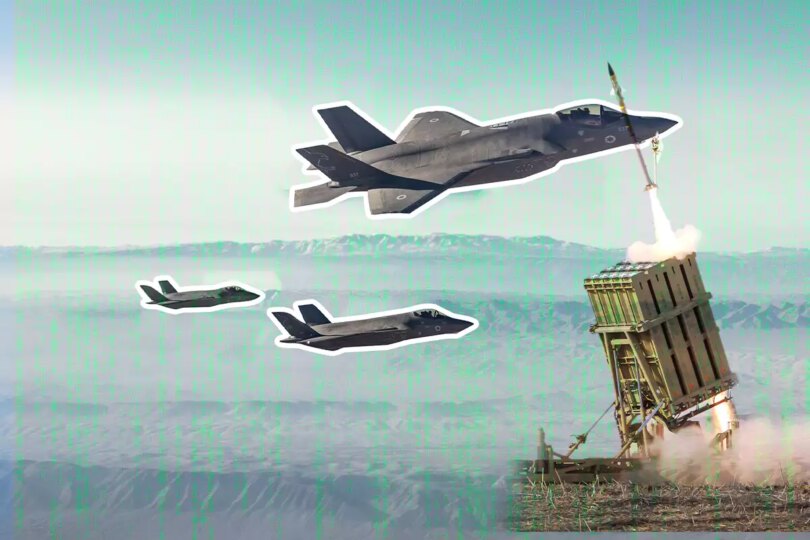
At the same time, the IDF presented data summing up the war in Iran and Lebanon. In Iran, the Israeli Air Force carried out strikes with about 19,000 munitions and bombs, while the US Air Force struck with about 17,000 munitions and bombs.
As previously reported, the operation’s opening strike was moved up from Saturday evening to Saturday morning after it became clear that Iran’s Defense Council was meeting above ground in one location, while two other gatherings of senior officials were taking place at the same time. The compounds were struck from long range. In Israel, officials took the risk that those meetings could be canceled at the last moment. In addition, no one could guarantee in advance that Iranian Supreme Leader Ali Khamenei would definitely be at the strike site.
Throughout the fighting, the Israeli Air Force contended with the issue of air superiority, and the IDF reported Friday that the Iranians tried to fire extensively at Israeli aircraft. On at least two occasions, formations were sent back to Israel while on their way to Iran after it became clear the aircraft were in danger. It can also now be reported that dozens of unmanned aircraft fell on Iranian soil during the operation.

According to the information Israel has, Iran had prepared to launch several daily barrages of dozens of surface-to-surface missiles at Israel, but in practice, after several days of a higher rate of fire, the number stabilized at about 10 missiles a day. In all, Iran launched about 550 surface-to-surface missiles at Israel, and another approximately 850 at Gulf states. In Israel, 90 ballistic missile impacts were recorded, including 64 cluster missiles. The IDF says no Israeli who was inside a protected space was killed as a result of a cluster strike. The military also said that during the war, five major impact sites from heavy missiles were recorded across Israel.
The military estimates that the economic damage to Iran amounts to at least $100 billion, while the Iranians assess the damage at much higher figures. The IDF says the Iranians are facing a dilemma over how to rebuild their systems, that leaders are operating like wanted fugitives, and that commanders are working out of tents and cars.
According to Israeli military intelligence, Iran is conducting a situational assessment, and only now is the scale of the damage in the country becoming clear to regime leaders. The internet is still cut off, and the leadership is having difficulty communicating with one another. At the same time, the assessment is that the Iranians have already begun preparing for the next campaign against Israel.
A “yellow line” in Lebanon
Less than 24 hours before the ceasefire with Lebanon, the IDF also defined a “yellow line” inside Lebanese territory, which, according to the military’s concept, is the line where forces should remain as long as Hezbollah, the Lebanese terrorist organization, is not disarmed, at least in southern Lebanon.
This is an area about 8 to 10 kilometers (5 to 6 miles) from the border. In some places, the forces are farther from the border, while in others they are closer to the international border. According to the instructions given to troops on the ground, IDF soldiers are continuing to operate in the areas where they are deployed, locate weapons and kill terrorists.

The message senior military officials are conveying to the political echelon is that the IDF has successfully met all the military objectives set for it and that, in effect, the ball is now moving from the military court to the political one. According to senior IDF officials, everything now depends on the negotiations taking place regarding the three arenas of fighting: Iran, Lebanon and the Gaza Strip.
As for Hezbollah, IDF data show that it launched about 5,500 rockets at Israel. Some 2,500 crossed into Israeli territory, while the rest fell in Lebanon or were fired at IDF forces operating in Lebanon. According to the IDF, in order to thwart high-trajectory fire at Israel, forces would need to maneuver north of the Litani River, and that is not something anyone intends to do right now.
“Nothing short of historic”
The IDF believes the achievement of the strikes in “Roaring Lion” is nothing short of “historic,” and that an opportunity has now opened to reshape the Middle East through the isolation of Iran and the creation of new alliances and coalitions with Israel at their center.
In addition, chiefs of staff in the region are in contact with Lt. Gen. Zamir and, among other things, are sending him the message: “Do not stop. Keep moving forward,” while stressing that they are ready to absorb any blow, provided the Iranian threat is removed.