
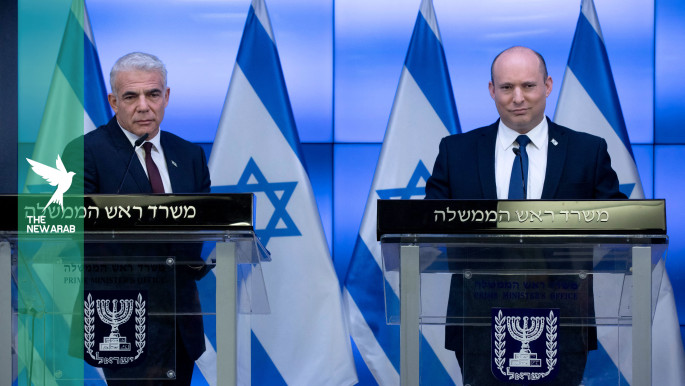
Ramallah, occupied West Bank – Israeli opposition leaders Yair Lapid and Naftali Bennett have merged their parties under a single banner called Beyahad (Together), to challenge Prime Minister Benjamin Netanyahu in elections expected by October.
The move revives the partnership that briefly unseated Netanyahu in 2021, but Palestinian analysts examining the realignment say it is unlikely to threaten his hold on power, and even less likely to alter Israeli policy toward Palestinians.
The two former premiers announced the merger at a joint press conference in late April, with Bennett positioned to lead the alliance and Lapid framing the project as a vehicle to redirect the country.
Their previous coalition, formed in 2021, ended Netanyahu’s 12-year run before collapsing within 18 months under the weight of internal contradictions.
The current government, which replaced it, is widely described as the most right-wing in Israel’s history.
Netanyahu’s hold on power has been further complicated by his ongoing corruption trial, which has shadowed Israeli politics since 2020.
The prime minister faces three cases involving alleged bribery, fraud, and breach of trust, including charges connected to regulatory favours granted to telecommunications mogul Shaul Elovitch in exchange for favourable coverage on the Walla news site.
Court hearings have been postponed multiple times, including a more than two-month pause linked to the Iran war, and the proceedings are expected to extend well beyond the October 2026 election.
Rearrangement within a single ideological space
For Marzouq al-Halabi, a Palestinian writer and analyst, the framing of the merger as a return of the so-called “change camp” misreads what is actually on offer.
The contest, he argues, is not between competing visions of Israel’s future but a rearrangement within a single ideological space.
“Conflict is not playing out between two opposing projects, but inside one Zionist vision that differs in its tools of management rather than in its substance,” he told The New Arab.
That structural reading is shared by a former Palestinian Authority (PA) Minister of Prisoners’ Affairs and political analyst Ashraf Ajrami, who warns against treating opposition consolidation as a passing event.
“Netanyahu,” he notes, “has spent years dismantling rivals through circumstantial and fragile alliances, and the current attempt to box him in carries real political pressure.”
But he sees the merger as evidence of “weakness rather than unity”. Lapid’s slipping poll numbers, Likud’s rise, and the emergence of former army chief Gadi Eisenkot as a potential rival all factored into the decision to consolidate behind Bennett.
“The merger, in this reading, was driven by necessity,” he told The New Arab.
Slogans circulating within the right, such as “Greater Israel” and “Complete Israel,” do not signal genuine ideological splits, Ajrami argues, so much as rhetorical variations within a shared framework.
The gap between Likud and its rivals on the Palestinian question is narrower than campaign messaging suggests. Across Israel’s political spectrum, settlement expansion, entrenched security control, and conflict management rather than resolution are treated as settled premises.
Even at moments of acute political tension, debate centres on lowering the cost of occupation, not ending it.
According to Arjami, Bennett, who comes from the religious Zionist current, has never hidden his opposition to a Palestinian state and has long advocated for annexing large parts of the West Bank. Lapid, despite a more liberal public image, has not put forward a project that goes beyond conflict management.
“The 2021 experiment, which included the Israeli Arab politician Mansour Abbas, is now being recast as a model, but Bennett has signalled he will not rely on Arab parties this time, narrowing the coalition’s possible base,” he added.
A battle of personalities, not programs
Rafiq Awad, an analyst of Israeli affairs, sees no scenario in which the alliance poses a structural threat to Netanyahu. The differences between Lapid, Bennett, and Netanyahu on policy, social vision, and even cultural orientation are minimal, he argues.
“All three operate within the same right-wing space, which makes the contest a battle of personalities rather than programs,” he told The New Arab.
“Netanyahu retains a historical and political weight that positions him before the Israeli public as the figure capable of leadership, and the right-wing voting bloc tends to consolidate around a strong personality and a clear platform, both of which favour him over his challengers.”
External and internal pressures could still sharpen the contest, Awad acknowledges, including the posture of the American administration, the priorities set in Washington, the weight of economic strain, and the manoeuvring of figures such as Avigdor Lieberman as an independent force.
These factors together may give the Lapid-Bennett alliance a margin of relative progress, without amounting to a strategic shift capable of unseating Netanyahu,” he adds.
The Beyahad merger has not, on the numbers, expanded the anti-Netanyahu camp.
According to polls by Kantar, Midgam, and Channel 12 conducted after the announcement, Beyahad and Likud are running roughly even at around 26 seats each, and only one of eight surveys taken since the merger has shown the opposition reaching the 61 seats needed to form a government without Arab parties.
Lapid’s liberal positioning may work against the alliance inside an electorate trending toward harder positions, he argues.
“The same image that distinguishes him in international media can be used as a mobilisation tool against him by harder factions of the right, which helps explain the alliance’s modest gains in opinion polling.”
Israeli political analyst Esmat Mansour offers a slightly different reading.
“Removing Netanyahu would require a broad coalition with money, influence, and reach across the political system, and Lapid stands to benefit from such an alignment.”
The merger expands the partnerships available to him and reduces the chances of a third figure splitting the anti-Netanyahu vote. Mansour cautions, though, that bringing right and left tendencies under one banner carries the risk of internal fragmentation, which “may push toward an even broader bloc whose central purpose is unseating Netanyahu, with disagreements deferred, not resolved”.
What changes for Palestinians, and what does not
If such a government were to form, Mansour expects shifts in tone rather than substance.
The Palestinian Authority’s role might be reconsidered, the management of Gaza adjusted, and ties with neighbouring states recalibrated. But the changes would be tactical, driven by Israel’s eroding international standing and growing economic pressures rather than by a rethinking of the underlying approach.
“Netanyahu’s own approach has shown limits in producing lasting political stability, opening space for attempts to reshape how conflict and crisis are managed, including through judicial reforms and adjustments to decision-making processes inside the system.”
The structural commitment to blocking Palestinian sovereignty, Ajrami argues, runs across coalitions. Whatever government emerges from the next election, the rejection of an independent Palestinian state remains a fixed point of Israeli policy.
Awad reaches the same conclusion.
“The general trajectory, including the entrenchment of geographic and political fragmentation, the continuation of hardened security policies, settlement expansion, and the closing of any horizon for a political solution, is treated within the Israeli establishment as a set of gains that cannot be rolled back.”
Any alternative government, in his view, may adjust the language used abroad without touching the substance of policy at home.
For Halabi, the wider context matters too. Israeli political life is being shaped by long wars whose outcomes remain unsettled, by the erosion of the doctrine of military decisiveness, and by visible cracks in international support, particularly inside the United States.
He cautions against reading these wars through narrow lenses, warning that reducing complex conflicts to a single weapons system or a single chokepoint, whether the Strait of Hormuz or Hezbollah’s drones, distorts what is happening on the ground.
“These pressures,” he tells The New Arab, “are reshaping the political map regardless of which faces appear at its top, and the costs of prolonged war are spilling beyond the immediate parties to weigh on the United States, its allies, and economies as far as Europe and East Asia.”
Mansour does not rule out that these shifts could produce mixed outcomes, positive or negative, given that crisis management often unfolds without prior planning.
The world, he says, is “watching for a change in Israel even if it is largely cosmetic”, treating it as a possible opening to ease the current international pressure.
“Netanyahu remains the cornerstone of the right-wing camp in the absence of any successor capable of filling the vacuum he would leave.”
His exit, he continues, whether through a judicial settlement or a political collapse, would not necessarily lead to moderation, but could instead clear the path for far-right politics to become even more entrenched in Israel.
This story is produced in collaboration with Egab
Aseel Mafarjeh is a Palestinian journalist focusing on politics and culture
Edited by Charlie Hoyle