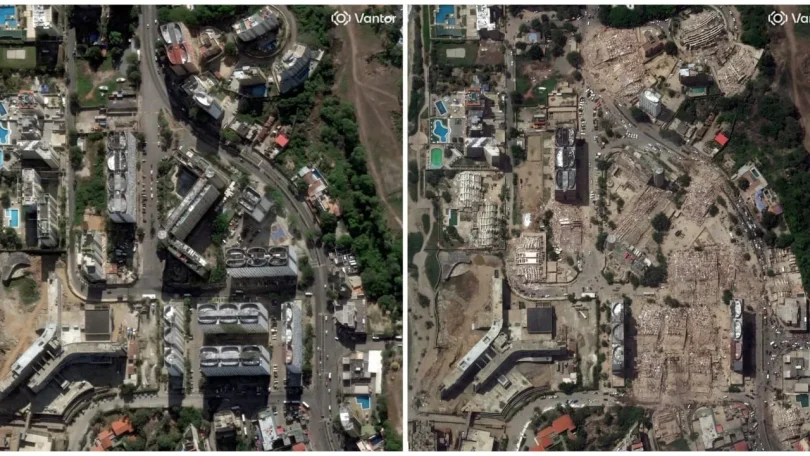
High-resolution satellite images captured by the Israeli company ImageSat International (ISI) were released on Friday, providing a visual understanding of the disaster zone in La Guaira, Venezuela, and highlighting how satellite intelligence contributes to damage assessment and emergency decision-making.
The imagery reveals extensive damage across several areas of the city, including the collapse of high-rise residential buildings in the Playa Grande neighborhood, as well as significant damage to neighboring structures and surrounding infrastructure.
Analysis of the imagery provides an up-to-date situation report of ground conditions, allowing agencies to assess the overall scope of the damage, pinpoint the hardest-hit areas, and monitor ongoing recovery operations.
Based on the available imagery at the time of photography, no major concentrations of rescue forces, heavy engineering equipment, or wide-scale aid operations could be identified in the documented areas.
High-resolution satellite imagery is a vital tool in natural disaster response, providing government bodies, emergency organizations, and aid agencies with an objective, current situation report – especially when ground access to affected areas is restricted.
Many thousands remain missing, time is running out
More than 68,000 people remain missing in Venezuela following two powerful earthquakes that devastated large parts of the country, according to reports from the Associated Press (AP) and Euronews.
The two consecutive quakes, measuring 7.2 and 7.5 magnitude, struck Venezuela last Wednesday just seconds apart, causing unprecedented destruction. While the epicenters were recorded in the Yaracuy region, the impact was felt far beyond the country’s borders, reaching as far as the Amazon rainforest in Brazil.
Currently, the official death toll stands at 1,430, with 3,238 injured.
The critical first 72 hours, considered the golden window for rescuing trapped individuals, have already passed, casting a heavy shadow over the chances of finding living survivors beneath the rubble. Experts have classified the disaster as the most powerful earthquake to strike Venezuela in more than 125 years.
Emergency teams from around the world are pouring in to support the 30,000 Venezuelan specialists leading the search-and-rescue efforts.
Venezuela’s Acting President, Delcy Rodríguez, who declared the affected areas a disaster zone, stated that 24 countries have offered assistance so far. This includes 521 tons of equipment, 86 K9 units, and over 2,741 rescue personnel. Additionally, US military aircraft are assisting with aerial reconnaissance.
Alongside official efforts, many residents are taking matters into their own hands out of sheer desperation. Heartbreaking videos circulating on social media show citizens digging through mountains of rubble with their bare hands in a desperate bid to locate loved ones.
At the same time, harrowing footage has emerged showing rescue forces miraculously pulling infants from completely collapsed buildings.
International community rushes to send aid
The international community is working to accelerate the delivery of aid. European Union Foreign Policy Chief Kaja Kallas spoke with Rodríguez on Sunday, noting that the EU has mobilized approximately €5 million in emergency assistance for the affected communities.
“I expressed the EU’s full solidarity with the Venezuelan people and our deepest condolences to families who have lost loved ones,” Kallas updated on her Twitter/X account.
The economic fallout of the disaster is staggering. An initial assessment by the United Nations Development Program (UNDP) estimates the cost of direct physical damage from the earthquakes at roughly $6.7 billion. This dramatic figure is expected to severely hinder the country’s recovery efforts, which were already grappling with a years-long economic and humanitarian crisis.