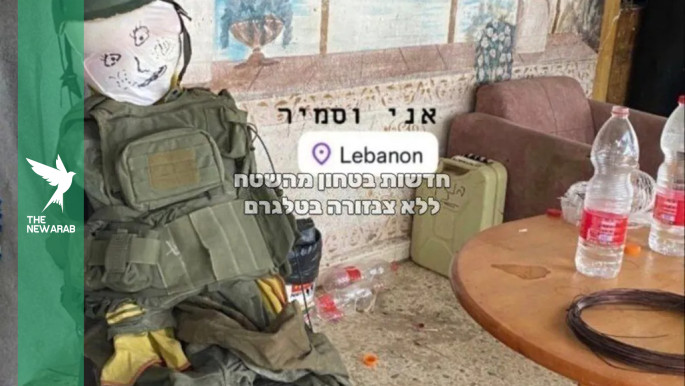
Photos circulated online in recent days showed the dummy figures wearing full combat gear inside buildings in southern Lebanon. [Screenshot]
Israeli forces occupying southern Lebanon have reportedly deployed lifelike mannequins dressed as soldiers inside homes and military positions in an attempt to lure and misdirect Hezbollah’s increasingly effective first-person view (FPV) attack drones.
Photographs circulated online in recent days and shared widely on Israeli media showed the dummy figures wearing full combat gear inside buildings in southern Lebanon, with Israeli military correspondent Itay Blumental describing the tactic as a “known” deception method used against drones and armed groups.
The images quickly spread across social media, where many users viewed them as further evidence of the growing pressure Hezbollah’s drone warfare campaign is placing on Israeli troops operating inside Lebanese territory.
The reported use of decoys comes as Hezbollah intensifies low-altitude FPV and fibre-optic drone attacks that Israeli media increasingly acknowledge have exposed weaknesses in the Israeli military’s technological and operational capabilities.
Since March 2026, Hezbollah has escalated the use of explosive FPV drones against Israeli troops, military vehicles and engineering equipment in southern Lebanon and northern Israel.
Unlike conventional drones, many of Hezbollah’s newer systems reportedly use thin fibre-optic cables that link the drone directly to its operator, making them largely immune to electronic jamming.
Israeli media recently acknowledged that senior military and defence officials have so far failed to find an effective technological response to the threat.
Israel’s Channel 7 reported over the weekend that Israeli Chief of Staff Eyal Zamir held a high-level meeting with military technology units and defence ministry officials to address Hezbollah’s growing drone capabilities, particularly fibre-optic drones.
According to the report, the discussions ended without an operational solution despite the involvement of senior technological and intelligence figures.
Israeli media described the drones as inexpensive but highly effective weapons capable of providing operators with uninterrupted live imagery until impact, allowing highly precise targeting.
The systems reportedly cost hundreds of dollars, yet are used against military hardware and defensive systems worth millions.
Israeli reports said Hezbollah’s drones were typically launched from distances of 10 to 15 kilometres and have increasingly targeted soldiers, bulldozers, engineering vehicles and newly established military positions.
In recent weeks, Hezbollah has also released footage showing explosive drones striking Israeli military vehicles, troop positions and Iron Dome systems in southern Lebanon.
Israeli media reported that soldiers deployed in southern Lebanon had increasingly resorted to improvised defensive measures, including camouflage nets, movement under darkness, protective coverings on vehicles and attempts to shoot drones down using light weapons fire.
The deployment of mannequins appears to form part of those battlefield adaptations.
Israeli media said the use of dummy soldiers was not yet an official military-wide tactic, but rather a local initiative developed by troops operating on the northern front.
The reports described Hezbollah’s explosive drones as one of the Israeli military’s main operational “headaches” in southern Lebanon, causing casualties on an almost daily basis.
Israeli media reports said the dummy soldiers were intended to attract Hezbollah surveillance and attack drones, draw fire away from real troops and potentially expose drone operators.