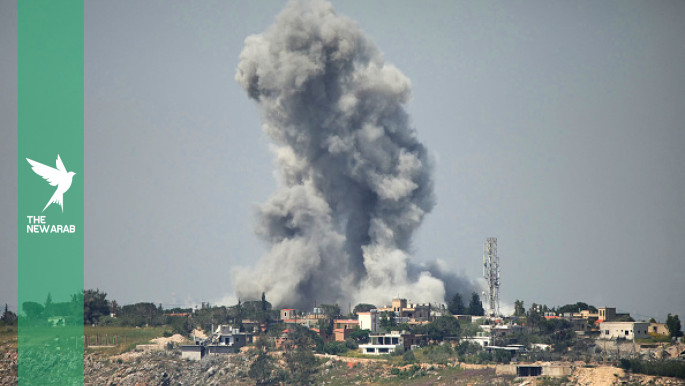
Smoke rises after an Israeli that targeted the village of Arnoun in the Nabatiyeh district [Getty]
The Israeli military issued evacuation orders for nine villages in southern Lebanon on Saturday as it continued deadly strikes despite a truce, while the United States said it would facilitate talks between the two countries next week.
An Israeli drone strike Saturday afternoon targeted a car and killed three people in a Mount Lebanon area, the state-run National News Agency (NNA) reported. The attack took place in an area known as Moltaka al-Nahrayn (the meeting of two rivers) in the Chouf district.
Two separate drone strikes also targeted two vehicles on the busy coastal highway in Saadiyat, about 35 kilometres south of Beirut, NNA reported. Ambulances were seen rushing to the scene where black smoke filled the sky. It was not immediately clear how many people died in those strikes.
Both areas are far from southern Lebanon, where Israeli strikes killed several people on Saturday.
In Saksakiyeh, a strike destroyed a residential building and killed at least four people as rescuers searched for six others. Another strike killed one man and his daughter in Nabatiyeh, while three others were killed in a strike on the Burj Rahhal-Abbasiyeh road.
Residents of Tayr Debba, Abbasiyeh, Burj Rahhal, Maaroub, Barish, Arnoun, Jannata, Zrariyeh, and Ain Baal were ordered by the Israeli army Saturday morning to distance themselves at least one kilometre from their villages.
In an earlier statement, the Israeli military claimed it had struck more than 85 Hezbollah infrastructure sites “from the air and on the ground” in the past 24 hours. It said these included weapon storage facilities, launchers, and structures used by the Iran-backed militant group.
On Friday, Hezbollah said it launched missiles and drones at military bases in northern Israel in retaliation for a recent attack south of Beirut, which Israel says killed a top commander.
Since fighting resumed between Israel and Hezbollah on 2 March, Israeli forces deepened their invasion of southern Lebanon and now occupy the entire border area, establishing a buffer zone where dozens of towns and villages have been flattened.
Around a million people have been forcibly displaced from much of the south and Beirut’s southern suburbs. More than 2,700 people have been killed.
Intensive talks
Lebanese Prime Minister Nawaf Salam said on Friday that his government was seeking full implementation of the 17 April ceasefire ahead of planned talks with Israel next week. The ceasefire was brokered by the US and later extended.
Lebanese and Israeli delegations will meet again at the US State Department on 14 and 15 May in a new round of direct, preliminary discussions aimed at putting an end to the decades-long conflict.
Full-fledged negotiations are yet to begin; however, next week’s talks will include more senior Lebanese diplomats and Israeli officials.
The State Department said that the US will facilitate two days of intensive talks between the governments of Israel and Lebanon.
Secretary of State Marco Rubio said the Lebanese government needed to be strengthened to extend its sovereignty over all of Lebanon and have exclusive control over all arms, adding that the US will not engage in any talks with Hezbollah.
Beirut has stressed that its priority was a permanent ceasefire, an end to the Israeli occupation of Lebanese territory, and the return of Lebanese detainees in Israel, and stated that the aim of the talks was a peace deal and not normalisation.
Israel has warned that it will stay in southern Lebanon and continue its attacks if Hezbollah is not fully stripped of its weapons, a demand the militant group has refused.
Hezbollah has slammed the talks and said it was not concerned with their outcome.