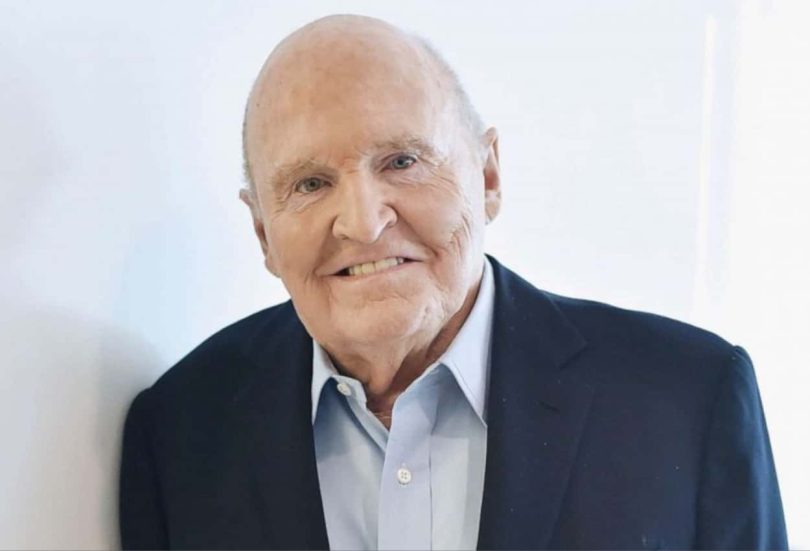
John Francis Welch Jr. (November 19, 1935 – March 1, 2020) was an American business executive. He served as chairman and CEO of General Electric (GE) from 1981 to 2001. Over those 20 years, GE’s market value rose from $14 billion to $600 billion. Many people consider him one of the top chief executives of the twentieth century.
While Welch was in charge, GE bought the RCA Corporation in 1986 and moved strongly into financial services with GE Capital, which eventually made up 40% of the company’s revenue. He also reorganized GE so that each business unit had to be first or second in its market, selling off those that were not. By the time he left, GE was the most valuable company in the world.
In recent years, historians and journalists have questioned Welch’s legacy, especially his decision to make GE rely heavily on financial services. Some say his focus on short-term financial results over long-term investment has influenced American corporate culture, including at companies like Amazon.
Profile Summary
| Category | Details |
|---|---|
| Full Name | Jack Welch |
| Birth Name | John Francis Welch Jr. |
| Date of Birth | November 19, 1935 |
| Place of Birth | Peabody, Massachusetts, U.S. |
| Date of Death | March 1, 2020 (aged 84) |
| Place of Death | New York City, New York, U.S. |
| Alma Mater | University of Massachusetts Amherst (BS); University of Illinois Urbana-Champaign (MS, PhD) |
| Occupations | Business Executive; Chemical Engineer; Writer |
| Title | Chairman & CEO of General Electric (1981–2001) |
| Political Party | Republican |
| Children | 4 |
Spouses
| Spouse | Marriage Details |
|---|---|
| Carolyn B. Osburn | m. 1959; div. 1987 |
| Jane Beasley | m. 1989; div. 2003 |
| Suzy Wetlaufer | m. 2004 |
Biography and Education
Jack Welch was born on November 19, 1935, in Peabody, Massachusetts. He was the only child of Grace, a homemaker, and John Francis Welch Sr., a railroad conductor. Welch was an Irish American and a Catholic, with all his grandparents coming from Ireland.
During middle and high school, Welch worked summer jobs as a golf caddie, newspaper delivery boy, shoe salesman, and drill press operator. At Salem High School, he played baseball and football, and was captain of the hockey team.
In his senior year, Welch was accepted to the University of Massachusetts Amherst to study chemical engineering. He spent his college summers working at Sunoco and PPG Industries. In his sophomore year, he joined the Phi Sigma Kappa fraternity. Welch graduated in 1957 with a Bachelor of Science in chemical engineering. He turned down several job offers to attend graduate school at the University of Illinois Urbana-Champaign, where he earned a master’s and a PhD in chemical engineering in 1960.
Welch received an honorary Doctor of Science from the University of Massachusetts Amherst in 1982 and an honorary doctorate from the University of California, Los Angeles in 2009.
Personal life
Welch and his first wife, Carolyn, had four children and divorced amicably in 1987 after 28 years of marriage. His second wife, Jane Beasley, was a former mergers-and-acquisitions lawyer. They married in April 1989 and divorced in 2003. Although Welch had a prenuptial agreement, Beasley required a ten-year limit, so she reportedly left the marriage with about $180 million.
Welch’s third wife, Suzy Wetlaufer (née Spring), co-authored his 2005 book Winning as Suzy Welch. She served briefly as the editor-in-chief of the Harvard Business Review. Welch’s wife at the time, Jane Beasley, found out about an affair between Wetlaufer and Welch. They married on April 24, 2004.
Beginning in January 2012, Welch and Suzy Welch wrote a biweekly column for Reuters and Fortune. They both left on October 9, 2012, after Fortune published an article critical of Welch and his GE career.
Legacy
Welch was frequently criticized for insufficient concern for the middle and working class. When questioned about high CEO pay relative to regular workers, including issues such as backdating stock options, golden parachutes, and large retirement packages, Welch called these claims “outrageous” and strongly opposed new SEC rules on executive compensation. He maintained that CEO pay should be determined by the “free market” without government or external intervention.
However, by Wall Street standards, a $100,000 investment in GE shares in 2000, near the end of Welch’s tenure, had lost approximately 80 percent of its value by 2021.
Despite this, business consultant Ron Ashkenas wrote in a 2015 Harvard Business Review article that “Jack Welch’s approach to breaking down silos still works.” He gave examples of engineering companies that found “fragmented, geographically dispersed” organizations make it “very difficult … to coordinate efforts across functions, keep everyone focused on the cost and delivery goals and get people to reach consensus.”
Welch has faced criticism for practices that harmed both workers and the company. He eliminated thousands of jobs at GE, contributing to the decline of the U.S. manufacturing base, and implemented annual reductions of 10% of employees, a policy later adopted by other companies. As a leading advocate of mergers and acquisitions, he contributed to a more concentrated and less dynamic economy. He also pioneered “financialization,” transforming GE from a manufacturing company into what was effectively an unregulated bank, which ultimately harmed the company in the long term.
As of late 2021, General Electric planned to separate into three public companies, effectively ending its existence as a single entity. These companies would operate independently in the aviation, health care, and energy sectors. In 2021, GE was led by H. Lawrence Culp Jr., appointed in 2018 as its fourth CEO since Welch’s departure. Several of Welch’s proteges had ultimately unsuccessful careers at other companies, including at Home Depot and during Dave Calhoun’s tenure at Boeing.
Death
Welch died from kidney failure at his home in New York City on March 1, 2020, at age 84. His funeral was held at St. Patrick’s Cathedral.
Net Worth
Jack Welch was an American business executive who had a net worth of $650 million at the time of his death in 2020.