Follow our live coverage here.
Two Japanese crude tankers are heading east along the Persian Gulf toward the Strait of Hormuz, adding to a growing number of vessels gathered at the entrance to the waterway during a US-Iran ceasefire, even as US President Donald Trump ramps up criticism and traffic remains limited.
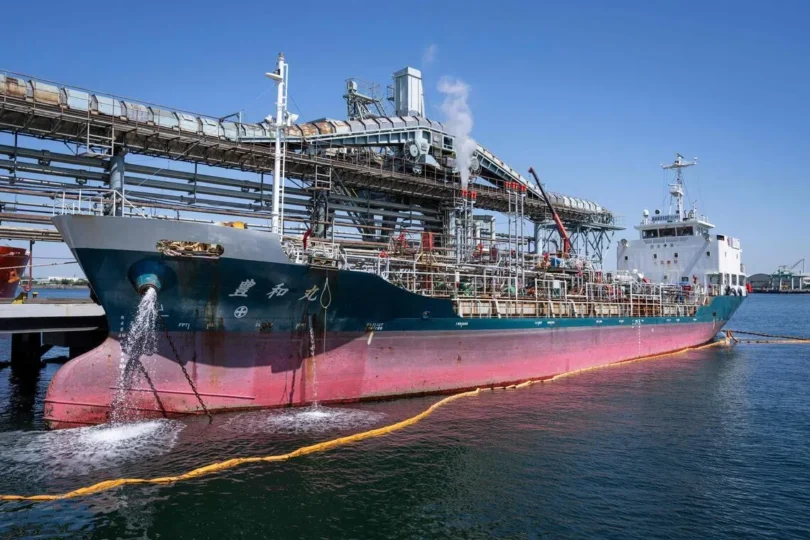
The Mayasan and Yakumosan, both very-large carriers each hauling around two million barrels of crude, began sailing east late on April 9 from waters off Ras Tanura in Saudi Arabia, where they have been since mid-March. The Sea Condor, a Greek-flagged products tanker that loaded in Kuwait, was also moving east in the direction of Hormuz.
With hundreds of vessels stuck since US and Israeli strikes began at the end of February, some are now beginning to shift positions along the 1,000km-long Persian Gulf to be nearer to Hormuz. A ceasefire has pushed shipowners to begin considering options, though most say conditions are still too unclear to attempt an exit.
Shipowners are not only concerned about the safety of crew and cargo, but also about the need to manage Iranian demands to secure safe passage, including payments which could expose companies to sanctions risks. Mr Trump, who announced a complete opening of Hormuz along with the ceasefire earlier this week, said on April 9 that he was optimistic, only to then chastise Iran for doing a “very poor” job of allowing oil through.
Traffic through the Strait, which ticked up at the weekend, has since slowed further.
That has not stopped vessels from preparing for a potential crossing. On April 9, three Chinese very large crude carriers (VLCC) arrived and clustered at a spot approaching Iran’s Qeshm, the island that now serves as a gateway for Hormuz transits. Two of the ships are linked to China’s Cosco Shipping, a giant and prudent state-owned player.
The Japanese ships sailing east on Friday have links to Mitsui OSK Lines, a major Japanese shipowner and key energy player. While the company extracted at least one vessel from the Gulf before this week’s truce, its president Jotaro Tamura on April 9 said the group would now need to scrutinise details and the implementation of the ceasefire before allowing its tankers to test the Strait of Hormuz.
The two VLCCs are managed by Mitsui OSK Lines (MOL), database Equasis shows. The company also owns Mayasan, while Yakumosan’s owner Phoenix Ocean shares MOL’s address. MOL said it could not comment on “the navigation status or operational measures of individual vessels”, adding that its priority was the safety of seafarers, cargo and vessels.
Mayasan sailed into the Gulf a few days before war broke out on Feb 28, ship-tracking data showed. It picked up crude from the United Arab Emirates and Saudi Arabia in late February. It is indicating Tomakomai, a port in northern Japan, as its destination.
Yakumosan entered the Gulf in late February, and picked up a cargo of Qatari crude from a floating storage vessel in early March. It then soon took another load from Saudi Arabia’s Juaymah, before idling for a few weeks off Ras Tanura. It is signalling a mustering point off Das Island in the United Arab Emirates as its destination.
Sea Condor, the Greek-flagged ship, also moved into the Gulf at around the same time and picked up Kuwaiti fuels in early March. It is heading to Sharjah. BLOOMBERG