
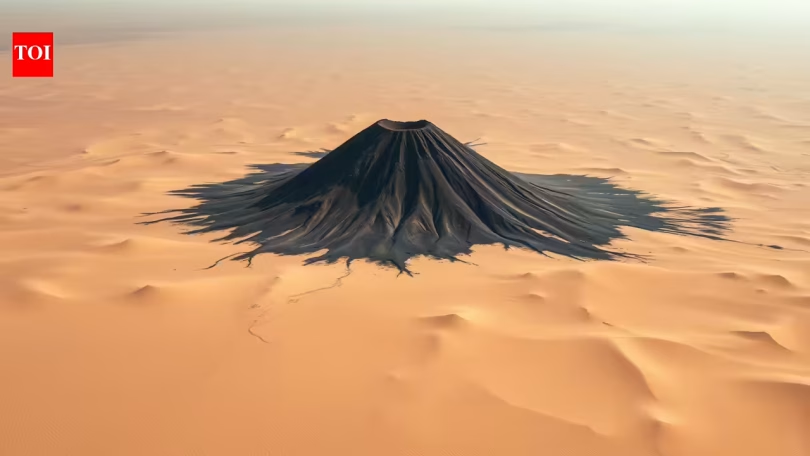
Hidden deep in the heart of the Sahara, a jet-black volcano draped in the remnants of ancient lava flows sits beside one of the most striking geological features on Earth, a volcanic crater so perfectly skull-shaped it looks almost deliberate. A photograph taken by an unnamed astronaut aboard the International Space Station on September 23, 2019, captured both formations in a single image, revealing the Toussidé volcano and the Trou au Natron caldera rising from the sand-covered plateau of northern Chad in extraordinary detail. The image offers a rare window into one of the planet’s least visited and most geologically compelling landscapes, a region where millions of years of volcanic activity have left permanent, dramatic scars across the desert floor that remain almost entirely unchanged to this day.
Toussidé volcano and why it looks so dramatically different from its surroundings
Toussidé, also known as Tarso Toussidé, is a potentially active stratovolcano located within the Tibesti Mountains, a remote volcanic range covering roughly 100,000 square kilometres of northern Chad and southern Libya. The peak stands 3,265 metres above sea level, making it the second-tallest mountain in the entire Tibesti region. What makes it immediately striking from space is its colour. The volcano and the sprawling mass of rock surrounding it appear almost completely black against the pale, sand-coloured plateau, because the ground around it is covered by a geological structure called a massif, built up from layer upon layer of overlapping magmatic rock left behind by multiple ancient lava flows that slowly poured down from the volcano’s summit over an enormous span of geological time. The massif stretches up to 32 kilometres across at its widest point, and its dark surface stands out sharply against the surrounding plateau that has been carved by eons of wind into a network of crisscrossing canyons, as documented by NASA’s Earth Observatory.
What the name Toussidé actually means
The name of the volcano is not simply a geographical label. According to historical records referenced in the JSTOR archive of Geographical Journal studies, Toussidé roughly translates to a phrase meaning something close to “which killed the local people with fire” in the language of the Indigenous communities living in proximity to the Tibesti range, which suggests a long cultural memory of violent or destructive eruptive activity at or near the site. Despite this unsettling etymology however, the Smithsonian Institution’s Global Volcanism Program has found no confirmed evidence that Toussidé has actually erupted during the Holocene, the current geological epoch that began around 12,000 years ago, meaning its period of genuinely dangerous volcanic output predates recorded human history in the region by a very considerable margin.
The skull-shaped caldera hiding just southeast of the volcano
Just southeast of the dark massif, visible in the upper right portion of the astronaut photograph as a small white circle enclosing several dark patches, lies Trou au Natron, a volcanic caldera that drops roughly 1,000 metres from its rim to its floor and measures around 8 kilometres across. When viewed directly from above, the combination of its pale white salt floor and a pair of dark volcanic cones rising from within it creates a striking resemblance to a human skull staring upward from the desert, an effect that has made the crater one of the most photographed geological formations in the region despite its extraordinary remoteness. The caldera is believed to have formed during an explosive eruption more than 120,000 years ago, far predating the Holocene and placing its violent origins well back in the Pleistocene era. It was once filled by a large salt lake that supported ancient algae and other microorganisms, but as the climate dried and the lake evaporated around the beginning of the Holocene, the retreating water left behind the thick white salt deposits that now coat its floor and give the skull formation its distinctively pale cranium-like appearance.
Why the entire Tibesti region once looked as dark as the lava massif does today
The massif surrounding Toussidé is not an isolated quirk of local geology but a visible remnant of a much broader volcanic history that once shaped the entire Tibesti landscape. Toussidé is one of the younger mountains in the range, which was itself formed by similar patterns of effusive lava eruptions long before Toussidé was born as a distinct volcanic structure. According to the Earth Observatory, the entire Tibesti plateau likely once matched the dark hue of the current massif before centuries of sand-blasting by Saharan winds gradually buried and lightened the surrounding terrain. Given enough time, perhaps another 100,000 years or so, the same process may eventually cause Toussidé’s dark massif to blend into the plateau around it just as the older parts of the range already have, slowly erasing one of the most visually dramatic geological signatures currently visible anywhere in Africa from space.
The volcano is dormant but not dead
While Toussidé has shown no confirmed eruptive activity throughout the Holocene, it has not gone entirely quiet. The European Space Agency, which captured its own satellite imagery of the region in 2021, notes that the volcano occasionally releases steam through small vents called fumaroles located near its summit, a clear indication that heat and geological activity continue below the surface and that the volcano remains technically active rather than fully extinct. Geologists have not yet conducted a thorough formal assessment of Toussidé’s eruptive potential, largely because the Tibesti region is so remote and has historically been difficult to access for scientific fieldwork, meaning significant questions about the volcano’s future behaviour and the precise chronology of its past eruptive cycles remain unanswered for the time being.