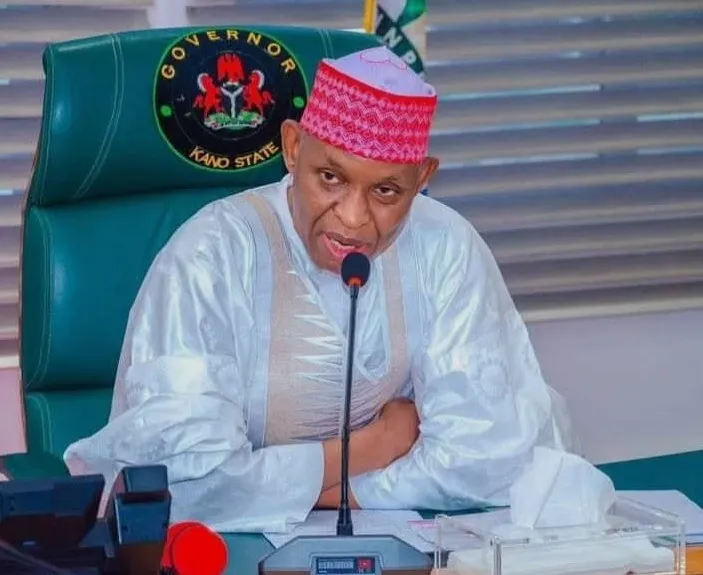
When sustained investment in education begins to yield measurable results, the numbers speak for themselves and this year, they are speaking loudly for Kano State under Governor Abba Kabir Yusuf.
The 2026 National Examinations Council (NECO) Senior School Certificate Examination results have placed Kano State at the top of the national table again, with the highest number of candidates recording at least five credits, including English Language and Mathematics, ahead of Lagos and Oyo, Nigeria’s other major education hubs. Kano recorded 74,413 successful candidates ahead of 72,496 in Lagos and 55,543 in Oyo.
Kano’s figure represents 1,917 more successful candidates than Lagos and 18,870 more than Oyo on this benchmark. But the more compelling story is one of trajectory, not just position. In 2025, Kano recorded 68,159 candidates meeting the same standard. This year’s 74,413 marks an increase of 6,254 candidates, a 9.2 per cent rise in a single year. That is not a one-off spike; it is the continuation of a deliberate policy direction under Governor Abba Kabir Yusuf, for whom education has remained a central pillar of governance since taking office.
That direction has been backed by budget, and the budget has been backed by results. Governor Abba Kabir Yusuf’s administration has consistently made education the largest single sectoral priority in its budgeting, 31 per cent of the approved 2025 budget, and again the largest allocation in the approved 2026 budget. But commitments are not measured in appropriation documents alone. It is measured in classrooms, in teacher welfare, in learning environments and ultimately, in results. This year’s NECO figures are exactly that: verifiable evidence that the Governor’s investment philosophy is translating into outcomes for Kano’s children and setting a better pace for the yet unborn generation that is sustainable Development.
No single actor, i.e government, school, teacher, or parent, can claim sole credit for a child’s success. But governments that consistently prioritise education, improve learning conditions, invest in teachers, and expand access create the conditions in which success becomes more likely, and more widespread. Kano’s numbers over the past two years reflect exactly that kind of enabling environment.
For Governor Abba Kabir Yusuf, this achievement is a foundation, not a destination. The next phase of ambition should extend beyond minimum-benchmark pass rates to stronger grades and deeper performance in core subjects, improved completion rates across the education pipeline, greater access to tertiary education, which has seen the government’s additional effort via creating a new polytechnic in Gaya, strengthened science and technical education, and expanded opportunities for girls and disadvantaged children. Because the true objective of education investment was never the examination certificate itself, it is human capital: the child who gains knowledge, the youth who acquires a skill, the graduate who becomes employable, the entrepreneur who creates jobs, and the citizen equipped to shape Kano’s future for better.
Worthy of noting is that these positives results are translations of the governor’s commitment by constructing over 1800 new class rooms, renovating over 2500 existing ones, opening of the hitherto closed down boarding schools, provision of over 150,000 units of seats for students and pupils these are asides human capital investments in the sector by recruiting over 18,600 teachers, continuous teacher training and development to mention just a few
The celebration by Kano is sacrosanct given the fact that it has over 9,000 public schools whereas Lagos has only about over 2,000, for the Abba Administration, the work continues. Because the real measure of an education legacy is not how many children pass an exam today, it is how many lives are transformed by the opportunity to learn, tomorrow. That is where Kano’s education story goes next.
Bello Adamu writes from Kano
[email protected]
30th September, 2026