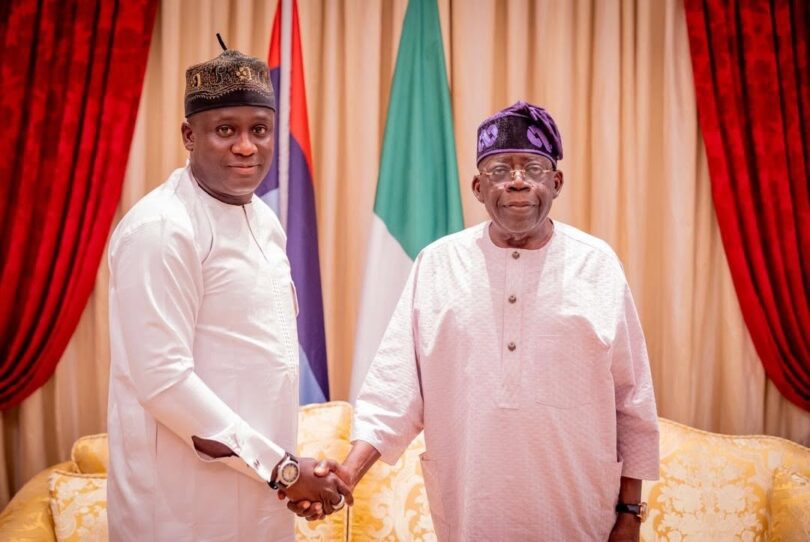
Engr. Salihu Yakub Danladi (left) and President Bola Ahmed Tinubu
Politics often teaches its greatest lessons through history. As tensions rise within the Kwara APC following the emergence of Engr. Salihu Yakub Danladi (SYD) as the party’s governorship candidate, many are quick to conclude that opposition from prominent party stakeholders automatically signals a flawed choice. History suggests otherwise.
In 2006 and early 2007, when Lagos State was searching for a successor to Governor Bola Ahmed Tinubu, Babatunde Raji Fashola was not the obvious favorite. Many established political heavyweights opposed his emergence. Some questioned his political pedigree, while others believed more experienced and influential politicians were better suited for the position.
Yet Tinubu, now the president of Nigeria, persisted with his choice.
The result was one of the most successful governorships in Nigeria’s democratic history. Fashola transformed Lagos through infrastructure development, public service reforms, urban renewal, transportation improvements, and a governance style that earned national and international recognition. He later went on to serve as a minister of the Federal Republic.
Many of those who opposed him remain respected individuals, but history remembers Fashola as the leader who was given an opportunity and justified the confidence placed in him.
The lesson for Kwara is straightforward: opposition from influential politicians does not automatically mean a candidate lacks merit. Sometimes, today’s unpopular choice becomes tomorrow’s success story.
However, there is another lesson from the Lagos experience that is equally important.
Governor AbdulRahman AbdulRazaq must be careful not to misunderstand the Fashola example. The lesson is not that every leader can simply impose a successor and ignore dissent. Tinubu’s political success was built not only on identifying talent but also on maintaining relationships, managing competing interests, building consensus, and continuously engaging stakeholders.
The current concerns being expressed by leading APC figures should not be dismissed as mere bitterness. Whether their grievances are justified or not, they represent significant constituencies within the party. Ignoring them could create avoidable fractures that may weaken the APC ahead of the general election.
This is therefore the time for engagement, not triumphalism.
Governor AbdulRazaq should convene meetings with aggrieved aspirants, listen to their concerns, reassure them about the future of the party, and demonstrate that every stakeholder has a place in the APC. Political leadership requires not only winning contests but also healing wounds after contests have been won.
Similarly, Salihu Yakub Danladi must embark on an immediate reconciliation tour. He should personally meet with all aspirants and party leaders, not as rivals but as partners in a common project. His greatest challenge is no longer securing the ticket; it is building the broad coalition necessary to retain power for the APC in Kwara State.
The opposition is already watching. Former Governor Bukola Saraki is reportedly reaching out to dissatisfied stakeholders and rebuilding relationships. Politics abhors a vacuum. Where reconciliation is absent, alternative alliances emerge.
The future of the Kwara APC will depend less on how Danladi emerged and more on what happens next. If reconciliation prevails over resentment and inclusion triumphs over exclusion, the party can emerge stronger and more united.
History gave Lagos a Fashola because a political risk was taken. But history also teaches that political victories endure only when leaders carry everyone along. That is the challenge before Governor AbdulRahman AbdulRazaq and Salihu Yakub Danladi today.