
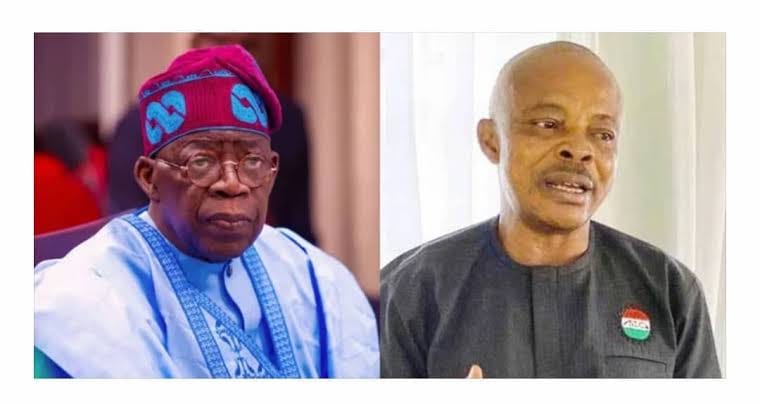
The recent remarks by Nigeria Labour Congress (NLC) President, Joe Ajaero, alleging that President Bola Tinubu’s administration has failed to engage with organised labour, are both misleading and unfortunate.
While Ajaero claimed during a podcast discussion that the government was “aloof” and unresponsive to labour’s correspondence between May and December 2025, the facts do not support such sweeping assertions.
There is ample evidence that the Federal Ministry of Labour and Employment has consistently intervened in labour matters on behalf of the Federal Government and President Tinubu. These interventions have sought to reach a middle ground and improve workers’ welfare, particularly in the areas of minimum wage negotiations and other pressing issues affecting the workforce.
Against this backdrop, portraying President Tinubu as “aloof” or disconnected from organised labour is not only inaccurate but appears to be a calculated attempt to de-market his administration ahead of the 2027 elections. Such rhetoric risks politicizing labour struggles and undermining the credibility of the NLC at a time when workers need pragmatic solutions, not political grandstanding.
The role of organised labour is to defend and advance the welfare of workers through constructive dialogue, policy advocacy, and collaboration with government and employers. Labour leaders must therefore avoid inflammatory narratives that overheat the polity, especially in a pre-election period. Instead, they should focus on actionable deliverables such as wage implementation timelines, pension disbursements, workplace safety, and structured relief measures for transport and food security.
By maintaining political neutrality and prioritizing workers’ welfare, the NLC can preserve its credibility and ensure that its advocacy remains issue-driven rather than politically motivated. Nigeria needs a labour movement that is patriotic, empathetic, and forward-looking—one that partners with government to rebuild institutions and improve livelihoods, not one that risks destabilizing the nation with partisan undertones.
It is important to stress that a labour centre of NLC’s stature must rise above partisan narratives, especially in a period leading into a major election in early 2027. The NLC cannot afford to be perceived as a willing tool in the hands of opposition politicians. There must be a clear distinction between genuine activism and political opportunism.
Nigeria is gradually recovering from years of neglect and decay under successive administrations. At such a delicate time, labour leaders should demonstrate sensitivity, patriotism, and empathy rather than resorting to strike threats and inflammatory rhetoric that risk overheating the polity.
The responsibility of organised labour is to constructively engage government, champion workers’ welfare, and promote national stability—not to stoke chaos or undermine democratic processes through provocative rhetoric.
History has shown that labour leaders who adopt a “strike-monger” posture during politically charged seasons often erode public trust and weaken the credibility of the labour movement. The NLC must therefore recalibrate its approach, focusing on dialogue, policy advocacy, and pragmatic solutions that strengthen the economy and protect workers, rather than issuing ultimatums that polarize the nation.
Nigeria needs a labour movement that is patriotic, empathetic, and forward-looking—one that partners with government to rebuild institutions and improve livelihoods, not one that amplifies political tensions. Ajaero’s comments, far from truth, risk diminishing the noble role of the NLC. The congress must return to its core mandate: defending workers’ rights responsibly, without becoming entangled in partisan battles.
*Kingsley Imeh, social commentator and media executive, wrote from Oredo LGA, Benin City.*